
This morning’s Gospel reading is Matthew 18:15–20:
Jesus said to his disciples:
“If your brother sins against you, go and tell him his fault between you and him alone. If he listens to you, you have won over your brother. If he does not listen, take one or two others along with you, so that ‘every fact may be established on the testimony of two or three witnesses.’ If he refuses to listen to them, tell the church. If he refuses to listen even to the church, then treat him as you would a Gentile or a tax collector. Amen, I say to you, whatever you bind on earth shall be bound in heaven, and whatever you loose on earth shall be loosed in heaven. Again, amen, I say to you, if two of you agree on earth about anything for which they are to pray, it shall be granted to them by my heavenly Father. For where two or three are gathered together in my name, there am I in the midst of them.”
Note: This reflection was first published in 2014, with minor edits.
Am I my brother’s keeper? This question goes back to the very beginning of God’s plan for salvation, and haunts us in a multitude of ways to this very day. Even though our readings today do not draw specifically from Genesis 4, the challenge of the Lord to Cain after the murder of his brother Abel practically shouts through the Scriptures for today:
Cain said to Abel his brother, “Let us go out to the field.” And when they were in the field, Cain rose up against his brother Abel, and killed him. Then the LORD said to Cain, “Where is Abel your brother?” He said, “I do not know; am I my brother’s keeper?”
Consider this man’s earliest recorded instance of back-talk. Cain had grown jealous over Abel’s status with the Lord, and killed him for it, having rejected God’s warning about sin “lurking at the door,” waiting for him. Cain’s sacrifice had not found favor with the Lord because Cain did not have charity in his heart, but instead harbored covetousness, and murdered Abel to spite God. Even afterward, Cain shows no remorse for the murder, but instead self-pity for the punishment that follows. His initial reaction to God’s interrogation was meant as a sarcastic attack, not a serious inquiry.
Even so, the question remains: Am I my brother’s keeper? As we read today, the answer is yes. We are called to love our neighbors as ourselves, but what does that mean? What kind of love does Jesus call us to exhibit? Not eros, and not even exactly philos (brotherly love), but caritas or agape — the self-emptying, sacrificial love that Jesus demonstrated on the cross for all of our sins. We must have charity in our hearts for our fellow men and women, especially when it comes to the path of salvation.
That doesn’t mean we drag people kicking and screaming against their will to love, though. Paul writes to the Romans that “Love does no evil to the neighbor; hence, love is the fulfillment of the law.” We “owe nothing to anyone, except to love one another,” Paul explains in Romans 13:8. As our other passages explain today, we do owe that much to each other, at least to the extent that we have made the pitfalls of deviating from the path of salvation plain.
In Ezekiel 33:7-9, the Lord tells Israel through the prophet that He has “appointed watchmen for the house of Israel,” meaning the prophets who often warned a rebellious nation to repent. The warning here, though, is directed at the watchmen themselves.
If I tell the wicked, “O wicked one, you shall surely die,” and you do not speak out to dissuade the wicked from his way, the wicked shall die for his guilt, but I will hold you responsible for his death. But if you warn the wicked, trying to turn him from his way, and he refuses to turn from his way, he shall die for his guilt, but you shall save yourself.
Our responsorial psalm today, from Psalm 95, expands that warning to others as well: “If today you hear God’s voice, harden not your hearts.” When God spoke through the prophets, the nation of Israel too often hardened its collective heart. However, the prophets in these cases were blameless, according to the prophecy of Ezekiel, because they had attempted to intervene in love with their brothers to put them back on the correct path. Had they held their tongue and allowed Israel to sin without rebuke, then the prophets — who knew better — would share in that sin.
Hence we come to today’s Gospel reading. In this passage, Jesus shifts the responsibility in a significant way to everyone in the Church, and not just those who prophesy. In the new covenant, all who are baptized have a part in the offices of priest, prophet, and king, offices which serve rather than rule others for the good of the plan of salvation from sin. Jesus provides a definitive answer to Cain’s mocking question, Am I my brother’s keeper? The answer here is plainly yes, and not just for those governing the Church but for the entire Church and all its members.
Even though Jesus expands this responsibility to all within the body of Christ, He still maintains the limits seen in Ezekiel. Jesus provides a more formal process for this, one that has been followed in one form or another in Christian communities for two millennia. First attempt to enlighten the offender privately so that any sin can be immediately repented of; if that doesn’t work, ask two or three others to intervene somewhat more publicly; failing that, let the whole Church decide whether the brother should be rebuked. If so and the brother remains unrepentant, then everyone has done what they can, and the rest needs to be left to God. Jesus promises elsewhere that the Holy Spirit will work through the Church if two or more are gathered in His name, and He emphasizes that here in this context of judgment.
Each step along this process allows for the offender to repent and for Christians to make this an exercise of caritas rather than revenge, hoping to see a sinner return to the fold. And in fact, it is the duty of the Christian to ensure that sinners find reconciliation and redemption. To silently allow sin to continue puts a Christian at the same peril as Ezekiel describes in his warning to prophets. But any such effort has to come from love of neighbor, not merely anger or the kind of sanctimony exhibited by the Pharisees when they called out sinners publicly in order to maintain their own stature.
Jesus has given us all significant office in the Church by the power of our baptism. The question for many of us is whether we use our gifts to fulfill those duties by demonstrating love of neighbor — the caritas that puts their needs ahead of our own — in service to His plan for salvation. After all, this doesn’t just apply to issues of correcting sin, but also of helping our brothers and sisters enough to where they can stand on their own and walk that path. In the tale of the Good Samaritan, Jesus taught a powerful lesson about the identity of neighbor, and in the parable of the talents, another lesson on the need to put our gifts to work for the Master rather than just bury them in our own fields for no purpose.
Are we being our brothers’ and sisters’ keepers in the sense of opening the path of salvation to others? Or are we, like Cain, too jealous and self-involved to truly open our hearts to the kind of self-sacrificial love that Jesus showed, and from which we benefit so much? Perhaps it’s time for us to check in with our office(s) and get to work.
Previous reflections on these readings:
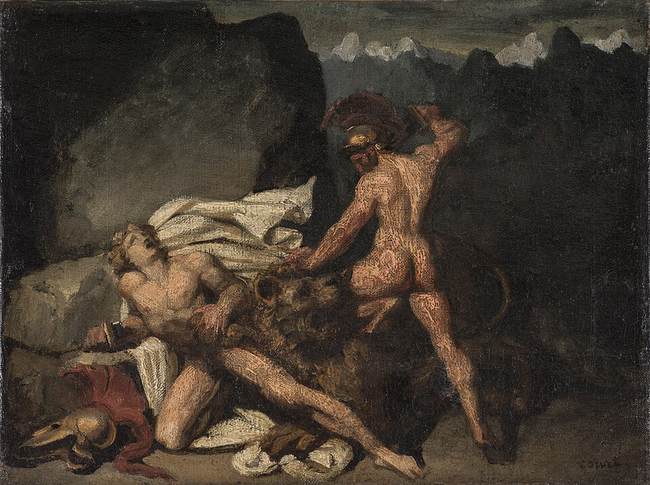
The front page image is “Cain and Abel” by Joseph-Désiré Court, c. 19th century. On display at the Musée des Beaux-Arts de la ville de Paris. Via Wikimedia Commons.
“Sunday Reflection” is a regular feature that looks at the specific readings used in today’s Mass in Catholic parishes around the world. The reflection represents only my own point of view, intended to help prepare myself for the Lord’s day and perhaps spark a meaningful discussion. Previous Sunday Reflections can be found here.
Editor’s Note: Our Sunday Reflections are free to all readers, but our VIP members help keep this platform going for everyone. Join the effort by using the promo code FIGHT to get 60% off new memberships and upgrades to VIP Gold and VIP Platinum!
Read the full article here






![Arizona Lawmakers Demand Deeper Katie Hobbs Bribery Review After Democrat AG Refuses Charges [WATCH]](https://www.lifezette.com/wp-content/uploads/2026/09/2026.09.06-15.01-lifezette-6a9d803ef3685.jpg "Arizona Lawmakers Demand Deeper Katie Hobbs Bribery Review After Democrat AG Refuses Charges [WATCH]")
![Elites Still Clueless About Real American Economy [WATCH]](https://www.lifezette.com/wp-content/uploads/2026/01/2026.01.10-01.07-lifezette-69624f29434ed.jpg "Elites Still Clueless About Real American Economy [WATCH]")