
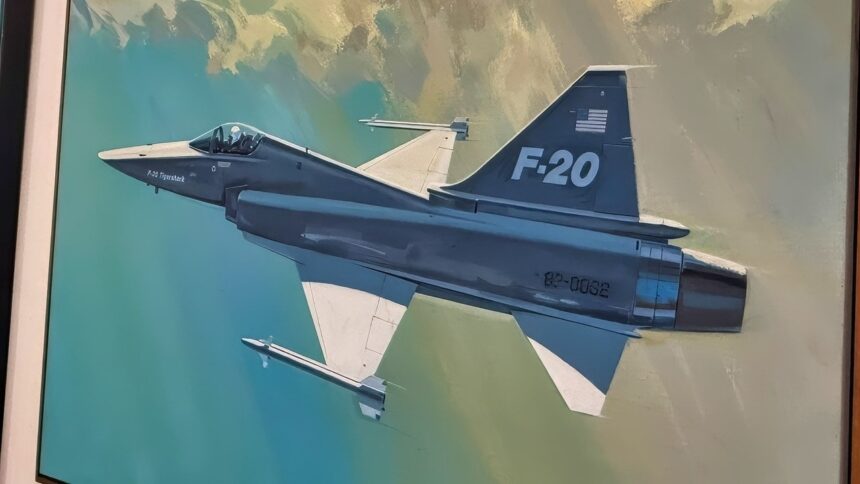

Summary and Key Points: Northrop paid for the F-20 Tigershark itself. More than $750,000,000 of company money went into the aircraft without a dollar of Pentagon research funding, and by the numbers it worked. The Tigershark out-turned the F-16 in sustained turn, 13.2 degrees per second against 12.8. Northrop projected roughly 15 maintenance man-hours per flight hour, compared with about 34 for a comparable F-16. Its AN/APG-67 radar could track 10 targets and shoot beyond visual range years before an F-16 could. In 1985, the company offered 396 of them at $15,000,000 apiece, compared with an F-16 costing around $18,000,000. Not one air force on earth bought a single aircraft. Northrop canceled the program in late 1986 and absorbed losses estimated near $1,200,000,000.
The F-20 Tigershark: The Fighter That Died Thanks to Bad Timing
Few American warplanes have a stranger legacy than the Northrop F-20 Tigershark, a jet that never suffered a single design failure, never lost a customer to a rival aircraft on merit, and never entered production, yet is still remembered as one of the best fighters the United States ever built.
The Northrop F-20 Tigershark was an advanced fighter plane when it was first produced in 1983. Initially, it was called the F-5G, an upgraded version of the F-5E with a much more powerful engine and a modern avionics suite featuring a vastly improved radar.
But the Pentagon, especially during the Carter years, was lukewarm at best about helping sell US-made warplanes to nations unless they adhered to his human rights parameters.
F-20 Tigershark Model at Western Museum of Flight. Image by Harry J. Kazianis/19FortyFive.com Image.
The F-20 Tigershark also didn’t sell because it faced stiff competition from the F-16, which had the advantage of US Air Force support, a superior loadout, and was already widely available for export.
The US government’s policy shift towards exporting existing aircraft like the F-16, rather than developing new ones, further limited the F-20’s market prospects.
Foreign nations assumed that because of the US’ support for the F-16, the F-20 was a second-tier aircraft, and even the Madison Avenue-type marketing with the famous Chuck Yeager couldn’t help. No one bought the F-20…and that was a shame.
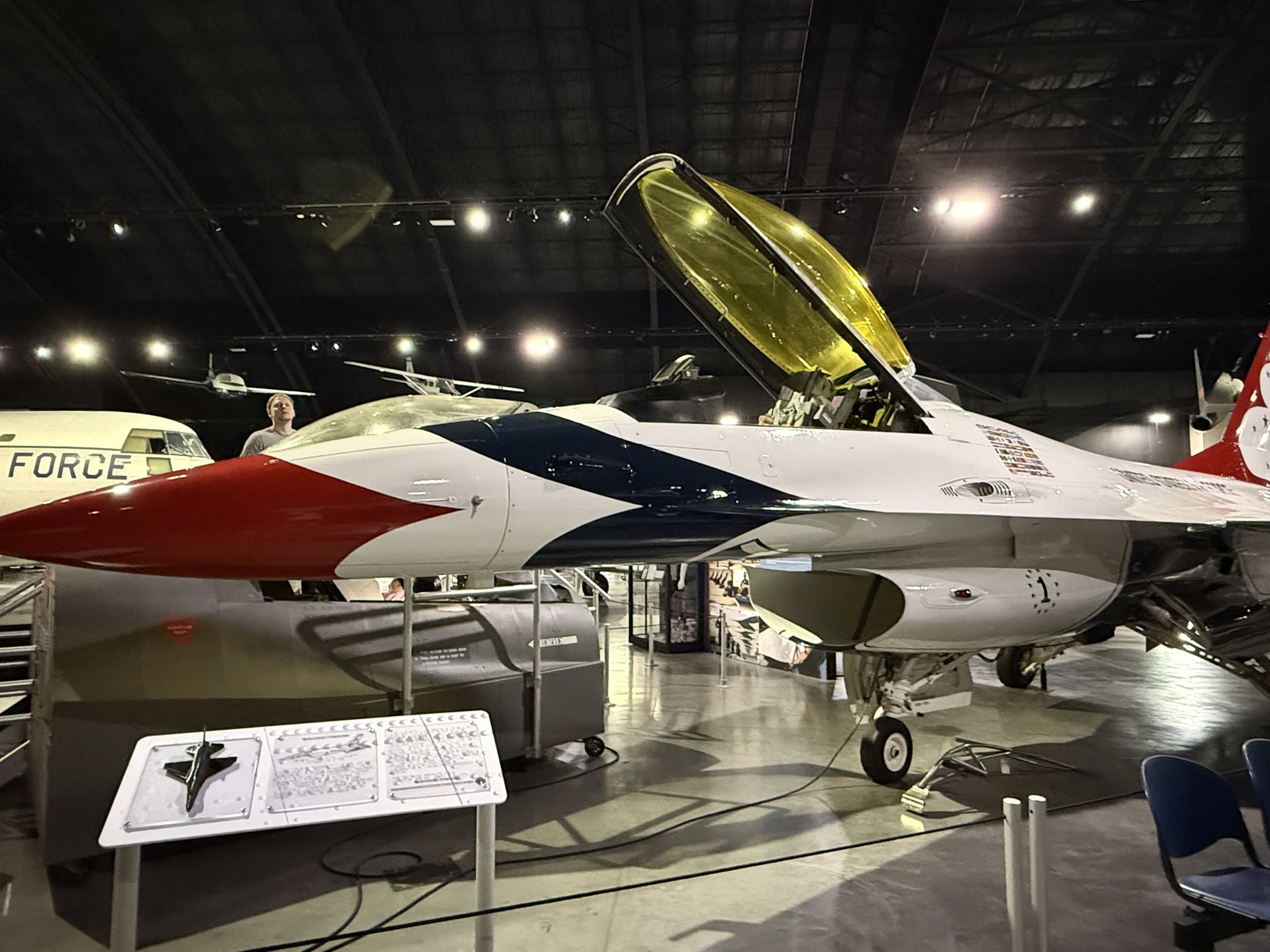
F-16 Fighter. 19FortyFive.com Image from the National Museum of the U.S. Air Force.
It was a wonderful aircraft. It just came into being at the wrong time.
Northrop poured more than $750 million of its own money into the program without a dime of Pentagon research funding, only to watch it collapse in 1986 for reasons that had almost nothing to do with the airplane itself.
F-20: Born From the F-5E Tiger
The Tigershark grew out of the F-5E Tiger II, the inexpensive, widely exported fighter Northrop had built for allied air forces since the 1960s.
Starting development in 1975 under the designation F-5G, Northrop bolted on a single General Electric F404-GE-100 turbofan rated at 17,000 pounds of thrust, about 40 percent more powerful than the F-5E’s twin engines, along with a new GE AN/APG-67 multi-mode radar capable of tracking ten targets at once and engaging beyond visual range with AIM-7 Sparrow missiles, a trick the early F-16 couldn’t match until 1989.
Renamed F-20 in 1982, the prototype first flew that August and reportedly hit Mach 2 on its maiden flight.
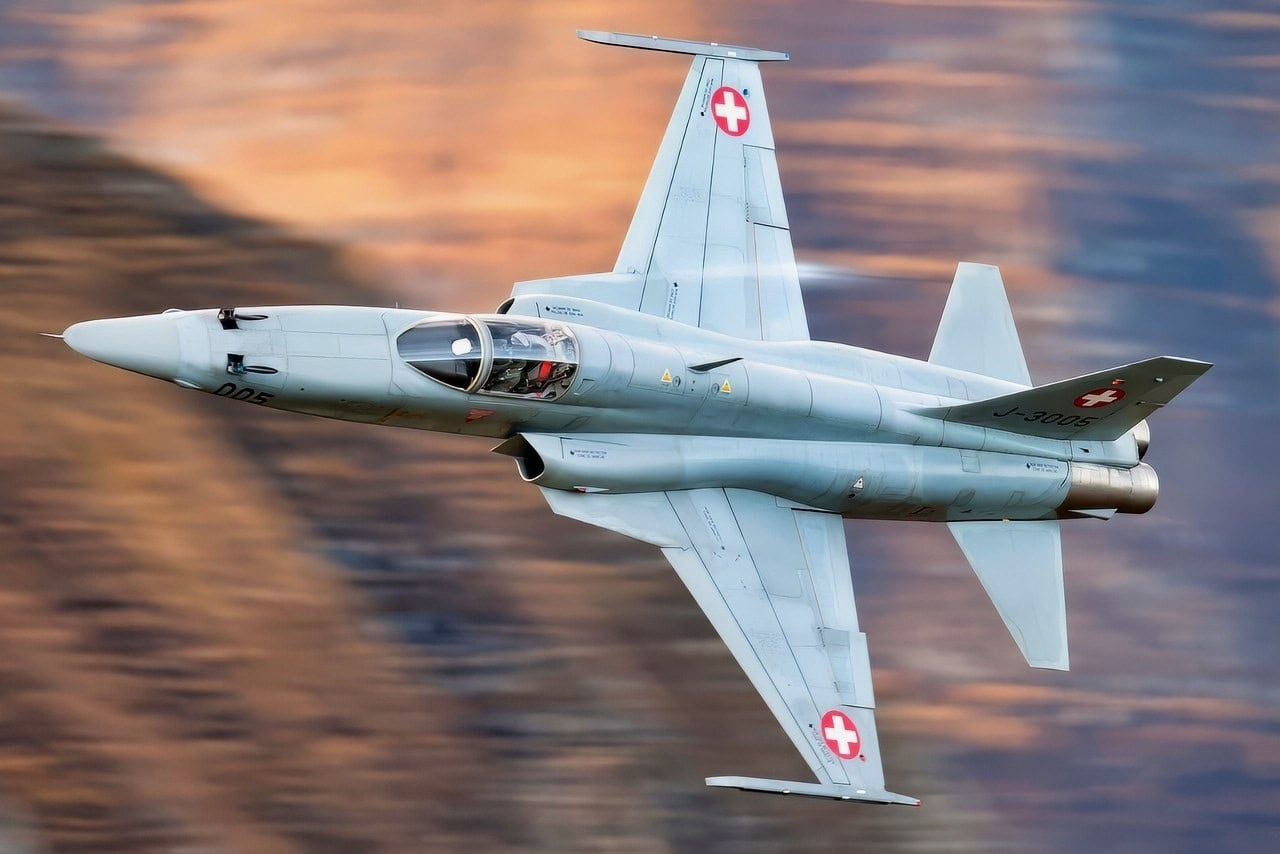
F-5E Tiger II Fighter. Image Credit: Creative Commons.
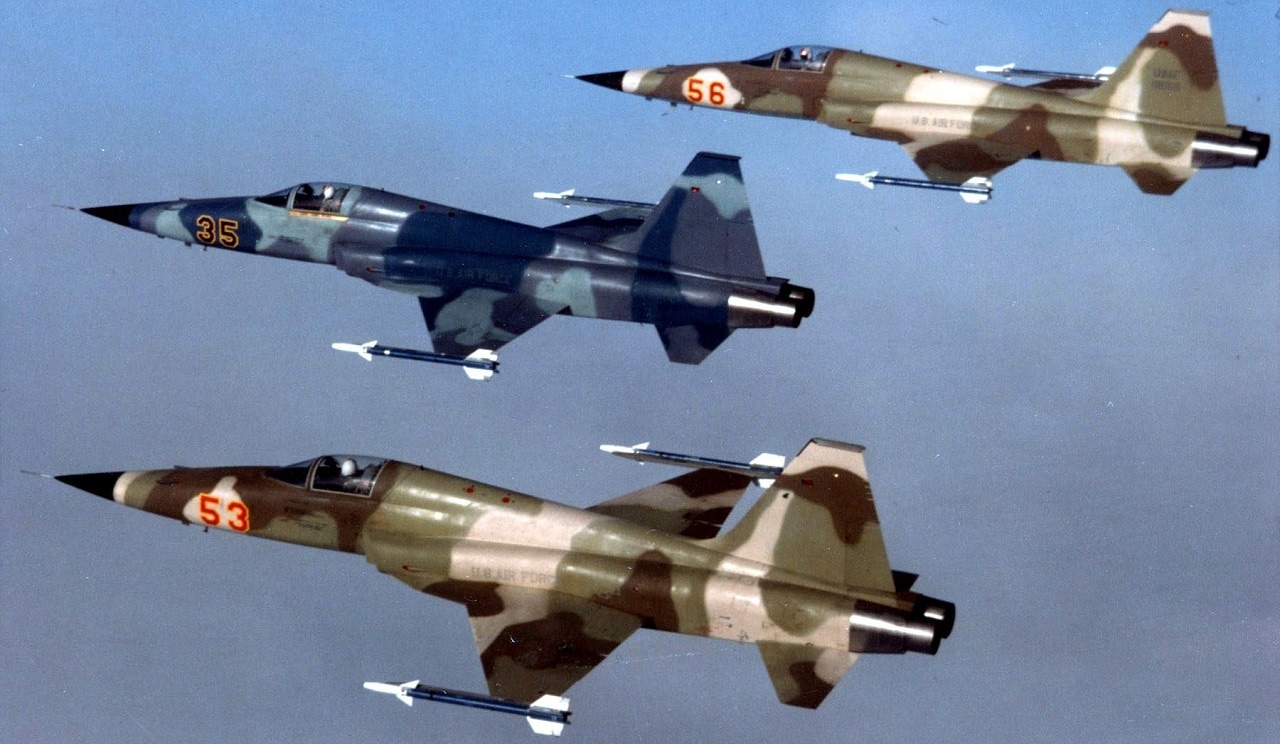
F-5. Image Credit: Creative Commons.
The new, more powerful engine pushed the aircraft to speeds of Mach 2.1 or 1,611 miles per hour. The beyond-visual-range (BVR) air-to-air capability was cutting-edge at that time, and a full suite of air-to-ground modes capable of firing most U.S. weapons.
The standard armament package consisted of two M39A2 20mm autocannons, each with 280 rounds of ammunition, and two AIM-9 Sidewinder air-to-air missiles carried on the wingtips.
The F-20 also featured an early version of a heads-up display and “hands-on throttle stick controls,” both of which were cutting-edge technology in 1983.
The F-20 Tigershark was competitive with contemporary fighter designs such as the General Dynamics F-16/79, a modified, export-oriented version of the F-16A/B that used the outdated General Electric J79 engine. Still, it was much less expensive to purchase and operate.
On paper, it was a remarkable value. Northrop projected the F-20 would need roughly 15 maintenance man-hours per flight hour, compared with about 34 for a comparable F-16, cutting maintenance manpower needs by over half while delivering, the company claimed, four times the reliability of a typical front-line fighter.
Across roughly 1,500 test sorties, the three prototypes reportedly achieved excellent availability, and the jet matched or beat the F-16 in sustained turn rate (13.2 degrees per second versus 12.8).
By 1985, with orders still not materializing, Northrop made a last, desperate pitch: 396 F-20As at $15 million apiece, undercutting the roughly $18 million F-16 of the day, a price built on volume that never came.
The F-20 Was Killed by Government Policy, Not Performance
The F-20 was purpose-built for the Pentagon’s “FX” program, a Carter-era initiative meant to offer allies a capable fighter without transferring the most sensitive U.S. technology.
That rationale evaporated almost as soon as the jet was ready to sell. The Reagan administration relaxed export restrictions on the front-line F-16 itself, approving sales to Pakistan, Venezuela, Turkey, and Greece and erasing the F-20’s core selling point overnight.
Taiwan, an obvious buyer given its large F-5 fleet, was blocked outright by the 1982 U.S.-China Joint Communiqué and instead pursued its own indigenous fighter.
Interest from Bahrain and Morocco fizzled into canceled letters of intent, South Korea and Pakistan evaluated but never committed, and India ultimately chose the path that became its own Tejas program.
Two fatal crashes in demonstration flights, Darrell Cornell in South Korea in 1984 and Dave Barnes in Canada in 1985, both attributed to G-force-induced loss of consciousness during aerobatics rather than any structural flaw, battered the program’s reputation at air shows exactly when it needed clean headlines.
Crucially, the U.S. Air Force never bought a single F-20 for itself, and several foreign governments had made their own purchases contingent on that American endorsement.
Without a domestic customer, or a sympathetic State Department pushing sales as hard as it pushed the F-16, the Tigershark had no political engine behind its technical one. Northrop canceled the program in late 1986, absorbing losses estimated near $1.2 billion.
The Tigershark Was An Example Of What Could Have Been
The aircraft could have had an intriguing future. Had the Air Force adopted even a small wing of F-20s, as an aggressor squadron, an Air National Guard interceptor, or a low-cost complement to the F-16, it likely would have unlocked the export orders that foreign buyers were waiting on, potentially delivering hundreds of airframes to Taiwan, South Korea, Bahrain, Morocco, and other longtime F-5 operators.
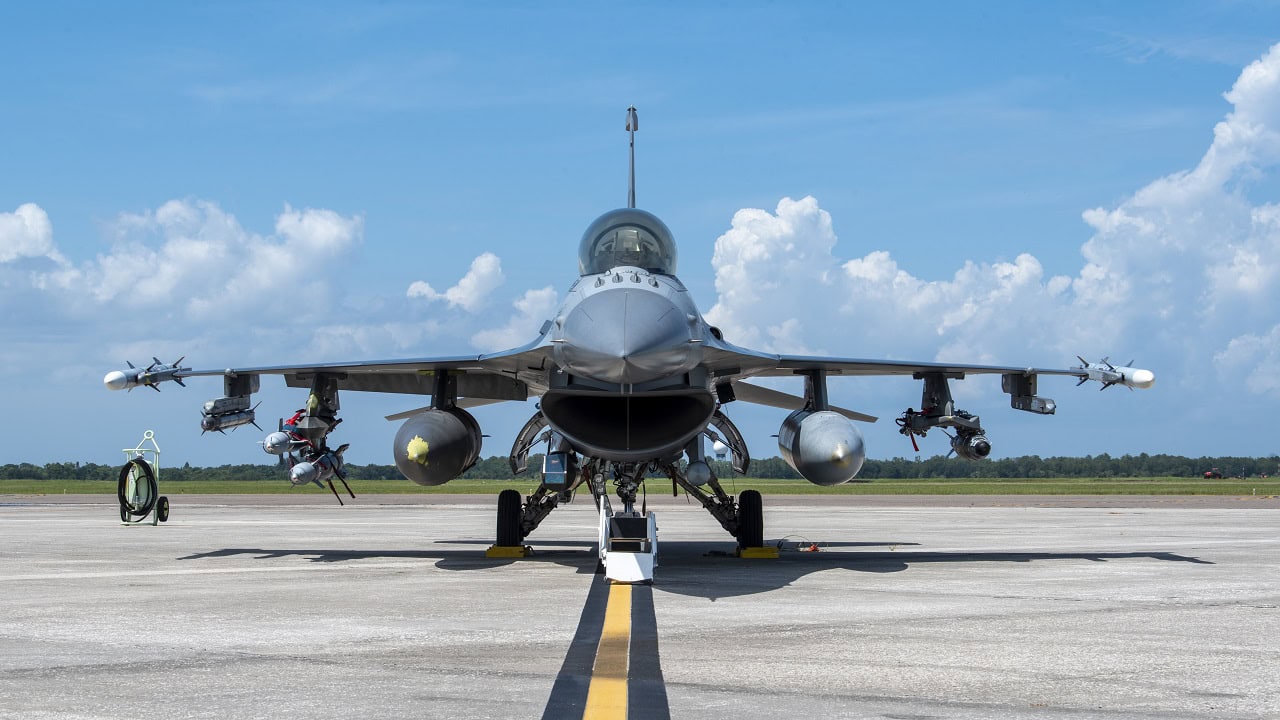
A U.S. Air Force F-16 Fighting Falcon aircraft sits parked on flight line at MacDill Air Force Base, Sept. 8, 2021. (U.S. Air Force photo by Airman 1st Class Lauren Cobin).
At a genuine production price in the $10–15 million range (about $30-$45 million today), a multinational fleet could have replaced aging F-5s and F-4s across a dozen air forces at a fraction of the F-16’s lifetime cost, with far lower maintenance burdens freeing up ground crews and spare-parts budgets for decades.
Instead, the F-20’s advanced radar survived only as a legacy component in Taiwan’s Ching-kuo fighter and South Korea’s T-50 trainer.
The F-20 was a great aircraft, a jack-of-all-trades, master of none. And it just came along when the US was heavily invested in the F-16.
About the Author: Steve Balestrieri
Steve Balestrieri is a National Security Columnist. He served as a US Army Special Forces NCO and Warrant Officer. In addition to writing on defense, he covers the NFL for PatsFans.com and is a member of the Pro Football Writers of America (PFWA). His work was regularly featured in many military publications.

![Shirtless Daredevil Dances, Leaps on Speeding Truck Across George Washington Bridge [WATCH]](https://www.rvmnews.com/wp-content/uploads/2026/09/2026.09.10-12.34-rvmnews-6aa2a3ceb5eb0.jpg "Shirtless Daredevil Dances, Leaps on Speeding Truck Across George Washington Bridge [WATCH]")




![Hunter Biden Meme Coin Torches Buyers as Mystery Trader Scores Nearly $1 Million [WATCH]](https://www.lifezette.com/wp-content/uploads/2026/09/2026.09.10-14.35-lifezette-6aa2c048ba70e.jpg "Hunter Biden Meme Coin Torches Buyers as Mystery Trader Scores Nearly $1 Million [WATCH]")