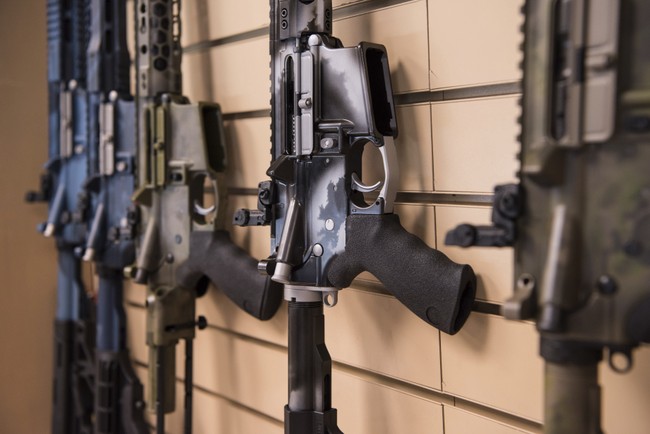

If, as expected, the Supreme Court strikes down bans on so-called assault weapons when it issues its verdict in Viramontes v. Cook County next year, the gun control lobby isn’t just going to give up on its efforts to make AR-15s and other centerfire semi-automatic long guns inaccessible to we the people.
Instead, we’re likely to see a concerted effort to put “permit-to-purchase” schemes in place, like the one in Colorado that took effect last month. The author of the new law has stated on the record that “in essence” it’s a gun ban by another name, and as we’ve seen, it’s already had a chilling effect on the ability of Coloradans to purchase these commonly owned arms.
An amicus brief filed in support of the petitioners in Viramontes urges the Supreme Court to look beyond the Cook County and Connecticut gun bans that are being challenged, and to craft a decision that will halt the gun control lobby’s next attacks on AR-15s in its tracks. The brief, submitted by Rocky Mountain Gun Owners, argues that Viramontes “concerns more than a single county ordinance or state law.” Instead, it “presents a recurring problem of constitutional administration: after this Court identifies conduct protected by the Second Amendment, some states and localities replace the invalidated restriction with a different mechanism designed to produce substantially the same practical result.”
The pattern is nationwide. Acquisition licenses, serial delays, cumulative fees, mandatory training, waiting periods imposed after eligibility has been established, expansive “sensitive place” designations, feature-based prohibitions, and categorical bans on commonly possessed semiautomatic firearms can operate individually or together to make exercise of the right costly and practically unavailable. Constitutional review must therefore examine what a law does, not merely the label a legislature gives it.
The brief then describes Colorado’s permit-to-purchase scheme in great detail and how it’s designed to get as close to an outright ban as possible without actually prohibiting the purchase and possession of these commonly owned arms. RMGO then points to the host of post-Bruen abuses that have been adopted in blue states with an eye towards diminishing the right to bear arms.
New York provides the clearest legislative example. Within days of Bruen, the State enacted the Concealed Carry Improvement Act. Official state materials described it as a direct response to the decision. The Act replaced “proper cause” with a new assemblage of burdens: character review, an in-person interview, character references, disclosure requirements, sixteen hours of training, recurring recertification, and a sweeping list of “sensitive locations.” It also adopted a default rule restricting carry on private property. A license nominally became easier to obtain under one criterion while becoming more burdensome and less useful overall.
The brief concludes by urging the Court not to adopt a “narrow decision confined to one drafting defect”, which RMGO argues would “invite another round of relabeling.”
Instead, the group argues that SCOTUS “should state the governing rules directly: commonly possessed semiautomatic rifles are ‘arms’; categorical bans on those arms are incompatible with Heller; governments bear the burden specified in Bruen; and courts must evaluate the substance and cumulative operation of a regulatory scheme rather than its formal label.”
The brief also offers three “clarifications” it would like the justices to adopt. The first deals with protected arms:
When a type of bearable arm is commonly possessed by law-abiding citizens for lawful purposes, government may not prohibit it by attaching a legislative label, identifying common features, or declaring that substitutes remain available. The choice among protected arms belongs to the people. The government could not defend a handgun ban by noting that long guns remained lawful. This rule would resolve the central issue here and prevent States from manipulating the level of generality to avoid Heller.
The second clarification RMGO suggests addresses licensing, arguing that Bruen‘s endorsement of “shall issue” concealed carry licensing should not be seen as “blanket approval of permits governing acquisition, possession, or carry.”
The third clarification concerns regulatory substitution. Governments may not answer a decision protecting public carry by declaring most ordinary destinations “sensitive,” answer a decision protecting common arms by prohibiting their sale, or answer a decision rejecting discretion by multiplying nominally objective prerequisites until few citizens complete them. Courts should view the challenged scheme as a whole and compare its practical burden with the historical tradition. That approach follows Wolford’s insistence that government cannot preserve the effect of an invalid rule through a new default.
It would be great if SCOTUS actually accepts RMGO’s suggestions and crafts the Viramontes decision in a way that anticipates how the gun control lobby and anti-Second Amendment politicians are likely to respond to bans on so-called assault weapons being declared unconstitutional. I don’t know how likely that possibility is though. I could see the majority opinion being crafted in a way that makes it clear bans on commonly owned magazines are also unconstitutional, but actually heading off a permit-to-purchase scheme would probably require a pretty broad ruling.
Still, the justices are well aware of how lower courts and blue states have tried to thwart and minimize the impact of Bruen, and maybe there are five of them who are concerned enough about a repeat that Viramontes will preemptively strike at the next moves by those who want to turn our Second Amendment rights into a privilege doled out to a select few by the State.
Read the full article here

![Democrats Aren’t a Big Tent Party, They Don’t Have Different Ideas, Michael Knowles Explains [WATCH]](https://www.lifezette.com/wp-content/uploads/2025/12/2025.12.18-05.00-lifezette-6944332f64657.jpg "Democrats Aren’t a Big Tent Party, They Don’t Have Different Ideas, Michael Knowles Explains [WATCH]")

![King of the Hill [WATCH]](https://www.boredtrashpanda.com/wp-content/uploads/2026/09/2026.09.12-15.12-boredtrashpanda-6aa56beaa6bdb.jpg "King of the Hill [WATCH]")
![Comedian Insists Jerry Seinfeld is Uncancellable Despite a Woke Festival Walkout Over Israel [WATCH]](https://www.boredtrashpanda.com/wp-content/uploads/2025/05/2025.05.16-11.18-boredtrashpanda-68271ef88cd70.jpg "Comedian Insists Jerry Seinfeld is Uncancellable Despite a Woke Festival Walkout Over Israel [WATCH]")