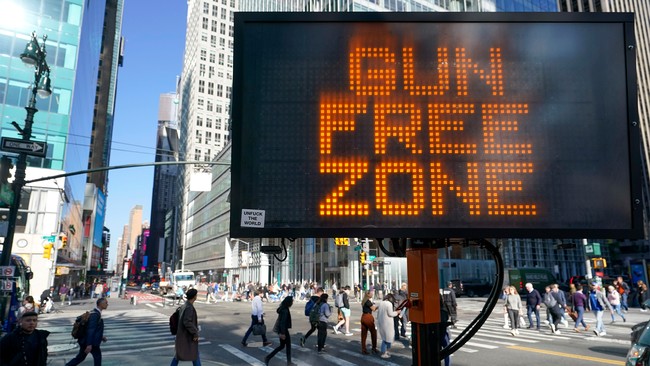

The Concealed Carry Improvement Act (which did nothing to improve concealed carry) was rushed into law by New York Gov. Kathy Hochul after the Supreme Court struck down the state’s “may issue” permitting scheme four years ago. The law has sparked numerous legal challenges to various aspects of the statute, from its ridiculous licensing mandates to the sweeping “gun-free zones” that it imposed.
One of those challenges has now reached SCOTUS’s doorstep. Christian v. James takes on New York’s prohibition of lawful carry in all public parks, which was upheld by the Second Circuit in another case known as Antonyuk on the grounds that the law “is within the Nation’s history of regulating firearms in quintessentially crowded areas and public forums, at least insofar as the regulation prohibits firearms in urban parks, though not necessarily as to rural parks.”
Even though the Second Circuit was willing to acknowledge there wasn’t much evidence offered by the state of New York in defense of its ban on concealed carry in wilderness spaces, the court upheld the entirety of the law by ruling Christian a facial challenge to the statute, meaning that in order to be successful the plaintiffs would have to show that there no circumstance exists where the law might be constitutionally applied.
The district court in Christian v. James acknowledged that “[b]ased on the record and arguments in this case, the right to keep and bear arms enshrined in the Second Amendment would require this Court—as counseled by the Supreme Court’s Second Amendment decisions—to declare the parks issue in Plaintiffs’ favor.” Because of the Second Circuit’s precedent in Antonyuk, though, the judge felt bound to decide the park issue in the State’s favor.
The cert petition filed by the plaintiffs (including Second Amendment Foundation and Firearms Policy Coalition) argues that the Court should accept the case for several reasons. First, they say that lower courts have split over how to analyze facial versus as-applied Second Amendment challenges.
If the Second Circuit’s approach to facial challenges were left to stand, virtually every prohibition on the keeping and bearing of arms—no matter how contrary to the constitutional guarantee—would survive a facial challenge, because all a court would need to do to reject a facial challenge would be to identify some person (a violent felon?), some place (a courthouse?), or some type of arm (a rocket launcher?) within the scope of the statute’s restriction.
The plaintiffs also argue that the Court needs to step in and resolve the split among lower courts over the time periods for historical analogy under Bruen. Some courts have stuck with 1791 and the ratification of the Second Amendment as the time period that matters most (or at all), while other courts, including the Second Circuit, have given equal or even more weight to laws adopted after the Fourteenth Amendment was ratified in 1868.
On one side of the split, the Third Circuit, Fifth Circuit, and Eighth Circuit, Founding-era history over later history. On the other side, the Second Circuit and Ninth Circuits give significant analytical weight to sources from the latter part of the nineteenth century and even prioritize such evidence over conflicting Founding-era evidence. The Seventh Circuit has cases on both sides of the divide but recently has declined to prioritize Founding evidence.
The plaintiffs maintain that history is on their side either way, but that Christian presents the Court with the opportunity to address the issue and offer guidance to lower courts.
The main thrust of their argument in favor of granting cert, though, is that the Second Circuit simply got it wrong by upholding the ban on lawful carry in parks.
The “majority disregard[ed] this history” from the Founding Era in favor of more recent history from “the late nineteenth century,” Pet.App.38a, “on the ground that contemporary public parks are so different from founding-era public parks that the principles of firearms regulation from the founding period cannot be applied to current circumstances.”
… But as Judge Menashi aptly concluded: “the historical evidence from the founding period cannot be discounted.” “The public parks of that period were not so different from contemporary parks that it is impossible to identify relevant principles of firearms regulation.” Id. “In principle, there is no difference between Colonial-era park-goers fishing, watching cockfighting, or playing whist; Victorian-era park-goers playing tennis, riding horse-drawn carriages, or doing whatever one does to foster solidarity across social classes; and modern park-goers playing pickleball, hiking, or riding hoverboards. Each is engaged in a type of recreation or leisure in a public location that sometimes doubles as a place of public assembly.”
The cert petition also touches on another important reason for SCOTUS to grant cert: the Second Circuit’s holding that guns can be banned in virtually all “quintessentially crowded areas and public forums.” In Wolford, the Court recognized that states cannot weave a “tight web of laws that severely restricts the carrying of firearms for self-defense” in our daily lives, but the Second Circuit vehemently disagrees and has given the green light to laws that do exactly that.
With the Koons/Siegel case challenging a host of “sensitive places” in New Jersey expected to be decided by the Third Circuit sitting en banc at any time, the justices might want to hold off on taking a case involving “gun-free zones” until they can address a multitude of these locations. If that’s their thinking, they should at least hold Christian. If the justices are looking for a more narrow case that will provide guidance to lower courts when addressing other “sensitive places,” though, Christian fits the bill to a T.
Editor’s Note: The radical Left will stop at nothing to enact their extreme gun control agenda and strip us of our Second Amendment rights.
Help us continue to report on and expose the Democrats’ gun-grabbing schemes. Join Bearing Arms VIP and use promo code FIGHT to receive 60% off your membership.
Read the full article here