
Originalism catches a lot of heat from the Left, but only because it gets in the way of what they want to do in so many parts of our lives. They’re fine with originalism when it comes to, say, the Fourth Amendment and the Fifth, but when we come to the Second Amendment, suddenly what the Founding Fathers wanted becomes secondary.
The Right tends to be more originalist, and that fits conservatism pretty well, since the whole idea of conservatism is to maintain or restore the Founding Fathers’ vision as best we can.
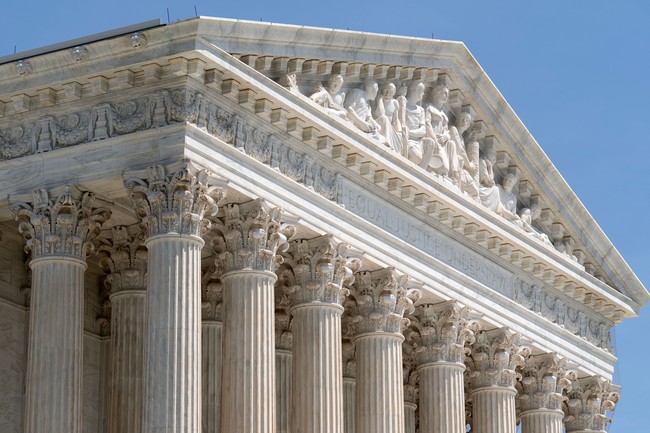
A key instrument of that is the Supreme Court. In theory, it should be able to hold firm on originalism, because most of the justices were nominated based on their originalist values.
And this year, a few cases are going to be key to determining just how originalist the justices actually are.
As a public-interest law firm marking 50 years of advancing an originalist interpretation of the Constitution, Landmark Legal Foundation has seen the issues before the court change many times. The court’s duty has not. Three cases this term will test whether the court does exactly that.
In Viramontes v. Cook County, the court will consider bans on AR-15s and similar semiautomatic rifles. Under District of Columbia v. Heller and New York State Rifle & Pistol Association v. Bruen, courts must examine the Second Amendment’s text and the nation’s historical tradition of firearm regulation. If a weapon qualifies as a protected “arm,” the government must demonstrate that its restriction is consistent with that tradition.
The 7th Circuit concluded that AR-15s are not protected “arms,” likening them to military M16s rather than firearms used for individual self-defense. That allowed the court to bypass Bruen’s historical inquiry entirely. Another lower court acknowledged that the rifles are bearable arms but nevertheless found historical support for banning them.
That support included 19th-century restrictions on Bowie knives and trap guns. But those laws generally regulated concealed carry, sales to minors, or criminal misuse, or prohibited rigging a firearm to discharge without anyone present. They are not historical equivalents of a categorical ban on possessing an entire class of commonly owned rifles.
The court should hold that these rifles are protected arms and that the historical record does not justify banning their possession.
In fact, with the anti-gunners’ fixation on the militia clause, a stronger case exists for defending the Second Amendment by overturning so-called assault weapon bans throughout the nation. I’d actually like to see “in common use” removed from the discussion entirely, if for no other reason than it would also hopefully preclude preemptive bans on new weapons technologies.
Still, this is one of the cases where we need to see an originalist majority give an originalist ruling.
We don’t need the wishy-washy kind where they sorta overturn it, but leave so much left on the table that no one has a problem finding a way around the ruling. Bruen wasn’t wishy-washy, but they still took advantage of every loophole they could find and made gun rights worse in places like New York, oddly enough.
Drop the hammer, drop it hard, and put an end to this foolishness.
Editor’s Note: President Trump and Republicans across the country are doing everything they can to protect our Second Amendment rights and right to self-defense.
Help us continue to report on their efforts and legislative successes. Join Bearing Arms VIP and use promo code FIGHT to receive 60% off your membership.
Read the full article here




![Mama Bear Goes Bonkers on High School Board Over Their Woke Priorities [WATCH]](https://www.lifezette.com/wp-content/uploads/2026/09/2026.09.26-13.19-lifezette-6ab7c668bfe84.jpg "Mama Bear Goes Bonkers on High School Board Over Their Woke Priorities [WATCH]")