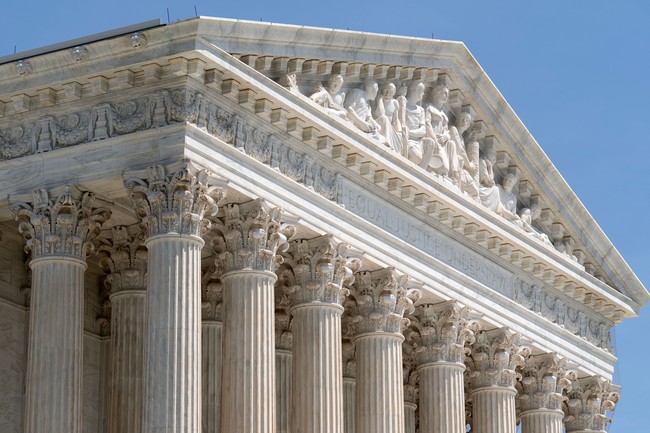

Progressive lawfare aimed at oil and gas companies reached the Supreme Court today in the form of Suncor Energy Inc. v. County Commissioners of Boulder County. This is an attempt by Boulder County to sue Exxon and Suncor over the effects of climate change on the county.
The Supreme Court of Colorado has already sided with the plaintiffs so unless this is overturned by the Supreme Court it will be the start of a nationwide trend attempting to bankrupt oil companies. Today, eight of the Justices heard oral arguments in the case after Justice Alito recused himself last week. The potential implications of this case are tremendous.
The Supreme Court kicks off a new term Monday with a case ostensibly about climate change but with much bigger stakes. The real issue in Suncor Energy v. Boulder County is whether states and localities can turn federalism on its head to dictate policy for the rest of the country…
The Supreme Court ruled unanimously in AEP v. Connecticut (2011) that the Clean Air Act pre-empts similar state nuisance claims related to CO2 emissions. But Boulder is trying to evade the Court’s holding by suing oil and gas producers in state courts. Boulder says the companies created a public nuisance and engaged in a “civil conspiracy” by selling products without warning about their climate effect.
The Colorado Supreme Court ruled Boulder’s state claims aren’t pre-empted by federal law. The judges reasoned that Boulder’s claims related to the production and marketing of fossil fuels, not their CO2 emissions. This is a semantic distinction without a difference. Under the Colorado court’s ruling, oil and gas companies would have no choice but to cease producing fossil fuels to avoid enormous liability. That’s the goal of the lawsuits, in addition to extracting a big government payday.
It’s pretty amazing that this is happening at the same time Democrats and DSA candidates nationwide are running on “affordability” and blaming Trump for the increased price of gasoline. If progressives get their way in this case the outcome will be hundreds of similar cases, each one demanding billions of dollars from oil and gas companies. Those companies only have one way to make up those losses and that’s by passing the costs on to consumers.
In fact, with the legal costs of their operations effectively infinite under this scheme, their only choice would be to shut down operations or face similar claims from thousands of counties, cities and maybe even individuals. After all, if Boulder County can sue for harms, why not Bob Smith?
🚨WHAT’S AT STAKE At #SCOTUS, Suncor’s attorney explains that “If Boulder’s claims are allowed to go forward, some 90,000 municipalities across the country will have the ability to make national and international energy policy.” https://t.co/eiseA9fhND
— Tyler O’Neil (@Tyler2ONeil) October 5, 2026
And if Boulder can sue Suncor and Exxon for actions taken in other states, why not sue individual consumers for owning gas-powered cars? This lack of a limiting principle for such climate change lawsuits came up today in arguments.
Suncor Attorney Kannon Shanmugam is right: Boulder’s argument provides NO meaningful limit to the scope of lawsuits against energy companies. If Boulder gets its way, climate activist lawfare will have free rein to destroy American energy. https://t.co/gQJtKttqra
— American Energy Institute (@4AmericanEnergy) October 5, 2026
The attorney for Boulder admitted as much under questioning from Justice Thomas.
Clarence Thomas just exposed Boulder’s plaintiff prosecuting its Suncor Energy case. (Boulder wants to sue energy companies for their ostensible impact on the climate.) Thomas got Boulder’s attorney to admit that if he prevails, they could just as easily sue local gas stations. Justice Thomas: “If you prevail, is there a limiting principle to whom you can suit?” Kevin Russell: “There are a number. There are constitutional limitations … The question here is not whether anything in the Constitution prohibits this lawsuit but whether specific theories they raised in the Colorado Supreme Court past are valid.” Thomas: “So you could just as easily sue large retailers of these products?” Kevin Russell: “Nothing in the Constitution prevents that.” Thomas: “But nothing in our theory prevents that?” Russell: “Nothing in our theory prevents that. In terms of when lots of people act together to cause widespread harm, there can be multiple defendants liable.”
— Tom Elliott (@tomselliott) October 5, 2026
All that to say, this scheme would be great news for lawyers but the price of gasoline and oil would spike and never return to earth. The price of electricity would also spike as the cost of natural gas would go up sharply as well. So while the left is campaigning hard on gas prices, progressives are also doing their best to make sure they are much higher thanks to this lawfare.
As mentioned above, Justice Alito recused himself but it sounds like Justice Kavanaugh is not going to be a swing vote on this one.
Justice Brett Kavanaugh on the precedents that support Suncor’s arguments: “As I read them together, [these precedents] make crystal clear that interstate air and water pollution are matters for federal law unless Congress specifically preserves state law. That is through and through those four cases.”
— Carrie Severino (@JCNSeverino) October 5, 2026
Even Chief Justice Roberts sounded pretty solid.
“Presumably if you prevail, the next day, a municipality in every single state will file a lawsuit that will probably copy your pleadings,” said Chief Justice John G. Roberts Jr. “How would you think that will work out on the ground?”
However, with only eight justices present, the liberals only need to pick up one vote to create a 4-4 tie. A tie would mean that the lower court ruling would stand. In this case that’s the Colorado Supreme Court. So the Boulder case would go forward under a tie. Could they swing Justice Barrett? She also didn’t seem convinced Boulder had the law on its side.
Supreme Court Justice Amy Coney Barrett questions the foundation of Boulder’s claim in Suncor v. Boulder: “I do not read either Ouellette or AEP to say they are authorizing states to apply state common law rules or apply their own law otherwise…” https://t.co/O5xxZ3vlNX
— Energy Brief (@EnergyBrief) October 5, 2026
The best outcome here is still for the Supreme Court to shut this down 5-3 and put an end to this all the similar cases now pending in blue states.
Luckily, Trump is president and not Kamala Harris, so the federal government is not siding with the plaintiffs here.
The Trump administration had flipped the government’s position in the case, reversing the Biden administration’s view that would have had it supporting Boulder, expressed in a recent similar case from Hawaii. Sarah M. Harris, a principal deputy solicitor general, told the justices that “interstate air pollution is an inherently federal area.”
We’ll have to wait for some time in 2027 before the court releases its decision on this case. Fingers crossed for a rejection of this lawfare.
The Boulder County Commissioners didn’t negotiate the Paris climate accord, but they are acting as if they should have had a seat at the table. The U.S. is currently fighting a war with Iran to guarantee the flow of oil that will affect gasoline prices. Boulder is pursuing a policy that seeks to keep oil prices high. That is bad energy policy that Congress has never endorsed. Worse, it undermines the Constitutional order.
The framers wrote the Constitution to prevent states from pursuing self-interested policies that intrude on the powers of other states and the nation. Individual states have sovereign police powers over crime and other matters, but they don’t extend to running the U.S. economy or its foreign policy.
Editor’s Note: Do you enjoy HotAir’s conservative reporting that takes on the radical Left and woke media? Support our work so that we can continue to bring you the truth.
Join HotAir VIP and use promo code FIGHT to receive 60% off your membership.
Read the full article here

![Blanche Unleashes Explosive Report Exposing Merrick Garland’s Assault on School Parents [WATCH]](https://www.rvmnews.com/wp-content/uploads/2024/07/2024.07.10-01.08-rvmnews-668e87b63bc14.jpg "Blanche Unleashes Explosive Report Exposing Merrick Garland’s Assault on School Parents [WATCH]")

![Chris Rock Takes Aim at Cancel Culture With Salem Witch Hunt Comparison [WATCH]](https://www.boredtrashpanda.com/wp-content/uploads/2026/10/2026.10.05-14.10-boredtrashpanda-6ac3afed408c7.jpg "Chris Rock Takes Aim at Cancel Culture With Salem Witch Hunt Comparison [WATCH]")