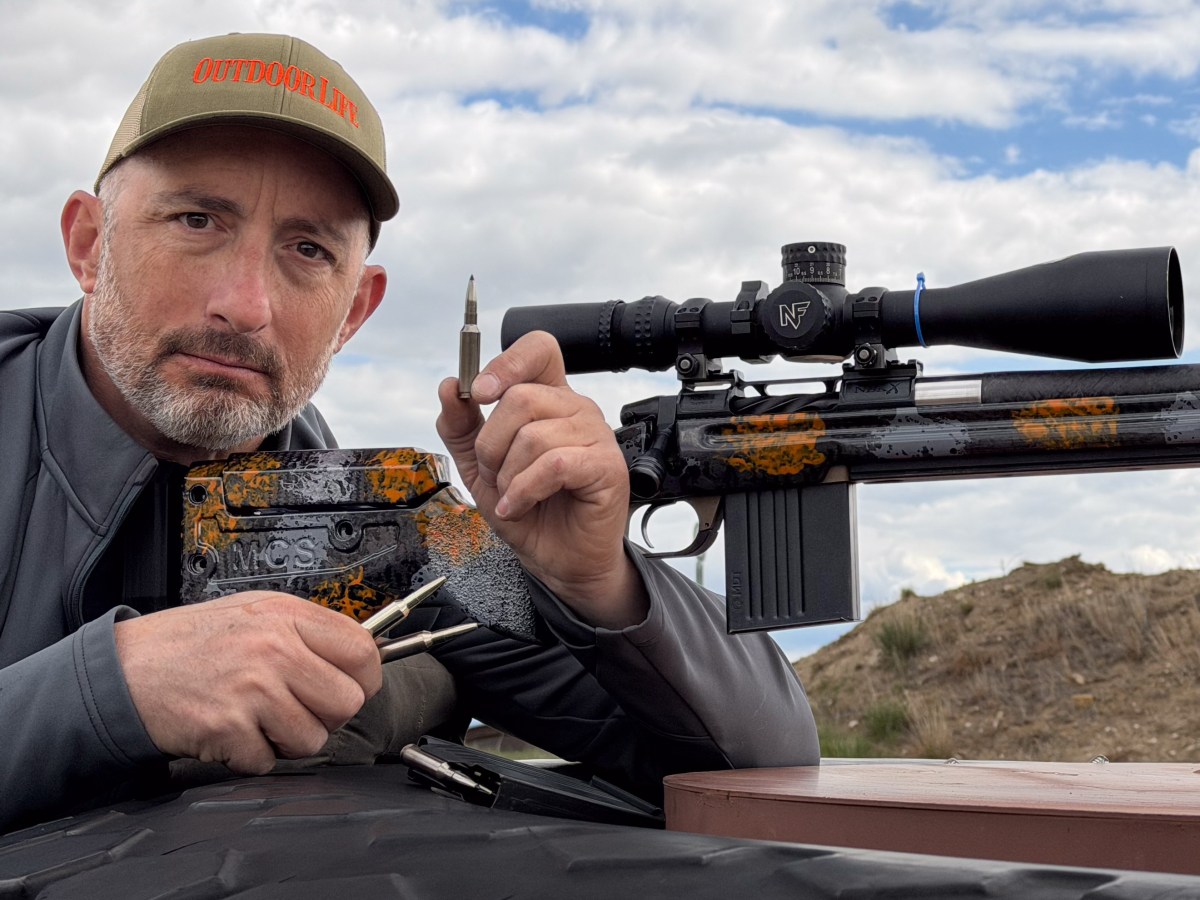

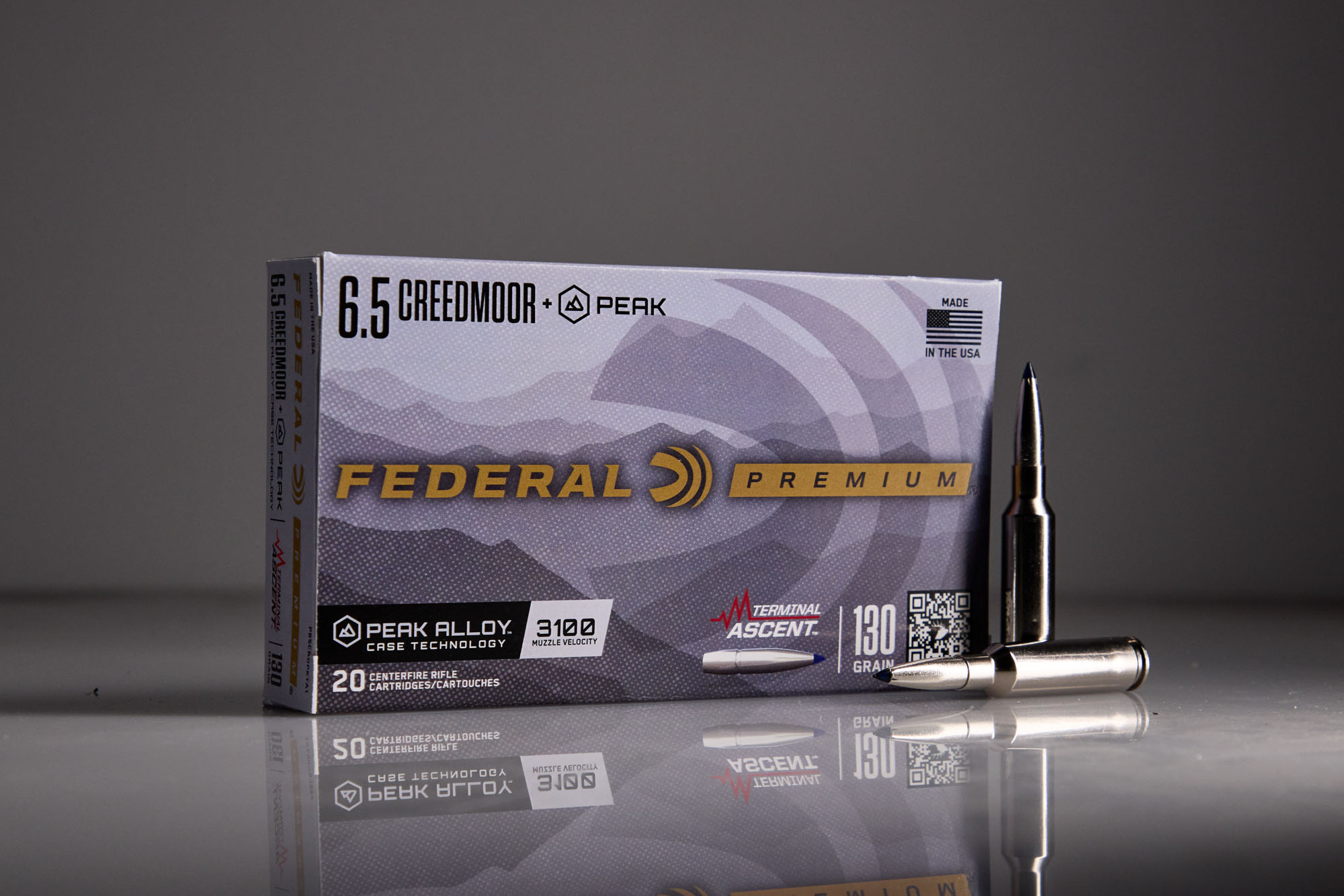
Did Federal’s Plus Peak 6.5 Creedmoor just make the 6.5 PRC obsolete? This new high-pressure technology gives the Creed a magnum-sized boost to muzzle velocity. In other words, Plus Peak takes an existing round, in this case the 6.5 Creedmoor, and makes it better.
I tested it in three rifles with two different barrel lengths (20 and 24 inches), shooting Plus Peak ammo against a standard Federal factory load with the same bullet, the 130-grain Terminal Ascent.
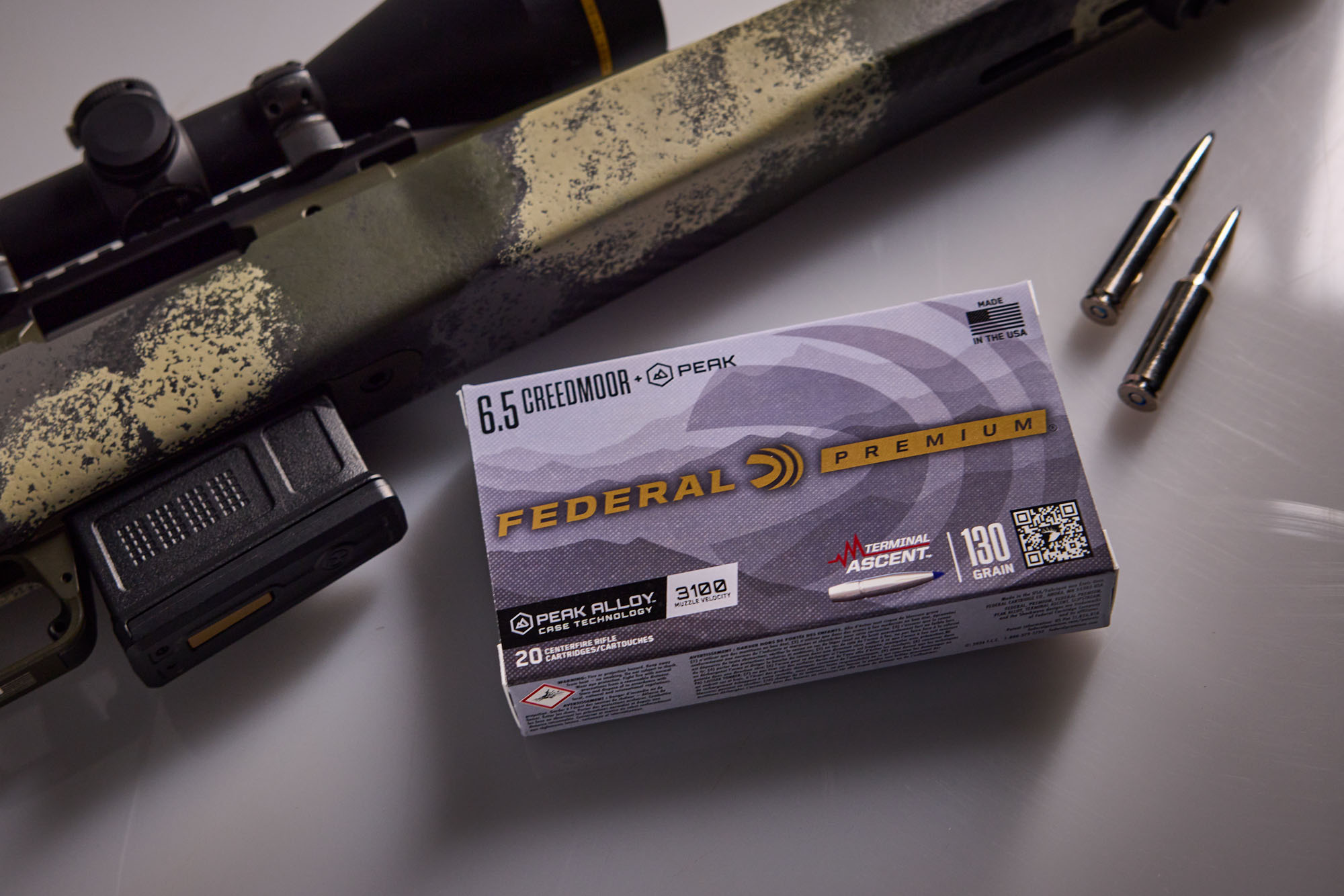
Here’s the quick takeaway. The Plus Peak version drove the Terminal Ascent 250 to 300 fps faster than the regular ammunition, a significant performance gain. I then grabbed a 6.5 PRC, the Plus Peak 6.5 Creedmoor’s intended competition, and put Federal’s factory 130-grain TA through it as well.
With the same bullet, the 24-inch 6.5 Creeds shooting Plus Peak ammo produced velocities matching my 24-inch 6.5 PRC. Not surprisingly, the 20-inch 6.5 Creed with the Plus Peak was about 75 fps slower. This experiment demonstrated that in Plus Peak trim, the 6.5 Creedmoor is on par with its larger PRC cousin.
| Rifle | Cartridge | Barrel Length | Bullet | Muzzle Velocity (Plus Peak) | Muzzle Velocity (Standard) | Velocity Gain |
| Custom Proof PXT | 6.5 Creedmoor | 24 inches | Federal 130-grain Terminal Ascent | 3060.5 fps | 2774.6 fps | 285.9 fps |
| Seekins SIC | 6.5 Creedmoor | 24 inches | Federal 130-grain Terminal Ascent | 3058.5 fps | 2761.7 fps | 296.8 fps |
| Nemo Electus | 6.5 Creedmoor | 20 inches | Federal 130-grain Terminal Ascent | 2989.4 fps | 2733.7 fps | 255.7 fps |
| Divide | 6.5 PRC | 24 inches | Federal 130-grain Terminal Ascent | N/A | 3064.3 fps | N/A |
* Velocities are based on the average of 10 shots measured with a Garmin Xero C2 chronograph
Plus Peak Launch Details
While the Plus Peak 6.5 Creed is being unveiled on 6/5 — that’s no coincidence — Federal says the ammunition will hit the shelves in early August.
Along with the 130-grain Terminal Ascent, Federal will offer the round with a 155-grain Fusion Tipped bullet to begin with. The Fusion Tipped has quickly become a favorite hunting bullet of mine for its accuracy and excellent terminal performance and is worth checking out no matter which cartridge you hunt with.
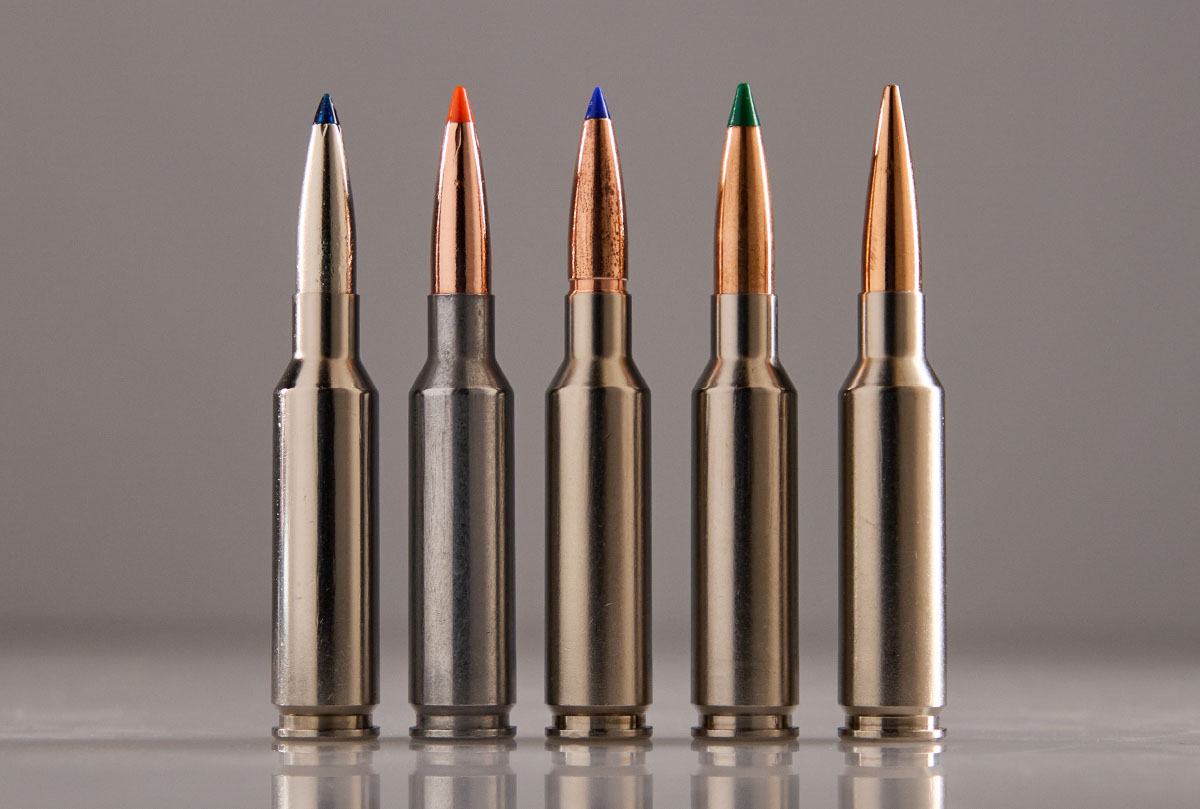
The Plus Peak 6.5 Creedmoor lineup will quickly expand to include a 127-grain Barnes LRX, 153-grain Sierra Tipped MatchKing, and 156-grain Berger Elite Hunter. Federal didn’t give specific timing but said they would be “fast followers.”
In other words, later this summer, hunters and shooters will be able to walk into their local gun store and purchase a box of 6.5 whoop-ass without having to spend an extra dime on their kit. And if you think this is going to stop with the Creedmoor, I’ve got some investment-grade Dale Earnhardt commemorative plates to sell you.

In the Footsteps of the 7mm Backcountry
If Plus Peak looks familiar, it’s because it is the same idea behind the 7mm Backcountry, which Federal introduced in early 2025. Both cartridges use Peak Alloy steel cases and can be loaded to 80,000 psi, a big leap over traditional brass cases that top out around 62,000 to 65,000 psi.
In the case of the 7 Backcountry, I was able to drive bullets from a 20-inch rifle that outran my 7 PRC ammo from a 24-inch tube with the same bullet.
Because the Peak Alloy case is much stronger than brass, it acts as a containment vessel insulating the action and barrel from the extra pressure. This increases velocity without inflicting extra stress on the rifle.
First Reactions to High-Pressure Cartridges
Trotting out a high-pressure round in a purpose-built cartridge is one thing. A smattering of early adopters jumped on the 7 BC, but it would have been odd if the masses rushed out to purchase rifles in a new round based on unvetted technology.
We saw a similar reaction to the .277 Sig Fury, another 80,000-psi cartridge which was introduced in late 2019. Most shooters seem to regard these rounds as niche curiosities, a perception reinforced by reports of temperamental performance and the relative scarcity of guns and ammo made for them.
What the Plus Peak 6.5 Creedmoor Signifies
Incorporating this technology into a regular round is different, however. I’ve talked before about how high-pressure cartridges aren’t a passing fad, but rather the future of rifle shooting — and the Plus Peak 6.5 Creedmoor lends ample weight to that argument.
I believe we’re on the cusp of a momentous shift in how we view rifle performance, not unlike how our forefathers must have reacted to the transition from black powder to smokeless propellants.
The push to adopt high-pressure rounds has come from the U.S. Military, which has mandated it to maintain an advantage over “near peer” adversaries (i.e. Russia and China) on the battlefield. The military wants our fighters to field rifles capable of defeating the body armor these (and other) countries are more frequently employing — and the way to do that is to drive bullets from our existing guns at higher speeds.
Historically, most hunters and shooters have equated rifle performance with speed — a concept the marketing gurus at gun and ammo companies have encouraged forever. Whether you look at the .250-3000 Savage, Roy Weatherby’s eponymous cartridges, the magnum craze of the 50s and 60s, or the short, super-short, and ultra-magnums of the early 2000s, it isn’t difficult to see that speed sells.
More velocity at the muzzle does have its advantages, but in the era of Modern Cartridge Design we’ve learned that balancing speed with the right kind of projectile is often preferable for long-range performance.
But if you load these sleek and aerodynamically efficient bullets — like the Berger Hybrid Target, Sierra Tipped MatchKing, and Hornady ELD-M — into larger (and therefore faster) cases you can enjoy the best of both worlds.
And when you add the intriguing PXT barrel technology that Proof Research just announced to the mix I can envision how cartridge design is going to enter uncharted territory with respect to speed and bullet design.
The Benefits of Plus Peak 6.5 Creedmoor
Like the 6.5 PRC, the Plus Peak 6.5 Creedmoor blends speed with efficient bullets but in a smaller package. The Creed is a true short-action cartridge and uses a standard .308-sized bolt face, while the PRC is chubbier and can have issues feeding through some short-actions if you want to load heavier bullets to their optimal length. It also requires a larger diameter bolt face (.540 versus .470 inches).
Rifles with internal magazines can usually accommodate five rounds of 6.5 Creedmoor, while they max out at three rounds of 6.5 PRC. For .308-class rounds, there are plenty of AICS and AW type detachable magazines to pick from, while the options for a 6.5 PRC are more limited.
How Plus Peak Performed During the Test
Federal stressed that the ammunition they sent wasn’t their finalized production run. It was intended for function testing in different rifles. They especially emphasized that it wasn’t loaded for precision, so I’m not judging it based on the groups it produced, though two of the rifles shot it quite well.
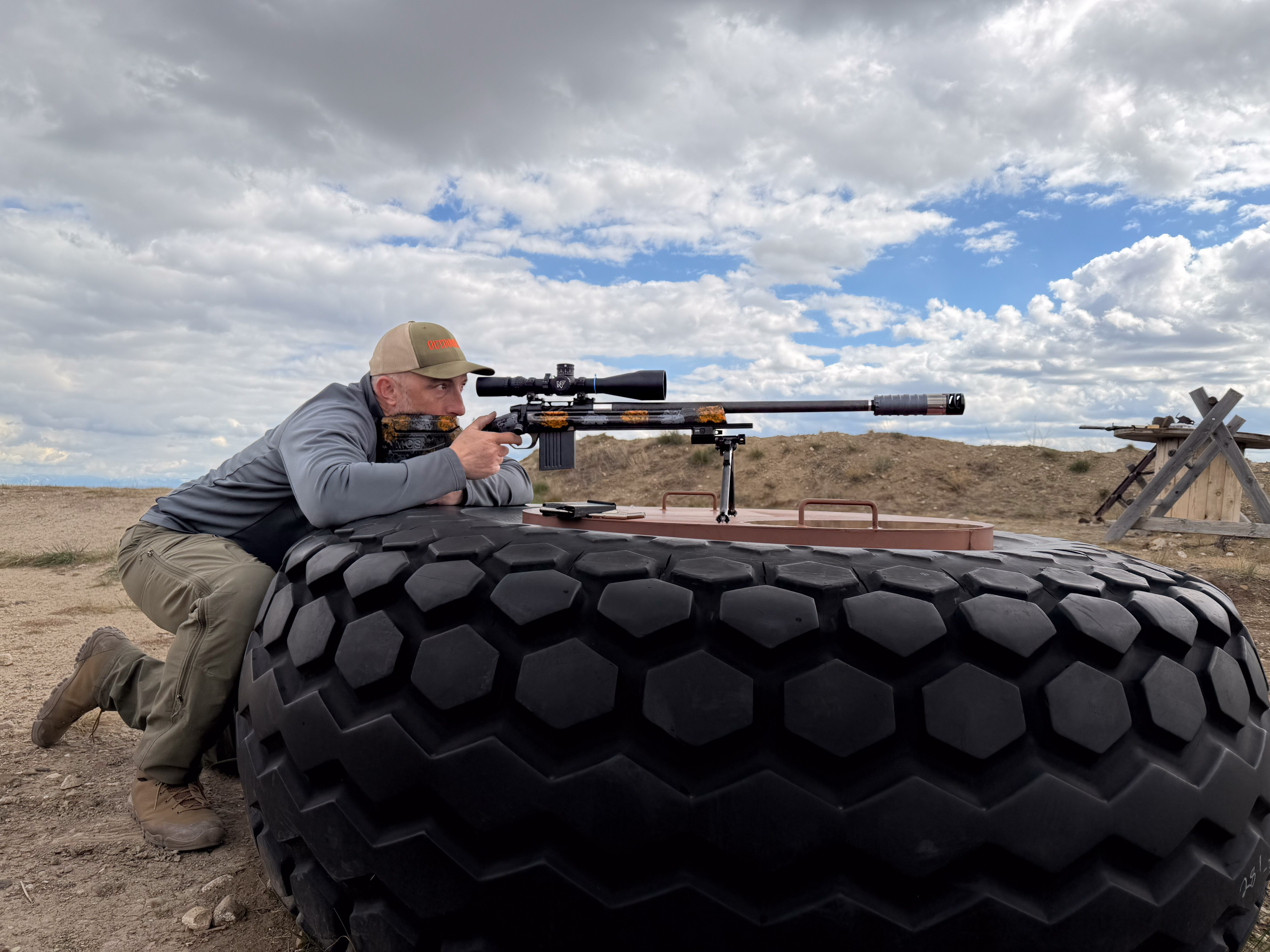
To test the ammunition, I put 10 shots (two 5-shot groups) through each 6.5 Creedmoor with both the standard and Plus Peak rounds. I ran the guns quickly, with no breaks for cooling, and used a Garmin Xero to chronograph the results that appear in the table above.
I also put two 5-shot groups through the 6.5 PRC, which was also loaded with the 130-grain Terminal Ascent, allowing for an apples-to-apples comparison.
In addition to the speed gains charted above a couple things really stood out during this evaluation.
Smooth Operation
The steel alloy cased Plus Peak ammunition cycled and extracted without issue. When the 7mm Backcountry was introduced, we experienced problems with heavy bolt lift in many rifles and, on occasion, difficulty in closing the bolt on rounds once a rifle got hot and dirty.
Federal diagnosed the issue and made changes to the Peak Alloy case, altering its dimensions a bit and incorporating extra steps into the manufacturing process. The steel alloy behaves differently than brass and these tweaks were done with that in mind.
Federal got it right out of the gate with the Plus Peak 6.5 Creedmoor, which behaved just like brass in my rifles. This is a huge relief for consumers who experienced (or heard about) the issues with the early runs of the 7 Backcountry.
Consistent Velocities
The low extreme spreads and standard deviations in muzzle velocity the Plus Peak ammo produced also caught my eye. With factory ammo, I consider SDs in the mid to upper teens good. (Based on adequate sample sizes, of course, ideally 20 rounds or more.)
The 10-shot strings I recorded generated SDs of 7.2 fps (Nemo Electus), 8.4 fps (Seekins SIC), and 10.3 fps (Impact with Proof PXT barrel).
The caveat here is that I don’t know how this ammo was loaded, but I do know that Federal made enough of this test ammunition that they weren’t meticulously crafted handloads. If they were run on the machinery that will be used for the actual production, that bodes well for the consumer.
Reloading the Plus Peak 6.5 Creedmoor
The question Federal has fielded more than any other about the 7mm Backcountry is whether it can be reloaded. The answer there has been a qualified yes. The main impediments have been: The inability to anneal the cases; the difficulty making dies that can adequately resize the steel; and the lack of propellants available to consumers that can duplicate the 7 BC’s velocities. (The round uses a powder that’s only sold to manufacturers.)
Federal says the story is different with the Plus Peak in 6.5 Creedmoor. No, you still can’t anneal the cases, but companies like Area 419, RCBS, and Short Action Customs are in the process of making dies, using what they’ve learned about the Peak Alloy steel in their design and manufacturing.
The best news, according to Federal, is that we can use commercially available propellants to load the Plus Peak cases to realize the 250 to 300 fps gains it has over standard 6.5 Creedmoor brass. This alone will spur serious shooters to give this new technology a try.
Paradigm Shift
It’s important to remember that the Plus Peak isn’t a new cartridge but a technology that makes an existing cartridge better.
One repercussion is that the SAAMI, the industry organization that sets the standards for the safe manufacturing of ammunition, is changing how it looks at cartridges.
Going forward, the 6.5 Creedmoor will still have a maximum pressure rating of 62,000 psi when made with traditional brass. But with Plus Peak cases, that value will now be 80,000 psi.
As other high-pressure case technologies come to fruition — and there are a pile of them in development — SAAMI might have to amend those numbers even more.
Proof’s PXT Monkey Wrench
Complicating this further is the introduction of Proof’s PXT barrels.
The exponential gain twist in these barrels, coupled with their radiused rifling profile (which doesn’t engrave the bullet with sharp edges), allow us to push bullets much faster than what traditionally rifled barrels are capable of.
In contrast to a standard barrel where the bullet slams into the rifling and begins rotating almost instantly, the PXT barrel starts with essentially no twist and slowly (in a relative manner) accelerates the bullet to its final twist rate.
(The reason traditional rifling has sharp edges is to gain purchase on the bullet as quickly as possible to get it spinning. This harsh engraving cuts into the bullet jacket, and can cause the bullet to come apart after exiting the muzzle, especially if it has been exposed to additional stress from increased pressure or a faster rate of twist.)
Because a PXT barrel babies the bullet, we can subject it to more pressure and velocity if we desire. So, it isn’t beyond the pale to image rounds in our future that jack pressure and muzzle velocities higher yet.
I’d like to be a fly on the wall as SAAMI tries to come to grips with this added variable too.
Plus Peak, the 6.5 PRC, and the Future
I get that some people will remain skeptical about high-pressure cartridges. But, in the immortal words of Bob Dylan, ‘the times they are a-changin’.
For the cost of a box of ammo, you can transform your 6.5 Creedmoor into a 6.5 PRC. That’s happening now. Next, we’ll see rounds like the .223 Rem. and .308 Win. added to the menu. And then the floodgates are going to open.
Federal will keep rolling out new variants. Other companies are sure to jump into the mix. The military will continue to push for more innovation. And we can only guess at what other enabling technologies, like Proof’s PXT barrels, are lurking in the wings.
Before long the crusty holdouts will find themselves in an ever-shrinking minority.
I don’t think I (or anyone else for that matter) can provide an accurate timeline. But things are going to look different in another year, I can promise you that. And the landscape will shift even more as we get five and ten years out.
Our beloved classic cartridges of today aren’t facing an extinction level meteor strike. It won’t happen that quickly. But before long, we will look back at this time and marvel at how rapidly and how significantly the world of guns and ammunition changed.
Read the full article here




![Tom Cruise Puts His Abs on Full Display for GQ at 64 [WATCH]](https://www.boredtrashpanda.com/wp-content/uploads/2026/09/2026.09.15-16.09-boredtrashpanda-6aa96da15dc9c-e1789571041178.jpg "Tom Cruise Puts His Abs on Full Display for GQ at 64 [WATCH]")
![Coast Guard Saves 15-Year-Old Stranded for Three Days Aboard Capsized Boat in Frigid Alaska Waters [WATCH]](https://www.rvmnews.com/wp-content/uploads/2026/09/2026.09.16-17.01-rvmnews-6aaacb7ce1059.jpg "Coast Guard Saves 15-Year-Old Stranded for Three Days Aboard Capsized Boat in Frigid Alaska Waters [WATCH]")