
Summary and Key Points: Sergeant First Class Alwyn Cashe pulled six of his soldiers and an Iraqi interpreter out of a burning Bradley Fighting Vehicle near Samarra, Iraq, on the night of October 17, 2005, doing so while his own fuel-soaked uniform was on fire, and he died of those burns three weeks later. For his actions, he was awarded the Silver Star, the Army’s third-highest decoration. It would take a campaign led by his own commander, a petition with a quarter of a million signatures, an act of Congress, and the signatures of two Presidents from opposing parties before an even greater honor was granted. Cashe received the Medal of Honor on December 16, 2021. He had been dead since 2005.
The Night Outside Samarra
Cashe was a platoon sergeant with Company A, 1st Battalion, 15th Infantry Regiment, 3rd Infantry Division, on his third combat tour, a former drill sergeant who had fought in the 1991 Gulf War and the 2003 invasion.
On the evening of October 17, 2005, he was commanding a Bradley Fighting Vehicle on a nighttime mounted patrol near an enemy-held village in Salah ad-Din Province when the vehicle struck a roadside bomb.
The blast ruptured the vehicle’s fuel cell and set it ablaze, drenching the men inside and Cashe himself in fuel. Cashe was in the gunner’s position and only lightly wounded by the explosion.
He climbed out.
What he did next is the reason for everything that followed. The driver was trapped in the burning vehicle, and Cashe, with another soldier, opened the hatch and pulled him free as flames engulfed the man. In the process, Cashe’s fuel-soaked uniform caught fire. Six soldiers were still inside. Rather than drop and smother his own flames, or wait for the fire to be brought under control, Cashe went back into the Bradley, then back again and again, pulling his men out one at a time while he himself burned.
The Medal of Honor citation renders it in the flat, exact language of an official finding: the flames gripped his fuel-soaked uniform and spread over his body, and despite the pain he set each rescued soldier on the ground and returned to the burning vehicle to retrieve another, all the while still on fire. A soldier at the scene later recalled Cashe’s only concern in the moment: he asked where his men were, looked at the vehicle, said they had to get the boys out, and started climbing in.
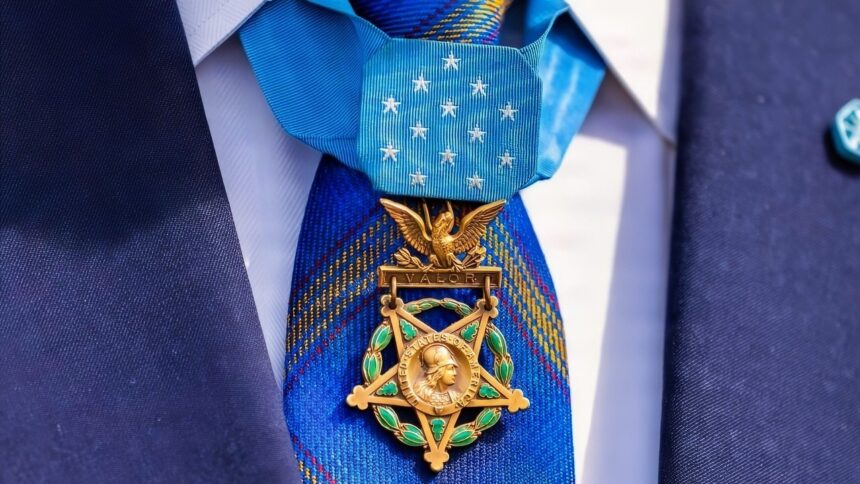
U.S. Army 1st. Sgt. Robert Durbin holds 1st Sgt. David McNerney’s Medal of Honor during an Enshrinement Ceremony at the Smithsonian National Postal Museum in Washington, D.C., on Sept. 22, 2013. The Smithsonian Institution accepted McNerney’s Medal of Honor for inclusion in the National Postal Museum collection where it will be displayed in the National Stamp Salon of the William H. Gross Stamp Gallery. (DoD photo by Staff Sgt. Teddy Wade, U.S. Army/Released)
He did not stop until every soldier had been removed, along with the body of the interpreter killed by the blast. The driver he pulled out first was Spc. Darren Howe, knocked unconscious in the blast alongside Staff Sgt. Douglas Dodge; and among the men in the fight, it was Sgt. Daniel Connelly, who helped get Howe clear, and Sgt. Joel Garcia, who tackled Cashe to the ground to beat out the flames when his uniform reignited for the last time.
The Burns He Did Not Survive
The cost was total. Cashe suffered second- and third-degree burns across most of his body, and even here the record carries the variance that comes when witnesses are being evacuated and no one is measuring.
The Silver Star citation and the Army’s own account put the burns at roughly 72 percent; other accounts of that night range as high as 80 or even 90 percent. What is not in dispute is that he refused evacuation until his soldiers had been treated and moved first.
He was flown to a nearby military hospital and then to the Army’s Brooke Army Medical Center in San Antonio, Texas, the military’s premier burn center, where he died of his injuries on November 8, 2005. He was 35 years old. He was not the only one who did not survive.
Three soldiers burned in the same attack later died of their wounds at the same Texas hospital: Staff Sgt. George Alexander Jr., 34, of Killeen, Texas; Sgt. Michael Robertson, 28, of Houston; and Spc. Darren Howe, 21, of Beatrice, Nebraska, the driver Cashe had pulled from the hatch.
Howe died on November 3; Cashe five days later. When Cashe could speak in the hospital, his sister Kasinal Cashe White recalled, his first question was about his soldiers: how were his boys?
The Third-Highest Medal
Cashe was posthumously awarded the Silver Star, and the man who recommended it was his battalion commander, then-Lieutenant Colonel Gary Brito.
The recommendation was made in the immediate aftermath, when the unit was still fighting, still absorbing its losses, and not thinking about medals.
It was also made without the full picture. Because every witness had been wounded and evacuated, Brito did not yet grasp the extent of what Cashe had done or the severity of the burns he had endured while doing it. The Silver Star was approved and awarded on the information available at the time.
Months later, home from Iraq and able to reconstruct the night from the accounts of the men who had been there, Brito reached a conclusion that would define the next decade of his life. He had recommended the wrong medal.
Reflecting on the action afterward, Brito told the Los Angeles Times in 2014 that “you don’t often find” truly selfless sacrifice of the kind Cashe had shown, putting his soldiers’ welfare before his own. A commander had decided, on the record, that he had under-decorated one of his own soldiers, and he set about trying to fix it.
The Wall of Five Years
Fixing it turned out to be far harder than anyone expected, and the reason was a single line of federal law.
Brito submitted a formal upgrade recommendation to the Army in May 2011, supported by additional witness statements and documentation.
It ran into a statute requiring that the Medal of Honor be awarded within five years of the act it recognizes.
Cashe had died in 2005. By the time the evidence supporting an upgrade had been assembled, the window had closed, and no amount of merit could reopen it administratively. The only instrument that could do so was an act of Congress waiving the limit specifically for him.
This is the part of the story that turns a battlefield into a bureaucracy. The waiver is not a formality; it is a rarely used exception. Doug Sterner, the military-awards historian who curates the Military Times Hall of Valor, has noted that since 1981 the five-year limit had been waived for only 91 service members, a group that includes soldiers from the Civil War’s Great Locomotive Chase.
To join that list, Cashe needed the Secretary of Defense to endorse the upgrade, Congress to pass a bill written for him alone, and a President to sign it, and then a President to actually award the medal. Each of those was its own obstacle, and each took years.
The Campaign
The effort that carried Cashe over those obstacles was unusually broad.
It included his family, the soldiers who had served under him, and a grassroots movement of veterans, one petition drive alone gathering roughly a quarter of a million signatures. It found congressional champions across the political divide.
On October 17, 2019, the fourteenth anniversary of the attack, a bipartisan trio of lawmakers with military backgrounds, retired Navy SEAL Dan Crenshaw of Texas, former Green Beret Michael Waltz of Florida, and Stephanie Murphy, also of Cashe’s home state, formally wrote to the Secretaries of Defense and the Army requesting the upgrade.
The bipartisan framing mattered because a bill waiving the law would need votes from both parties to move forward.
In August 2020, after a lengthy Army review, Defense Secretary Mark Esper completed his own examination of the case and wrote to lawmakers that he supported the upgrade and would recommend it to the President, provided Congress lifted the five-year bar.
That endorsement unlocked the legislation. Representative Murphy introduced the waiver bill, HR 8276, which authorized the President to award Cashe the Medal of Honor for acts of valor during Operation Iraqi Freedom, and the House passed it unanimously on September 22, 2020. It then stalled briefly in the Senate amid an unrelated fight over a Supreme Court nomination before clearing.
Two Presidents
The last stretch ran straight through a change of administrations, which is why the honor bears two signatures.
President Donald Trump signed the waiver into law in December 2020 as part of the annual defense authorization bill, removing the legal barrier at last. The expectation was that a ceremony might take place before Trump left office in January 2021, but the White House team coordinating the announcement determined that the ceremony would fall to the next administration.
Nearly a year later, on December 16, 2021, President Joseph Biden presented the Medal of Honor at the White House, where Cashe’s widow, Tamara Cashe, accepted it on her husband’s behalf. Biden called him “a soldier’s soldier, who literally walked through fire for his troops.”
The award carried a second distinction beyond the valor it recognized. Cashe became the first Black service member to receive the Medal of Honor for actions in the wars in Iraq and Afghanistan, and the first Black recipient of the award since the Vietnam War. Over the course of the campaign, some of his advocates had openly asked whether race was among the reasons the original Silver Star was not revisited more quickly, and whether troops from recent wars faced a higher bar for the nation’s top valor award than those from earlier conflicts.
Those questions were never resolved, and the Army has not conceded them; what is documented is that the case became a rallying point for a broader argument that the military’s medals process needed to be reviewed.
What the Sixteen Years Measured
Cashe was awarded the Medal of Honor sixteen years, one month, and twenty-nine days after the night he earned it.
The valor was settled within weeks; everything after that was the machinery of recognition grinding through a commander’s second thoughts, a five-year statute, a Pentagon review, a bill written for one man, two congressional chambers, and two Presidents.
His medal is now displayed, and his name is on a garden at Fort Stewart, on an Army installation’s memorials, and in the roll of the Congressional Medal of Honor Society. The gap between the act and the award is not a footnote to his story. It is the story, and it is the reason his case is cited whenever anyone argues that the system for recognizing valor is too slow to serve the people it exists to honor.
In June 2025, Representative Darrell Issa introduced the Valor Has No Expiration Act, legislation intended to allow the military to review and upgrade past valor awards without the five-year wall, so that the next soldier in Cashe’s position would not need an individual act of Congress to receive what a commander believed he had earned. The bill does not carry Cashe’s name. It carries the argument his sixteen years made for him.
About the Author: Harry J. Kazianis
Harry J. Kazianis (@Grecianformula) is the former Senior Director of National Security Affairs at the Center for the National Interest (CFTNI), a foreign policy think tank founded by Richard Nixon based in Washington, DC. Harry has over a decade of experience in think tanks and national security publishing. His ideas have been published in the NY Times, The Washington Post, The Wall Street Journal, CNN, and many other outlets worldwide. He has held positions at CSIS, the Heritage Foundation, the University of Nottingham, and several other institutions related to national security research and studies. He is the former Executive Editor of the National Interest and the Diplomat. He holds a Master’s degree focusing on international affairs from Harvard University.

![New FBI Files Expose ‘Deep State’ Push to Join Trump Probe and Target Elon Musk [WATCH]](https://www.lifezette.com/wp-content/uploads/2026/09/2026.09.16-17.10-lifezette-6aaacd9767557.jpg "New FBI Files Expose ‘Deep State’ Push to Join Trump Probe and Target Elon Musk [WATCH]")