
The legality of so-called assault weapons is sitting in the scales of justice with the U.S. Supreme Court. An amicus shoots through the “dangerous and unusual” defense of bans.
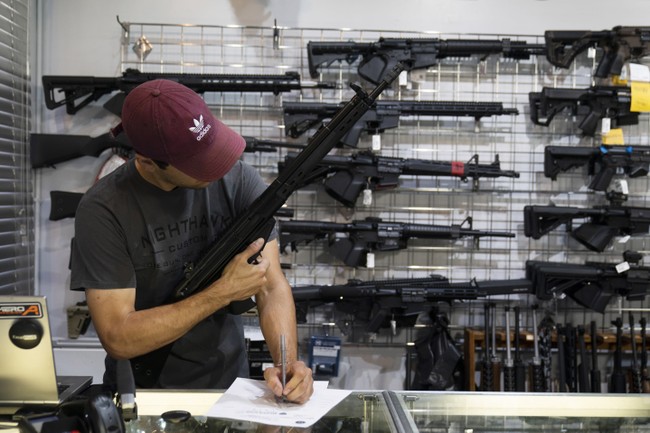
Viramontes v. Cook County, consolidated with Grant v. Higgins, are cases challenging local and state prohibitions respectively on commonly owned semi-automatic firearms. The cases will likely put an end to categorical bans on so-called assault weapons. 46 amicus briefs have been filed in these cases. One brief submitted by the Hawaii Rifle Association takes a novel approach to language used in Heller.
The 79-page brief authored by attorney Alan Beck takes an interesting approach. Beck’s reasoning might be the key to decoding other issues that proponents of Second Amendment preservation could find useful. This comes as the U.S. Third Circuit Court of Appeals upheld that machineguns are not protected arms as they are both dangerous and unusual. Rather than pin the dangerous and unusual language directly to hardware, Beck says it’s really conduct that the Heller opinion was referencing.
“This Court should not find the rifles at issue in this litigation are dangerous and unusual weapons,” the brief says. “That is because the term ‘dangerous and unusual’ weapons does not refer to any particular type of weapon or characteristic of any arm. Rather, it refers to forms of conduct with weapons.”
Beck argues that “‘dangerous and unusual’ weapons was a conjunctive test” and that “all weapons were considered dangerous.” The brief notes that the unusual portion “referred to an unusual use of a dangerous weapon.” What kind of conduct does the brief contend would be unusual? When a weapon is being used in a “manner reasonably foreseeable to cause terror.”
It’s no accident that terror is the word that was used in the brief. The Statute of Northampton is quickly referenced as an analogue. Interestingly enough, the same analogue was cited in the combined Koons and Siegel cases by the State of New Jersey during en banc oral arguments at the U.S. Third Circuit Court of Appeals. What the State of New Jersey fails to see is something that Beck — and other Second Amendment luminaries — plainly zero in on.
In the Statute of Northampton, prohibited behaviors are enumerated. Conduct specifically prohibited includes: “nor bring no force in affray of the peace.” The brief breaks down the etymological roots of the word “affray.”
“Affray, Is derived from the French word effrayer, to affright, and it formerly meant no more, as where persons appeared with armour or weapons not usually worn, to the terror of others; and so is the word used in the statute of Northampton [],” the brief explains via citation of Timothy Cunningham’s 1789 law dictionary via Heller.
The amicus brief goes on for pages of historical analogues that chastise the behavior of individuals instead of the hardware. An argument that pops up commonly today when discussing any arms prohibition and/or “gun control” law. Punish the bad actors, not the law-abiding gun owner.
“Either way, as historically understood, the prohibition against carrying ‘dangerous and unusual’ weapons requires an arm to be carried in a threatening manner,” Beck writes. “The longstanding prohibition on the carrying of ‘dangerous and unusual weapons’ thus refers to types of conduct with weapons.”
A 2025 Dickinson Law Review article embraces similar reasoning. “Dangerous and Unusual: How Heller’s Ahistorical Assumption Violates the Founders’ Original Intent” by Oliver Krawczyk & Gilbert Ambler also looks at how “dangerous and unusual” would have been viewed at the time of the founding.
“Historical “dangerous and unusual” offenses do not support modern possessory prohibitions due to their analogical mismatches on public location, manner of carry, conduct proscribed, and penalties,” Krawczyk and Gilbert write. “But these offenses are distinguishable for an additional reason—the historical record suggests that ‘dangerous and/or unusual’ was a legal term of art describing the unjustified and disproportionate use of force, not the dangerousness or rarity of particular types of weapons.”
Beck’s brief is sound. If the court — and I dare say legislators — look at the Heller dangerous and unusual qualifier through this historical lens, nearly all bans of any arm would be unconstitutional if the bearer acts in a lawful manner.
The conduct described isn’t a New York City lawful manner either. Nearly the entire island of Manhattan has been defined as a so-called sensitive location and carrying a firearm in deadly Times Square would be considered unlawful.
The lawful manner that’s being discussed includes conduct that does not terrorize the people. In short, not arming with the intent to engage in illegal acts of harm. This argument is the key to shredding all bans. My permit to have these arms is my virtuous intent.
Editor’s Note: President Trump and Republicans across the country are doing everything they can to protect our Second Amendment rights and right to self-defense.
Help us continue to report on their efforts and legislative successes. Join Bearing Arms VIP and use promo code FIGHT to receive 60% off your membership.
Read the full article here