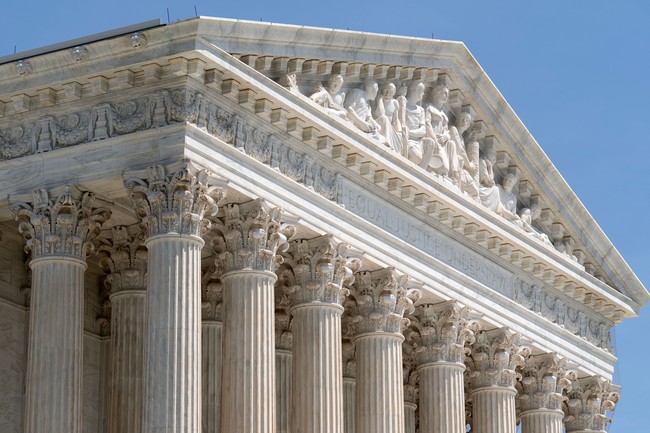

Over at The Reload, Stephen Gutowski has an interesting podcast that’s worth a listen. This week’s guest is Georgia State University Law Professor Andrew Willinger, who’s also the former executive director of the Duke University Firearms Law Center. As Gutowski notes, Willinger is hardly a fan of the Supreme Court’s Second Amendment jurisprudence, and the law professor isn’t particularly excited about the Supreme Court taking up the issue of “assault weapon” bans next term.
Willinger notes that, so far, every appellate court that’s weighed in on AWBs has upheld the prohibition on AR-15s and other semi-automatic firearms. Some, including the Seventh Circuit, have pointed to 19th-century restrictions on Bowie knives as analogues to the bans on so-called assault weapons.
He said courts have padded those laws with much earlier and much later weapons restrictions, such as the National Firearms Act of the 1930s. He noted some courts have also used the similarity between AR-15s and military weapons, like the M-16, to uphold the modern bans.
He rejected the idea that the consensus surrounding assault weapons bans in the lower courts is primarily a product of geography. Gun-rights activists have long claimed the fact that only a handful of deep blue states have these sorts of bans means only left-leaning circuits have the opportunity to review them. But Willinger argued that the judges involved in the decisions come from a fairly diverse background, with a number of them being Republican appointees.
Unfortunately, being nominated by a Republican president is not a guarantee that a judge will respect the right to keep and bear arms, at least in any meaningful way. Responding to Willinger on X, Second Amendment Foundation’s Kostas Moros also argued that several of the appellate court decisions have been “far from unanimous.”
Andrew Willinger was on the Reload Podcast. Obviously, I disagree with his views on the Second Amendment and Bruen, no point in trying to rebut all that as it’s the same old debates.
But I do want to push back on his argument that the lower court consensus *is* meaningful.…
— Kostas Moros (@MorosKostas) July 12, 2026
7-4 in the 9th circuit in Duncan, similar with the 4th circuit in Bianchi. Both had dissents that were clearly more persuasive than the majorities (though I’m biased haha). That in and of itself is akin to a soft split.
There is one area where Willinger and Moros do agree, however. Both think it’s likely that the Supreme Court will break with the decisions of the lower courts that have found bans on commonly-owned arms to be compliant with the Constitution and will strike down the “assault weapon” bans in Cook County, Illinois and the state of Connecticut that are being challenged before SCOTUS.
Willinger acknowledges that there are four justices who’ve strongly indicated they would strike down bans on “assault weapons,” and he predicts that Chief Justice John Roberts and/or Justice Amy Coney Barrett will join Gorsuch, Kavanaugh, Alito, and Thomas in a majority opinion. I think that’s a pretty safe bet, at least for now.
So is it meaningful that every appellate court to consider an “assault weapon” ban has upheld them? I think where it really matters is at the appellate court level, where one opinion gets cited by another circuit, then those two decisions get cited, and so on. The unanimity may also have played a role in the Supreme Court not taking up the issue before now, since the Court generally doesn’t get involved unless or until there’s a circuit court split. That hasn’t happened yet, though it’s widely expected that the Third Circuit will create a split when it issues its rulings on New Jersey’s gun and magazine ban.
Now that SCOTUS has agreed to address these bans, I don’t think the lack of a split is going to be a deciding factor in how the Court ultimately rules. All of the Court’s Second Amendment jurisprudence points to the idea that arms that are in common use for lawful purposes cannot be banned, even if those arms are also misused by criminals. Only three states (Georgia, Tennessee, and Arkansas) banned outright the sale of Bowie knives, and Georgia’s ban was held to violate the Second Amendment by the Georgia Supreme Court. A handful of other southern States imposed high property taxes on the possession of these knives in an attempt to discourage ownership, but even that doesn’t suffice to prove a national tradition of regulation, in my view.
Now, it is worth noting that SCOTUS did not take either of the cases challenging magazine bans in California and Washington State, respectively. Rather than denying cert outright, the Court is hanging on to those cases, and they’ll likely be sent back down to the lower courts for a do-over after Viramontes and the Connecticut cases have been decided. I’d hate to see a decision that struck down bans on so-called assault weapons while leaving the door open for bans on “large capacity” magazines or restrictions on magazine capacity. That’s probably my biggest concern about what SCOTUS will do next term. Even without a circuit court split, though, I think outright prohibitions on so-called assault weapons are soon to be a thing of the past.
Read the full article here