
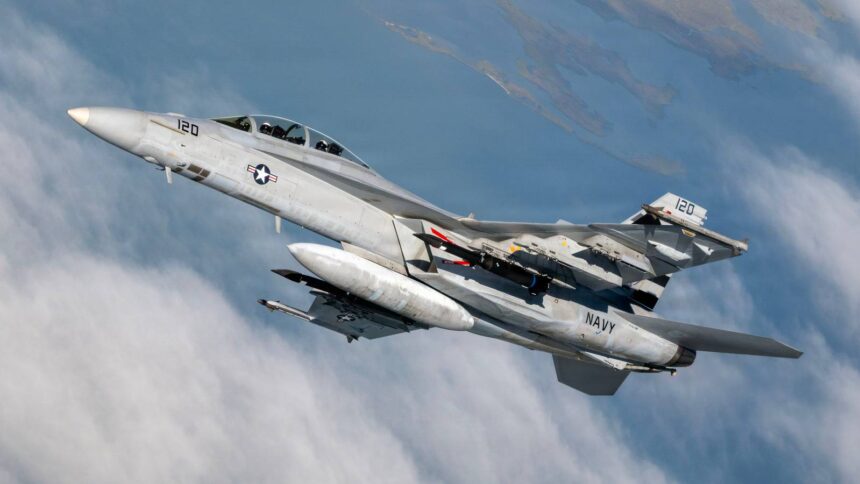

The Army and Navy recently announced billions in missile and drone acquisitions.
The Navy made a production delivery order in mid-September to deliver $200 million worth of Blackbeard hypersonic missiles while the Army inked a contract worth up to $1.2 billion with Lockheed Martin to push its next-generation Precision Strike Missile (PrSM) Increment 2 into production.
The Navy announced the award through a private-public partnership on Sept. 14, to develop the weapons with industry partner Castelion after previously ordering 50 Early Operational Capability weapons from the startup in June.
The service announced the new award through the Department of the Navy Rapid Capabilities Office (DONRCO), Portfolio Acquisition Executive Aviation (PAE(A)) and the Future Capability Development and Integration (FCD&I) Aviation Rapid Capabilities Cell.
“To win in contested environments, we must deliver lethality at scale inside the operational window of relevance,” said Vice Adm. John “Doc” Dougherty IV, commander PAE(A) and Naval Air Systems Command, in a statement. “This production award is a testament to what is possible when the Navy aligns agile acquisition with commercial manufacturing discipline.
We are putting game-changing hypersonic capability into the hands of our war fighters, dramatically expanding the lethal reach of naval aviation.”
Castelion will carry out the Navy’s missile production at its Project Ranger campus in Rio Rancho, N.M., as well as its facility in Torrance, Calif.
‘Clearing Red Tape’
The Army’s PrSm deal follows a critical August flight test at White Sands Missile Range where the upgraded weapon, launched from a HIMARS platform, successfully tracked and engaged a moving maritime target.
Designed to replace the aging Army Tactical Missile System (ATACMS), the new variant features an advanced multimode seeker providing soldiers the ability to fire lethal, long-range strikes against time-sensitive ship and land threats across contested littoral zones.
“The Navy’s decision to move into production reflects its confidence in the Blackbeard program, and the progress we’ve made together,” Bryon Hargis, co-founder and CEO of Castelion, said in a statement. “That’s how you get capability to the fleet fast, clear red tape, and partner with industry.”
Blackbeard missiles are air-launched, hypersonic strike weapons that provide carrier-based strike fighters with a responsive, long-range, high-speed strike option against maritime and land targets, according to the Navy.
They also enhance survivability against advanced air defenses and are considered an affordable missile option for the military to use.
Munitions Remain Focal Point in Middle East Conflict
The procurements come amid reported concerns that the U.S. is suffering from a munitions’ shortage as its war with Iran continues, surpassing the seven-month mark last week.
The Trump administration has requested a $1.5 trillion defense budget from Congress.

In July, Defense Secretary Pete Hegseth told Senate Appropriations Committee lawmakers that not fully funding the Department of Defense (DOD) to the tune of $1.5 trillion is the “greatest threat” the United States faces at home and abroad.
In August, the Navy awarded a $22.9 billion contract to Raytheon to develop Tomahawk missiles.
One month earlier, the Pentagon announced two framework agreements with defense companies Northrop Grumman and Lockheed Martin to triple the production of Patriot Advanced Capability-3 (PAC-3) components, and quadruple the production of Terminal High Altitude Area Defense (THAAD) components.

![Two Dead, 35 Injured After Gunfire Erupted at a Homecoming Block Party in Georgia [WATCH]](https://www.rvmnews.com/wp-content/uploads/2024/07/2024.07.13-09.18-rvmnews-66924660a4e0e.jpg "Two Dead, 35 Injured After Gunfire Erupted at a Homecoming Block Party in Georgia [WATCH]")
![Brazil’s Election Just Unleashed a Conservative Shockwave [WATCH]](https://www.talkred.com/wp-content/uploads/2026/10/2026.10.05-06.57-talkred-6ac34a5aa879c.jpg "Brazil’s Election Just Unleashed a Conservative Shockwave [WATCH]")