

Summary and Key Points: In 2004, the United States flew the fastest air-breathing aircraft in history, but the effort then stalled. NASA’s X-43A reached Mach 9.6 that November, but the Vision for Space Exploration had already pulled NASA toward the Moon and Mars; the X-43B and X-43C were canceled, and the Pentagon’s attention was on Iraq and Afghanistan. The Air Force carried the idea forward with the X-51A Waverider, but China fielded the DF-17 and Russia the Avangard first, and the United States is still racing to field what NASA proved possible 22 years ago.
X-43A: A Hypersonic History Forgotten
The U.S. is spending billions to develop hypersonic weapons that, in some respects, NASA already proved possible 22 years ago. In 2004, NASA’s X-43A hit Mach 9.6 — about 7,346 mph — and became the fastest air-breathing aircraft ever flown. Then the program ended that same year before any successor could be built, and China and Russia caught up while the U.S. gave up.
The X-43A Was a Game-Changer, But Was It Canceled?
As the United States continues to accelerate funding for hypersonic weapons in response to advances being made by China – allocating $3.9 billion in fiscal year 2026 specifically for hypersonic weapons projects – it’s worth remembering that this is really an effort to field a capability that it demonstrated more than two decades ago.
In 2004, NASA’s X-43A reached Mach 9.6 using a scramjet engine, becoming the fastest air-breathing aircraft ever flown.
The flight validated a concept long considered theoretically viable but practically unproven: sustained hypersonic flight using atmospheric oxygen rather than onboard oxidizers. Yet despite that breakthrough, the program ended almost immediately.
No operational system followed, and no direct successor entered service.
Today, as the U.S. seeks to field hypersonic weapons at scale, the X-43A serves as a reminder of the challenges that come with developing such an advanced capability.
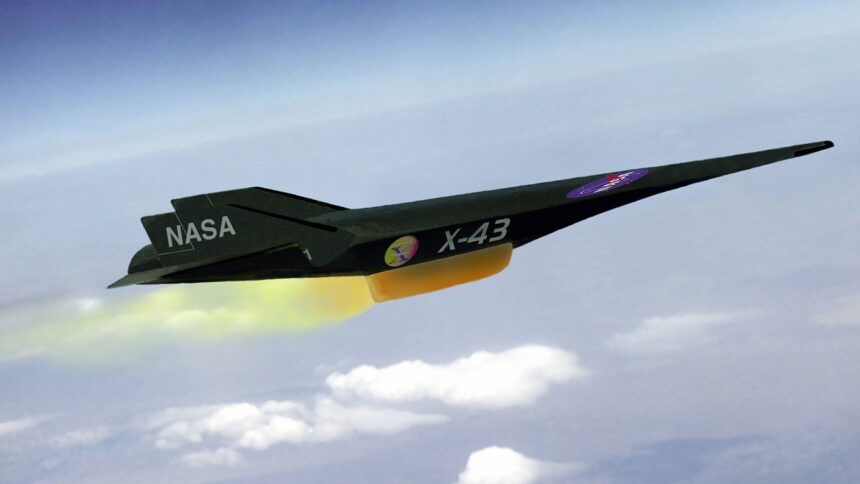
X-43D. Creative Commons Photo.

The X-43A was a small experimental research aircraft designed to flight-demonstrate the technology of airframe-integrated supersonic ramjet or “scramjet” propulsion at hypersonic speeds above Mach 5, or five times the speed of sound. Its scramjet engine is an air-breathing engine in which the airflow through the engine remains supersonic.
The X-43A and What It Actually Achieved
The X-43A was developed under NASA’s Hyper-X program, which aimed to determine whether a scramjet engine could operate in real-world flight conditions. Unlike conventional jet engines, scramjets operate at supersonic speeds, allowing sustained flight at hypersonic velocities above Mach 5.
Three X-43A vehicles were built. The first test flight in 2001 failed when the Pegasus booster rocket malfunctioned and the vehicle was lost. However, the two subsequent flights in 2004 succeeded.
One reached approximately Mach 7, and the final flight in November 2004 achieved Mach 9.6, setting a record for air-breathing flight.
The engine itself operated for only a few seconds – roughly 10 seconds of powered flight – but that was enough to generate critical data on stability and aerodynamic performance at hypersonic speeds.
The X-43A was not, however, a prototype weapon, nor was it an aircraft. This was a validation platform designed to demonstrate that scramjet propulsion could operate outside controlled environments.
Wind tunnels and simulations had suggested it was possible, but the X-43A provided the first real-world confirmation.
A Program That Wasn’t Designed To Last
The X-43A program effectively ended in November 2004, immediately after its final successful flight, when the third and final vehicle reached Mach 9.6 before splashing down in the Pacific Ocean. After that, no further flights were scheduled, and no additional vehicles were built. The program ended.
The apparent abrupt ending of the X-43A program makes sense when viewed through the lens of its design. Hyper-X was never intended to produce an operational system — it was a very tightly scoped research initiative with clearly defined objectives and a fixed endpoint.
And each X-43A vehicle was expendable. After being carried into the air by a B-52 and accelerated to hypersonic speed by a Pegasus rocket booster, the vehicle separated, performed a brief powered flight, and then fell into the ocean. There was no recovery system in place, nor was there a plan to transition the research into a specific development.
The total cost of the Hyper-X program was approximately $230 million, reflecting its role as a focused technology demonstrator rather than a long-term development effort. Its purpose was to answer specific technical questions, not to lay the groundwork for immediate deployment.
And by late 2004, those questions had been largely answered. Scramjet propulsion had been demonstrated in flight, and the data collected provided a foundation for future research. In that sense, the program did not fail by any measure – it simply concluded as intended.
However, that explanation only accounts for why the X-43A itself ended, and does not explain why the technology did not evolve into something larger and longer-lasting.
Why the Program Was Canceled
While the X-43A program technically succeeded, follow-on programs were canceled or deprioritized.
One major factor behind the decisions was a shift in NASA’s strategic focus. In 2004, the U.S. government announced the Vision for Space Exploration, which redirected NASA resources toward returning humans to the Moon and eventually reaching Mars.
Hypersonic atmospheric flight, while technologically and scientifically significant, was not a part of that agenda. As a result, follow-on efforts such as the X-43B and X-43C were canceled before they could move forward.
Budget constraints also came into play. Hypersonic propulsion was a high-risk, long-term investment with uncertain pathways to operational use, making it difficult to justify both financially and politically. At the time, the Department of Defense was focused on more immediate priorities, including counterinsurgency operations in Iraq and Afghanistan, which placed less emphasis on advanced high-speed strike capabilities — even if starting early would have paid dividends later.
There were, however, still some technical and practical limitations that would have persisted even with funding. The X-43A used hydrogen fuel, which offers high performance for scramjets but presents major storage and handling challenges for operational systems.
A transition to hydrocarbon fuels, which are more practical for military use, required further research and development that had not yet been completed.
Instead of scaling the X-43A directly, the U.S. shifted toward other experimental programs.
The most notable successor was the X-51A Waverider, developed with support from the U.S. Air Force, which focused on longer-duration hypersonic flight using hydrocarbon fuel.

The X-51A Waverider is set to demonstrate hypersonic flight. Powered by a Pratt Whitney Rocketdyne SJY61 scramjet engine, it is designed to ride on its own shockwavem and accelerate to about Mach 6. (U.S. Air Force graphic)
The Consequences of Ending X-43A
The long-term consequences of these decisions are now being felt in the global hypersonics race. By the mid-2000s, the United States had established a clear lead in scramjet propulsion — but that lead didn’t last. Over the following decade, China and Russia invested heavily in hypersonic technologies, developing systems such as China’s DF-17 medium-range ballistic missile and Russia’s Avangard glide vehicle.
Meanwhile, the U.S. effort became fragmented across multiple programs, leading to delays and cancellations that slowed progress.
A 2023 report by the Congressional Research Service noted that U.S. hypersonic programs have faced technical challenges and cost growth, compounded by testing delays, raising concerns about future capability gaps.
Specifically, it noted that while Russia has conducted research on hypersonic weapons technology for the last forty years, it accelerated its efforts in response to American missile deployments across the U.S. and Europe, and the U.S. withdrawal from the Anti-Ballistic Missile Treaty in 2002.
“Russia thus seeks hypersonic weapons, which can maneuver as they approach their targets, as an assured means of penetrating U.S. missile defenses and restoring its sense of strategic stability,” the report explained.
The U.S. falling behind on hypersonic research, therefore, presented an opportunity for Russia and China to catch up or leap ahead.
And this is nothing new. The X-43A illustrates a pattern in U.S. defense innovation. Breakthrough technologies are often successfully demonstrated, but the transition from research to deployment is inconsistent, driven by cost growth, shifting priorities, structural limitations, or political decisions.
In this case, the absence of a clear pathway from demonstrator to operational system meant that early progress did not translate into sustained capability, and that gap is now shaping policy decisions.
Current hypersonic programs are being accelerated not because the underlying science is new – it’s not – but because the strategic environment is changing and favoring the continued development of these technologies.
About the Author: Jack Buckby
Jack Buckby is a British researcher and analyst specializing in defense and national security, based in New York. His work focuses on military capability, procurement, and strategic competition, producing and editing analysis for policy and defense audiences. He brings extensive editorial experience, with a career output spanning over 1,000 articles at 19FortyFive, and has previously authored books and papers on extremism and deradicalization.

![Obama Faceplants with Cringe Claim About Women in Power [WATCH]](https://www.rvmnews.com/wp-content/uploads/2026/09/2026.09.25-13.28-rvmnews-6ab676e789ddb.jpg "Obama Faceplants with Cringe Claim About Women in Power [WATCH]")