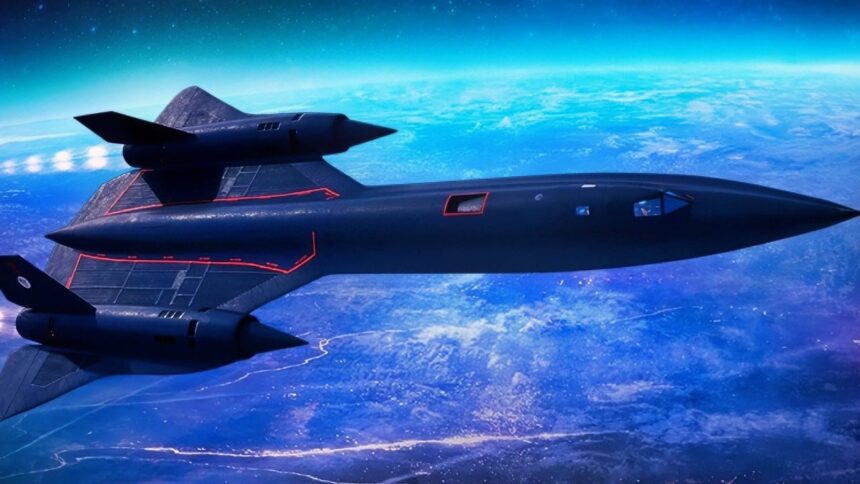

Summary and Key Points: Somewhere over the Barents Sea in 1986, pilot Ed Yeilding was flying an SR-71 Blackbird at around 75,000 feet — high enough to see the horizon 335 miles away and make out the curvature of the Earth — when he spotted a long white contrail a hundred miles ahead, coming straight at him and far below. He knew what it was.
The SR-71 vs. Russia’s Best MiGs
It’s been more than half a century since the SR-71 Blackbird set speed records that remain unbroken, but today the aircraft remains one of the most extraordinary military jets ever built.
During the Cold War, American pilots flew the unarmed spy plane at more than three times the speed of sound and at incredible altitudes of above 70,000 feet. The jet was used to photograph military installations thousands of miles away and gather intelligence while hostile fighters and air defenses tried to track it.
And during a mission near the Soviet Union in 1986, an SR-71 crew got a very close look at one of the fighters sent up to intercept them.
While flying over the Barents Sea near the northern Russian coastline, pilot Ed Yeilding and reconnaissance systems officer Curt Osterheld watched as a Soviet MiG-31 raced toward their aircraft and climbed rapidly to try to reach it.
MiG-31 fighter. Image Credit: Creative Commons.
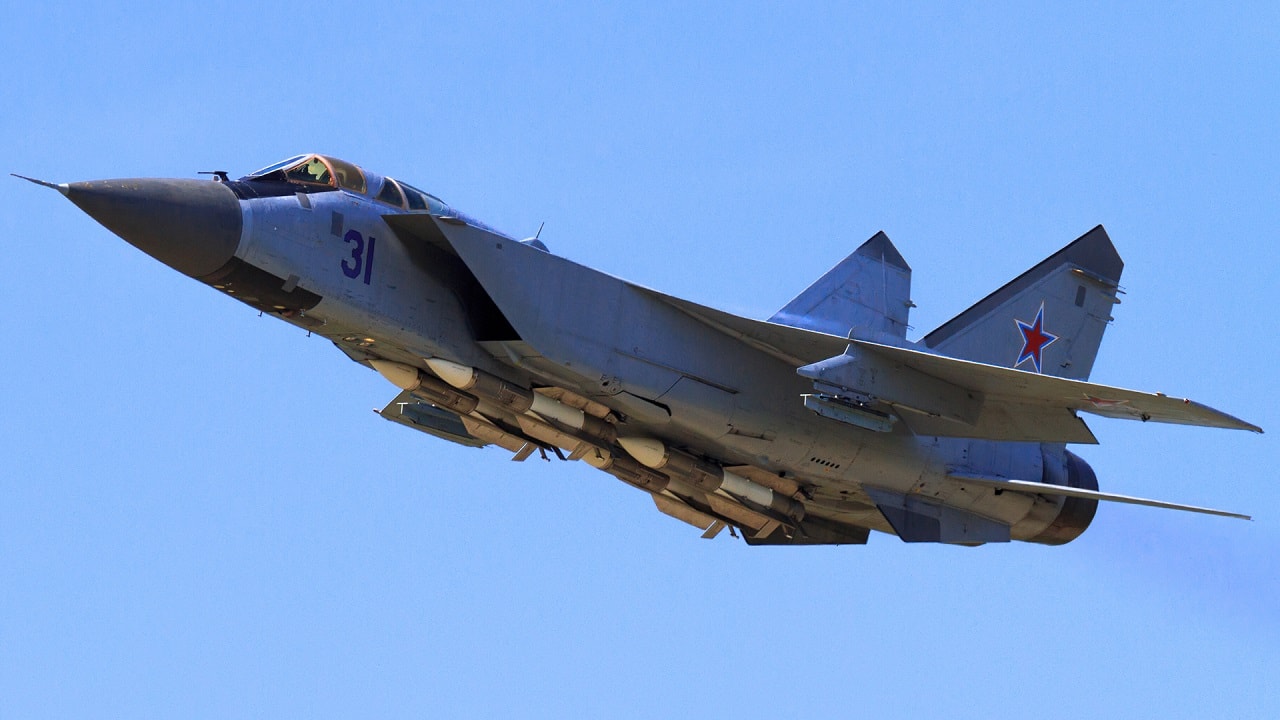
MiG-31. Image Credit: Creative Commons.
What followed was an incredible encounter between two of the fastest and highest-flying military aircraft ever built — one that was trying to complete an intelligence mission and another trying to get close enough to stop it.
The SR-71 Blackbird’s Cold War Mission
The SR-71 was built by Lockheed’s secretive Skunk Works division and was designed as a strategic reconnaissance aircraft. It entered U.S. Air Force service during the 1960s.
The aircraft was powered by two Pratt & Whitney J58 engines and could cruise at more than Mach 3 and fly above 80,000 feet. Its crews could therefore gather intelligence while remaining extremely difficult for enemy fighters and surface-to-air missiles to reach. That evasiveness meant that the aircraft did not need to carry offensive weapons — and it didn’t.
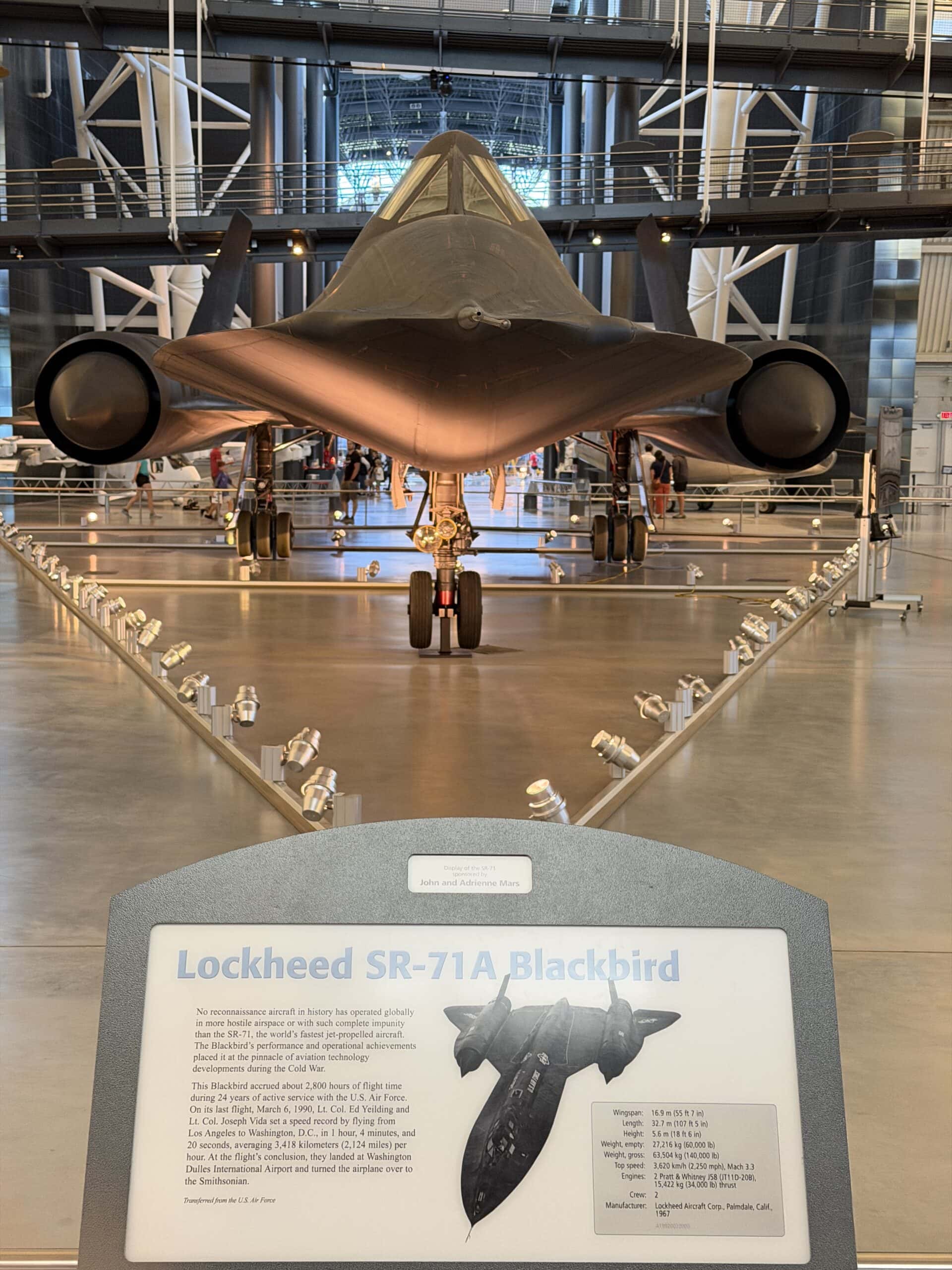
SR-71 Blackbird. Image taken at the Smithsonian on 6/30/2026 by 19FortyFive
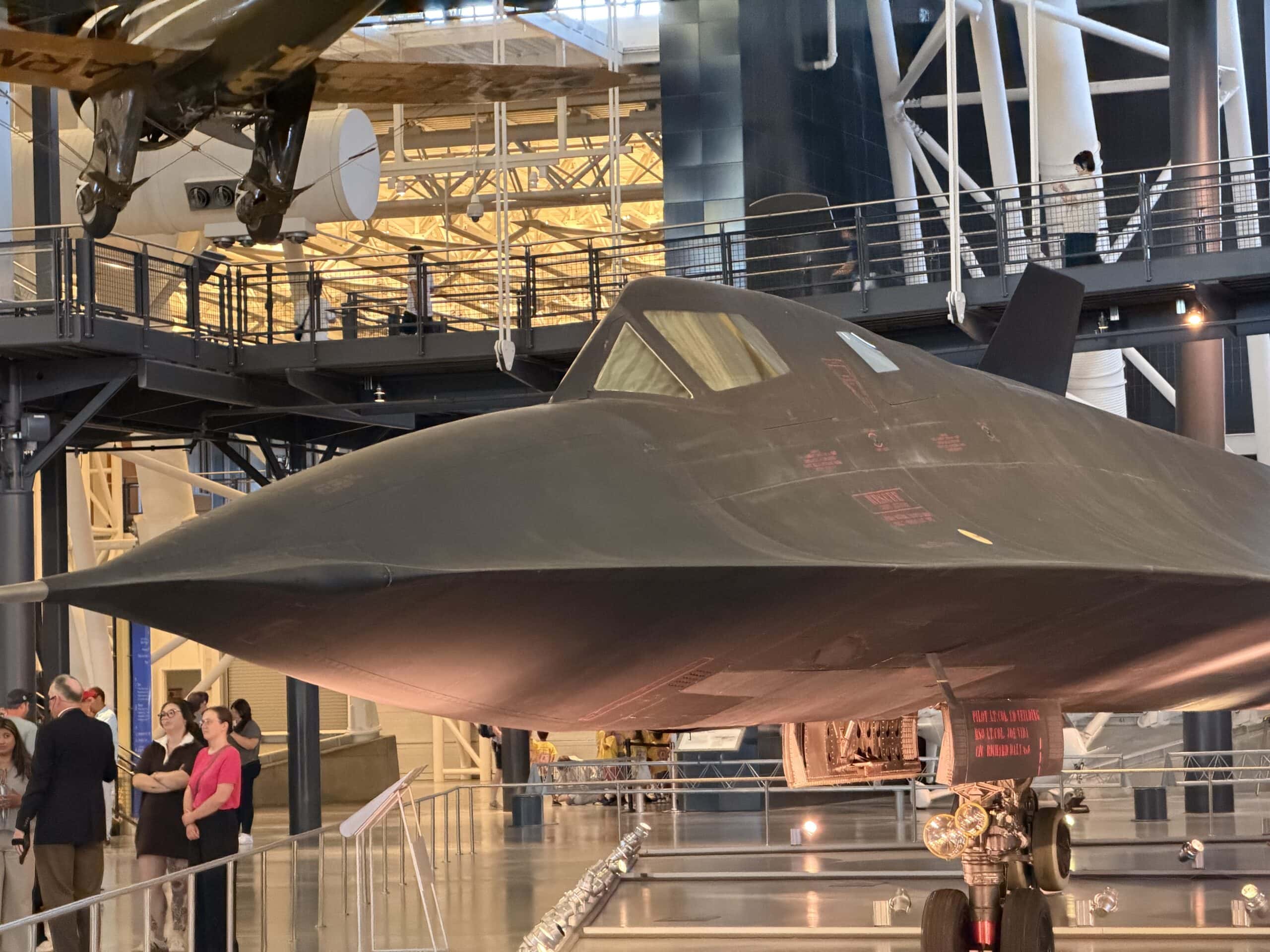
SR-71 Blackbird. Image taken at the Smithsonian on 6/30/2026 by 19FortyFive
Yeilding once recalled seeing an approaching interceptor while the Blackbird was flying at roughly 75,000 feet near the Soviet Union.
“Our altitude then was probably about 75,000ft. At that altitude, we could see the horizon 335 miles away and see the slight but noticeable curvature of the earth. The view was grand. Ahead were miles of Barents Sea and snow-covered Russia beyond. In the distance far ahead, at perhaps 100 miles, I could see a long, bright white Russian contrail flying directly toward us, but at a much lower altitude. I knew it must be a Soviet fighter, probably a MiG-31, then the newest Soviet supersonic interceptor. I raised my periscope and saw that we too were leaving a long contrail. I knew the fighter could see our contrail as easily as I could see his. Since we were flying a routine reconnaissance track that the Soviets had seen many times, I knew the fighter knew exactly where we would start our 90° right turn to parallel the coast in a westerly direction,” he wrote in a well-documented account.
A Potential Missile Attack
It presented a risk to the aircraft and crew.
The SR-71 was operating outside of Soviet territorial airspace, but the Soviet pilot could anticipate where the American aircraft was ultimately heading.
Yeilding also knew exactly what could happen if the Blackbird accidentally crossed that boundary.
“I imagined the Soviet fighter pilot was much like me, with a love of aviation and trying hard to be one of the very best. I also assumed he had orders to fire his missiles if I was late with my turn and slipped over Soviet territorial waters to within 12nm of Soviet land, and I assumed the pilot would like nothing better than an opportunity to fire his missiles at an SR-71 Blackbird. Just three years prior, on 1 September 1983, a Soviet fighter shot down a Korean Air Lines 747 that accidentally crossed into Russian airspace north of Japan, killing all 269 aboard. Certainly, the SR-71 Blackbird would be a prized target,” he said.
But the Blackbird crew believed their aircraft still had the advantage.
At such extreme altitude, an interceptor would have needed to climb aggressively while also positioning itself to launch a missile against an aircraft already traveling at around three times the speed of sound.
The MiG-31 Made A Move
It was a long shot, but the MiG-31 pilot made a move. As the SR-71 prepared to turn, Yeilding watched the Soviet fighter climbing towards them.
“Our 90° turn toward the west was programmed for 32° of bank. In the turn, I kept close watch on my instrument panel as always, ready to handle any malfunction. During my instrument crosscheck, I turned my head frequently to watch the fighter’s contrail and saw that he was in a very steep climbing turn toward us. Perhaps a minute into my turn, while turning my pressure suit helmet with my hands so that I could see behind, I saw the grey metal of the fighter, low at my left 7:30 position, at the top of his steeply climbing contrail. We were still in our right 32° banked turn, but I could see him, barely larger than a dot. I could not discern any identifying features like twin tails or distinctive shape. From my F-4 experience with intercepts and visual acuity, my best guess is that 8 miles was his closest approach. He appeared to run out of airspeed at the top of his contrail, at maybe 65,000ft or about 10,000ft below us. I saw his nose drop below the horizon and fall away. Curt and I stayed on course and got the pictures,” Yeilding said.
Back at RAF Mildenhall, a British forward operating base for the Blackbird during the Cold War, Yielding said an intelligence officer told the crew with near certainty that the aircraft was a MiG-31.
Soviet pilot Major Mikhail Myagkiy’s logbook later listed 14 successful SR-71 intercepts between August 1984 and January 1987, including an interception on October 6, 1986 — the date Yielding believed the encounter could have occurred.
That encounter was ultimately a good demonstration of what made the SR-71 so special.
Even when one of the Soviet Union’s most capable interceptors at the time got within miles of the Blackbird, the American crew simply stayed the course and completed the mission before flying home again.
About the Author: Jack Buckby
Jack Buckby is a British researcher and analyst specializing in defense and national security, based in New York. His work focuses on military capability, procurement, and strategic competition, and he produces and edits analysis for policy and defense audiences. He brings extensive editorial experience, with a career output spanning over 1,000 articles at 19FortyFive, and has previously authored books and papers on extremism and deradicalization.



![Trump Blasts Senate Democrats for Blocking Data Center Ratepayer Protections, Help Americans [WATCH]](https://www.lifezette.com/wp-content/uploads/2025/11/2025.11.10-09.59-lifezette-6911b775aae3a.jpg "Trump Blasts Senate Democrats for Blocking Data Center Ratepayer Protections, Help Americans [WATCH]")