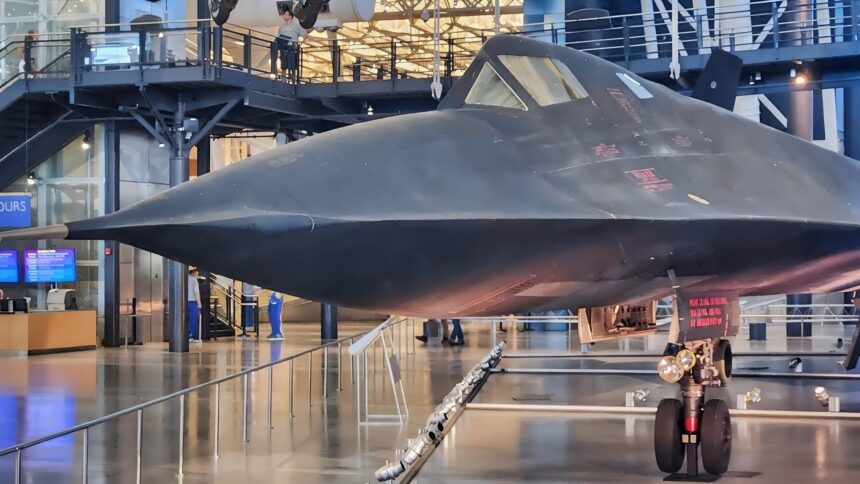

Summary and Key Points: The SR-71 Blackbird outran more than 4,000 missiles fired at it and could photograph 100,000 square miles of terrain in an hour from 80,000 feet, yet on the ground it dripped fuel like an old motorcycle. The drips were part of the design, and the story behind them explains why every mission began with a trip to a tanker. The Blackbird’s crews have stranger stories still, from a reported Mach 3.55 dash over Libya to night skies filled with more stars than anyone on the ground will ever see.
The SR-71 Blackbird Leaks
SR-71 Blackbird. Image Credit 19FortyFive.com Photo Archive/This Is An Original Photos.
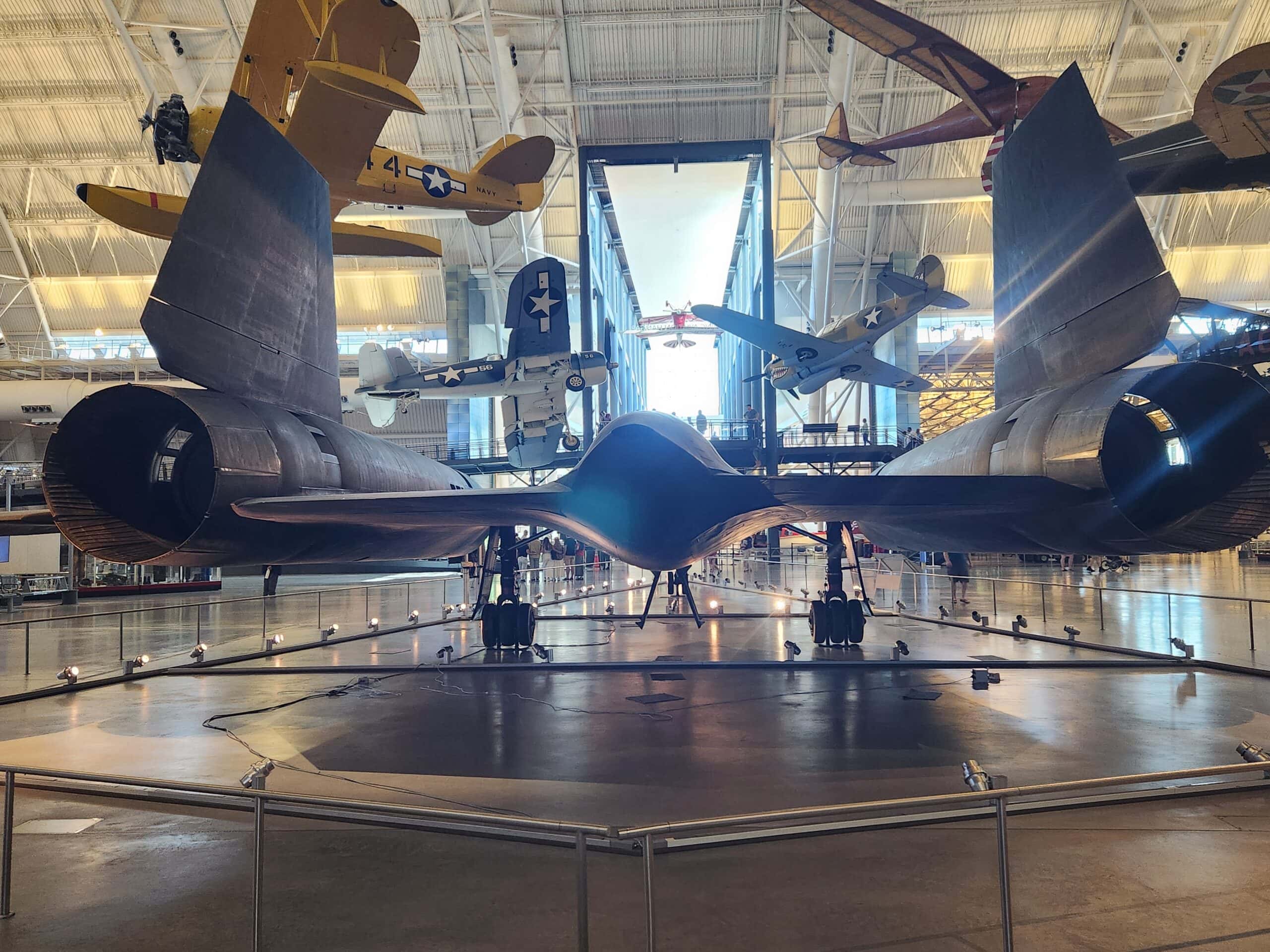
SR-71 from 19FortyFive.com original picture archive. Image taken at the Smithsonian.

SR-71 from 19FortyFive.com original picture archive. Image taken at the Smithsonian.

SR-71 from 19FortyFive.com original picture archive. Image taken at the Smithsonian.
The SR-71 Blackbird was an outstanding aircraft. It was designed and built by Clarence “Kelly” Johnson’s Lockheed “Skunk Works” in Burbank, California. It was intended to be a long-range, high-altitude, Mach 3+ strategic reconnaissance aircraft.
The Blackbird outran over 4,000 missiles; it combined revolutionary stealth, sustained Mach 3+ speed, and advanced engineering, making it virtually untouchable.
While streaking across the sky at 80,000 feet, the SR-71 could photograph 100,000 square miles of terrain in an hour.
And it was all that and much more.
The SR-71 is still the fastest known crewed, air-breathing jet to be formally put into service. The Blackbird’s top speed was officially Mach 3.2, but it has long been rumored that the aircraft could reach even higher speeds.
But a fascinating aspect of the Blackbird was that, while on the ground, the aircraft, by design, seeped JP-7 fuel all over the runway. And the SR-71 on display at the Smithsonian Air and Space Museum, still seeps JP-7.
Why Did the Blackbird Seep Fuel?
To the uninitiated, the fact that the Blackbird would seep fuel like an old Harley seeps oil would be considered an enormous red flag. But it wasn’t so; in fact, it was quite the opposite.
The Blackbird was designed to weep its specialized JP7 fuel. When developing the aircraft, engineers accounted for the temperature fluctuations it would encounter. The Skunk Works’ engineers knew that the plane’s components would heat up as the aircraft gained more speed.
So, the aircraft’s speed would cause friction, and the fuselage panels, which were fitted loosely on purpose, would then expand and seal perfectly once the aircraft reached speeds of Mach 3.
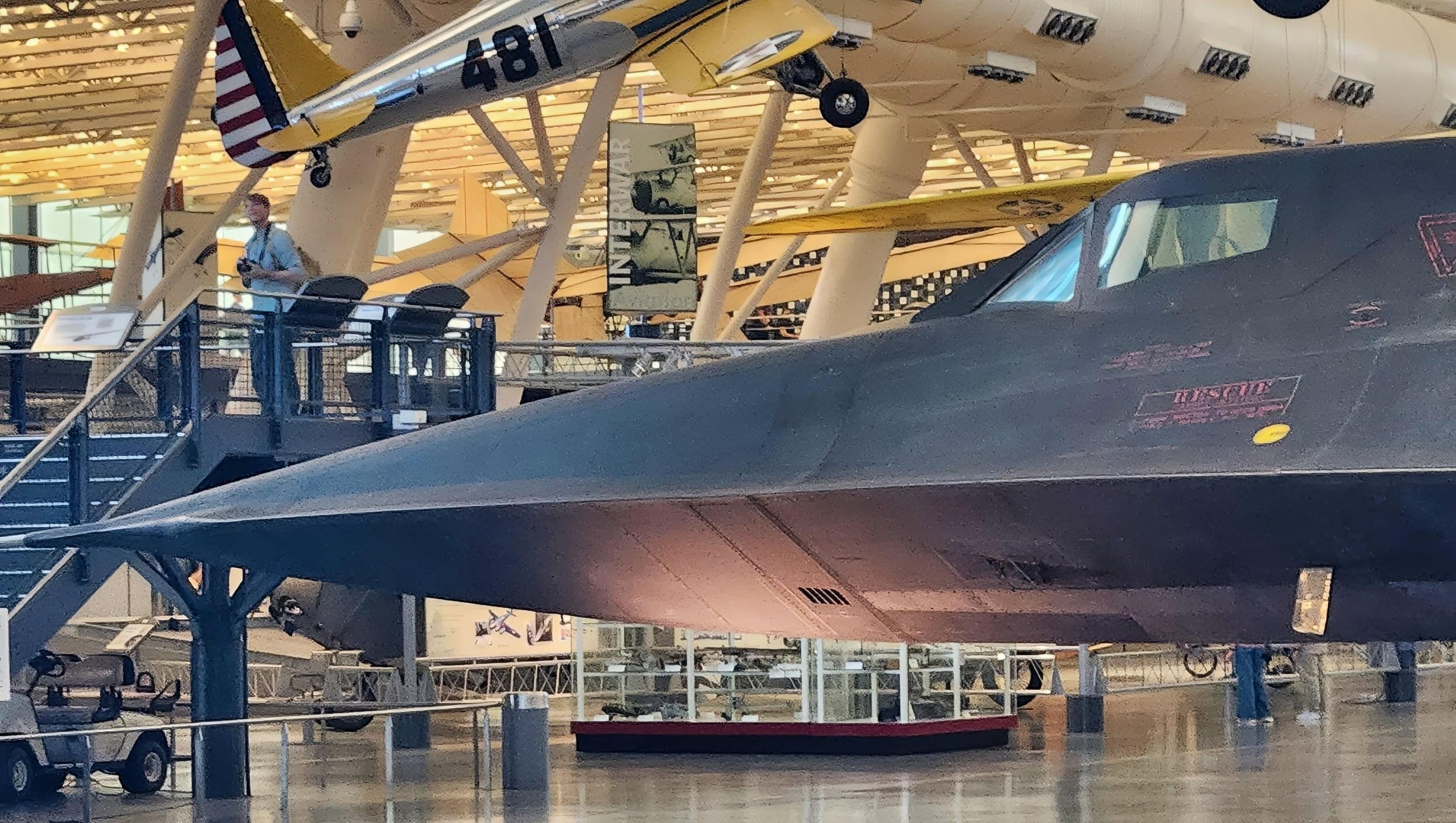
SR-71 Blackbird at Smithsonian. Image Credit: 19FortyFive.com
As Linda Sheffield Miller pointed out, “The aircraft did not have a traditional fuel bladder. JP-7 would dissolve the tank liners then available. The six main fuel tanks formed their exterior skin with room for expansion.”
The JP7 had such a high flash point that a lit lighter wouldn’t ignite it. So the puddles of JP-7 under the Blackbird were not a danger at all.
So, it took off with limited fuel on board, then rendezvoused with an aerial tanker for refueling.
Did the Fuel Leakage Cause The Aerial Refueling To Occur?
“Many people believe we refueled after takeoff because the aircraft leaked fuel so profusely that we needed to fuel up quickly,” Col. Richard H. Graham, a Blackbird pilot, said to Blackbird.com.
“We had to refuel right after takeoff for only one reason, and it wasn’t because we leaked JP-7 fuel on the ground. Yes, the plane does leak fuel, but not enough to require refueling after takeoff.
“The JP-7 fuel reaches temperatures well over 300 degrees F. during Mach 3 cruise. making the fumes in each of the six fuel tanks highly volatile and potentially explosive. The aircraft’s metal skin approaches 400°F, further increasing the volatility of the fuel in the tanks. One of our aircraft’s limitations was a maximum speed of Mach 2.6 without an inert atmosphere inside the fuel tanks.
“The aircraft had three liquid nitrogen Dewar flasks containing 260 liters of liquid nitrogen, located in the nose wheel well. The only way to ensure a 100-percent inert atmosphere in each fuel tank was to refuel the plane in flight, filling each tank completely with JP-7 and allowing the ambient air in each tank to vent overboard.
“Once full of fuel, gaseous nitrogen would now dominate each fuel tank’s empty space above as it burned off JP-7. The nitrogen gas pressurized each fuel tank to 1.5 psi above ambient pressure and inerted the space above the heated fuel to prevent autogenous ignition. This is why we refueled after takeoff.”
How Fast Could the SR-71 Blackbird Actually Go?
No official data shows a higher sustained speed under normal operations. Even decades after retirement, it has not been eclipsed by any subsequently introduced aircraft.
This makes the SR-71’s performance an ongoing benchmark point for aeronautical design, even as technology has changed dramatically in the decades since its inception.
The limitation on its speed was not due to the aircraft’s titanium frame but to a crucial safety restriction on its Pratt and Whitney J58 engines. But two Air Force crewmen took an SR-71 over Libya to an astounding Mach 3.55 (approximately 2,400 mph).
Seeing 3.5 Trillion More Stars At 80,000 Feet Than Anyone On the Ground
Flying at the edge of the stratosphere at 80,000 feet, they were above 95 percent of Earth’s atmosphere, eliminating atmospheric distortion and scattering and allowing for vastly superior celestial visibility, which their astro-inertial navigation system often utilized.
The sky appears almost black because sunlight does not scatter in the thin atmosphere, making stars visible even during the day.
“Doing the Korean DMZ out of Kadena on a moonless, clear night, we could see 3.5 trillion more stars at 80,000 feet than you can on the ground. That’s according to Palomar Mountain Observatory in California,” former SR-71 pilot David Peters said.
About the Author: Steve Balestrieri
Steve Balestrieri is a National Security Columnist. He served as a US Army Special Forces NCO and Warrant Officer. In addition to writing on defense, he covers the NFL for PatsFans.com and is a member of the Pro Football Writers of America (PFWA). His work was regularly featured in many military publications.