


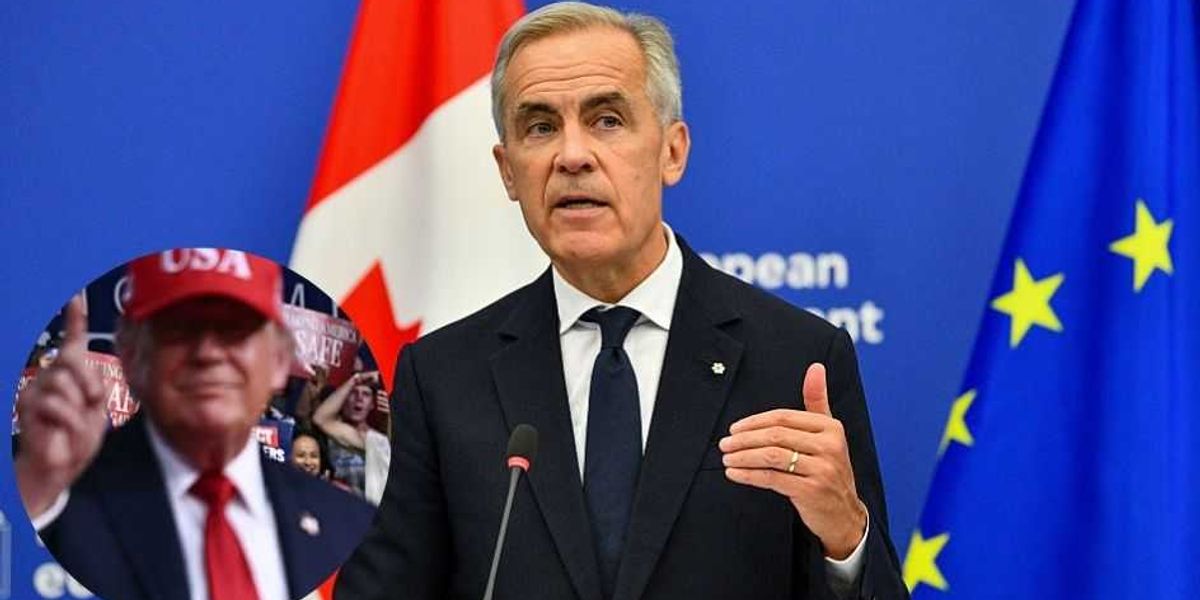

Canada isn’t joining the European Union. But Prime Minister Mark Carney has embraced an unprecedented proposal to make Canada the EU’s first “associate member” — and exactly what that means has yet to be decided.
The proposal could draw Canada much more deeply into Europe’s economic and strategic orbit, with closer cooperation on defense, energy, critical minerals, artificial intelligence, digital trade, and even opportunities for Canadians and Europeans to live and work across the Atlantic.
While that’s not an explicit call to adapt European migration policy, it seems fair to ask: How far does Carney ultimately intend that mobility to extend?
And it comes as Canada’s relationship with its overwhelmingly largest trading partner, the United States, remains strained.
Vague ‘ambition’
In a speech Thursday to the European Parliament in Strasbourg, France, Carney publicly welcomed a proposal unveiled a day earlier by European Commission President Ursula von der Leyen.
“Yesterday, President von der Leyen spoke of moving beyond CETA to an alliance for the future — opening the door to Canada becoming the European Union’s first associate member,” Carney said. “Canada welcomes this ambition.”
But “associate member” does not currently describe an established category of EU membership that Canada can simply enter. Carney acknowledged that the two sides would have to determine what the new relationship actually entails.
“An alliance for the future is a unique, positive approach that we will define together, building on our common strengths and based on our shared values,” he said.
That ambiguity raises an obvious question: What exactly would Canada be signing up for?
If “associate membership” ultimately means adopting elements of the EU’s regulatory regime without receiving the voting rights of a member state, Canada could conceivably wind up with some of the obligations of membership but little say in writing the rules.
Migrants welcome?
Immigration is another unanswered question. Carney explicitly called for deeper “people-to-people ties,” including allowing young people “to live, work, and study where they want on either side of the Atlantic.”
While that’s not an explicit call to adapt the EU’s freedom-of-movement rules or to accept European migration policy, it seems fair to ask: How far does Carney ultimately intend that mobility to extend?
The same questions apply to regulation. Would closer integration require Canada to conform to more EU rules on technology, trade, climate, or other areas? Would Canada contribute financially to European programs? Would Ottawa have any formal role in making rules it agreed to follow?
None of those questions has an answer yet. That’s precisely the problem with celebrating “associate membership” before anyone has defined what it means.
RELATED: MEME-FODDER MARK: Carney blew up the trade deal. Now Canada is the punch line.
Andrej Ivanov/Washington Post/Getty Images
Jumping the gun
Carney nevertheless offered a sweeping description of the relationship he wants.
“Canada and Europe should secure our strategic autonomy through deep cooperation in the full range of strategic capabilities, including critical minerals, defense industrial capacity, AI and compute, energy security, space, and payments,” he said.
“We should move towards seamless digital trade in non-agricultural goods and a wide range of services.”
The proposal would build on an economic relationship that already includes the Canada-European Union Comprehensive Economic and Trade Agreement, as well as Canada’s participation as the first non-European country in the EU’s Security Action for Europe defense initiative.
But there is an enormous economic reality hanging over Carney’s European ambitions: The United States remains by far Canada’s largest export market.
Europe may offer Canada opportunities to diversify. Geography and decades of economic integration, however, aren’t easily wished away.
Tempting tariffs
President Donald Trump has already warned that he could respond with tariffs if he concludes Canada’s closer relationship with the EU is directed against the United States.
When asked about possible Canadian associate membership Wednesday, Trump responded, “If I think it’s at all a hostile act, I will put very serious tariffs” on Canada.
Carney did not name Trump in the passages of his European Parliament speech dealing with Canada’s desire for greater economic independence. But he repeatedly argued that the changing international order requires Canada and Europe to become less vulnerable to pressure from more powerful countries.
“The objective is not self-sufficiency. It is collective resilience,” Carney said.
He argued that Europe offers Canada “market power,” research, advanced manufacturing, and a growing defense industry, while Canada offers Europe energy, critical minerals, and expertise in artificial intelligence, quantum computing, space, and finance.
“Where our strengths differ, they complement,” Carney said. “Where they overlap, they create scale.”
Crucial omission
Carney also invoked Canada’s historic ties with Europe and described the two as natural partners in defending democracy and the rule of law.
“We are not fair-weather allies. We do not pursue zero-sum deals,” he said. “Our commitment to the rule of law, and our unyielding defense of human dignity, individual freedom, and democracy share the same deep roots.”
At one point, Carney credited European resistance movements and European institutions with preserving the continent’s freedom.
“Freedom was won thanks to the heroism of the European resistance during the war,” he said.
That account conspicuously omitted the enormous American contribution to the liberation of Western Europe — not to mention that of Canada itself, Britain, and the other Allies — as well as the postwar American role in European security through NATO and the Marshall Plan.
Carney ultimately framed the proposed partnership as a means of insulating Canada and Europe from coercion by larger powers.
“Canada and Europe are each strong. Europe and Canada are stronger together,” he said.
The goal, he continued, is to ensure that “no one can control our open markets, impair our sovereignty, threaten our territorial integrity, or undermine our freedoms, our democracies, our rule of law.”
Carney sees Europe as Canada’s path toward greater “strategic autonomy.” His critics may wonder whether Canada is reducing its dependence on one enormous neighbor only by binding itself more closely to a distant political and regulatory bloc.
And until Carney and the EU define what “associate membership” actually means, Canadians won’t know what obligations come with the invitation — or what their country would be getting in return.
Read the full article here