

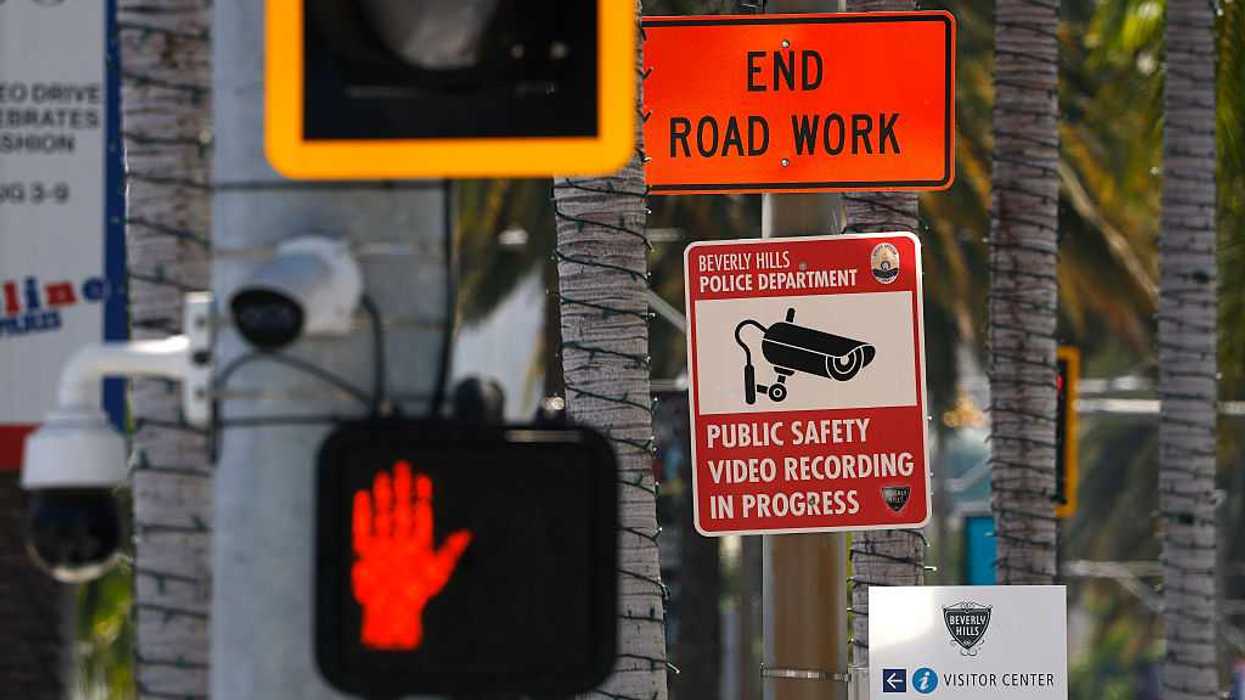
Cities and states are moving quickly in response to concerns about governments’ expanding use of public surveillance cameras, automated license plate readers, audio detection devices, and similar tools. That is healthy. The country needs a serious debate over when crime prevention becomes pervasive surveillance.
Flock Safety says its AI-assisted network includes more than 120,000 cameras in 49 states and processes some 20 billion license plates each month, along with other vehicle characteristics. Public resistance has grown just as quickly.
The debate is overdue. Voters should decide how much surveillance they are willing to tolerate before the cameras decide for them.
On Monday, the Douglas, Massachusetts, Police Department announced it was discontinuing Flock cameras and immediately deactivated its monitoring accounts, citing a “divisive atmosphere” around the technology, Boston 25 News reported.
Other communities have restricted, suspended, or removed the cameras in Arizona, Florida, Kentucky, Massachusetts, and Wisconsin. Similar fights are under way in Louisiana, Michigan, Minnesota, and New York.
Congress has joined the fight. “Flock cameras are emerging as a rare area of bipartisan agreement on Capitol Hill,” Axios reports. Rep. Tim Burchett (R-Tenn.) and two other House Republicans introduced a bill last month to bar the federal government from buying Flock cameras or similar technology.
Flock emphasizes that its customers own the data, control access, and choose whom to share it with. Those customers are governments. That places responsibility where it belongs: on public officials who deploy the systems, and ultimately on voters who elect them.
Critics are right to worry that mass license-plate collection can become a surveillance system for people who have not been accused of any crime. AI dramatically expands what authorities can infer from otherwise ordinary observations by making huge quantities of location data searchable, sortable, and easy to combine.
Promises about retention limits deserve skepticism. Americans have already seen the National Security Agency spy on the American people under programs justified in the name of national security. The problem is not that every surveillance tool will be abused. It is that centralized databases make abuse much easier when safeguards fail.
RELATED: Cities are kicking out Flock. The surveillance might be here to stay.
Scharfsinn86/Getty Images
Recent cases give the public reason to be wary. Officers or other government personnel have faced allegations or charges involving misuse of camera systems in Texas, Missouri, Wisconsin, Florida, Georgia, and Kentucky. Some cases involved thousands of searches for personal purposes. The Institute for Justice has found 170 cases involving alleged misuse of automated license plate reader data and related systems.
The legal question is not simple. In principle, a camera that records a license plate visible on a public road resembles an officer observing the same plate while walking a beat. Police plainly may watch public places. Courts have long held that people generally have less privacy in public than at home, although the Supreme Court has recognized some limits when technology allows government to reconstruct a person’s movements in extraordinary detail.
That distinction is crucial. The constitutional permission to observe something in public does not automatically justify collecting every observation, storing it, cross-referencing it, and making years of movement searchable at the touch of a button. Scale can change the character of a government power.
Nor does constitutionality settle whether a policy is wise. States and local communities are entitled to decide that the risks outweigh the benefits. Voters should force officials to say clearly what information will be collected, how long it will be kept, who may search it, and for what purpose.
RELATED: When did we agree to be watched?
 Justin Sullivan/Getty Images
My preference is stricter: Government personnel should not be able to search historical surveillance data without a warrant signed by a judge and tied to a specific suspected crime. Ideally, access would be limited to serious crimes rather than routine traffic enforcement. These systems should not become automated revenue machines.
That approach would preserve a useful investigative tool while protecting the ordinary citizen’s ability to travel public roads without creating a government dossier of his movements.
The backlash against Flock cameras is not irrational fear of technology. It is citizens recognizing that a power capable of helping police catch criminals is also capable of tracking the innocent.
That debate is overdue. Voters should decide how much surveillance they are willing to tolerate before the cameras decide for them.
Read the full article here