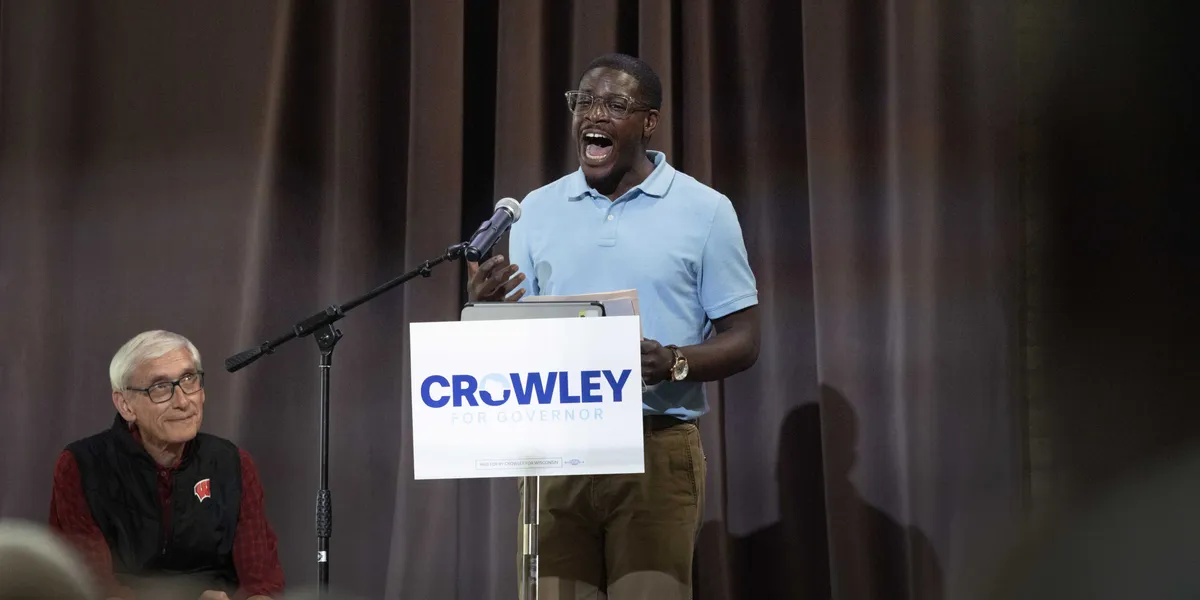

Milwaukee County Executive David Crowley upset socialist Francesca Hong in Wisconsin’s Democratic primary for governor on Tuesday.
But he’s no moderate. Crowley has pursued anti-white diversity, equity, and inclusion policies since taking office, from public parks to health care administration.
‘Apply a racial equity lens to all County decision-making.’
Crowley and every Wisconsin Assembly Democrat opposed a constitutional amendment in January banning race-based discrimination or preferential treatment by government agencies, though his dedication to DEI began much earlier.
Crowley began enlarging the county’s DEI programs shortly after his election as county executive in 2020, and he expanded the Racial Equity Ambassador team built under his predecessor during his first three months in office.
During that time, the Office on African-American Affairs “provided over 11,000 hours of racial equity training to more than 3,000 Milwaukee County employees to normalize discussions on racism, implicit bias, and microaggressions,” Crowley said in an August 2020 press release.
Crowley also deployed these ambassadors to public parks to determine if they were racist. Each park was reviewed and assigned a value in the Milwaukee County Park Equity Index, and parks’ “equity index score” helped determine “major maintenance funding allocations.”
As county executive, Crowley has publicly and consistently blamed white people for Milwaukee’s problems.
RELATED: Francesca Hong voted to protect pedophiles as assemblywoman
Daniel Boczarski/Getty Images
“People in historic positions of power have typically been straight and white and male,” Crowley said in 2020. “People fall in the river because those who hold the power don’t always have the interests of all people in mind.”
Crowley supported an ordinance requiring Milwaukee County to “identify and address policies, practices, and power structures that, whether intentionally or unintentionally, work in favor of white people and create barriers for Black, Brown, Indigenous people, and people of color,” according to the county website. Crowley was later responsible for the statute’s implementation and expansion.
The ordinance wasn’t just a declaration of Crowley’s policy priorities. It was binding on all future county executives and Milwaukee County government as a whole.
“The ordinance ensures racial equity is a top priority of Milwaukee County government and remains larger than any one government leader,” according to the Office of Equity Projects and Programs webpage.
Crowley also upheld standards designed to exclude white applicants from both hiring and promotional pathways.
“We are always mindful of considerations of diversity when promoting our staff,” Crowley’s 2020 racial equity budget review reads.
“To attract a diverse field of applicants, we have focused on reaching out to our contacts and organizations throughout the city (e.g. the Wisconsin Black Lawyers Association and the Hispanic Lawyers Association) to let them know when there is an opening.”
The county didn’t merely reach out to contacts. It spent taxpayer money selectively advertising to non-white job-seekers.
“This year we have added money to support ads on blackjobs.com (to attract professional African American job seekers) and hispanicjobs.com (to attract Hispanic, Latino, and Latinx candidates),” the review reads.
RELATED: Swing-state election official resigns amid mail-in ballot investigation
 Scott Olson/Getty Images
White employees who managed to keep their jobs were subject to race-specific condemnation. The county noted in that same review that it was “recognizing the work white people need to do to change their understanding and historic perception, to bring culture change in support of diversity and racial equity.”
Crowley and his team knew their DEI priorities weren’t making Milwaukee more prosperous. The COVID-era budget admitted that “racial equity and revenue generation by nature clash.”
Despite that admission, Milwaukee still spent millions in grants distributed according to DEI metrics.
“Our pursuit of racial equity will not be put on pause for the pandemic. It is crucial to invest in our marginalized communities now to secure a path forward and opportunity for continued economic growth long after the COVID-19 pandemic subsides,” Crowley said in a December 2020 press release after awarding $11.6 million to 1,534 businesses.
“In step with the County’s mission to address racial inequity, priority was given to businesses with a letter of support from a member of the Ethnic & Diverse Chamber Coalition, a group of chambers of commerce supporting entrepreneurs of color, women, LGBT, and veteran-owned businesses,” according to the release.
A 2021 Wisconsin Partnership Program outcome report found that 66% of grant recipients were indeed minorities, women, or veterans.
These programs are active and ongoing.
Milwaukee also launched a Racial Equity Lens Strategy team in 2021, “developing tools and processes to apply a racial equity lens to all County decision-making.”
“From advancing racial equity efforts to investing in affordable housing, mental health services, and public transit, we’ve realized great progress over the last four years in making Milwaukee County the healthiest community in Wisconsin,” Crowley said in 2024 reflection on the end of his first term.
Crowley and the Milwaukee Office of Equity did not respond to requests for comment.
Like Blaze News? Bypass the censors, sign up for our newsletters, and get stories like this direct to your inbox. Sign up here!
Read the full article here