


Liberals thinking that they may have won the congressional redistricting battle in Missouri might be headed for a major upset.
Missouri lawmakers repealed the Show-Me State’s 2022 congressional map last year and passed legislation, HB 1, enacting new congressional boundaries — effectively changing Democratic Rep. Emanuel Cleaver’s Kansas City-based district into a Republican-leaning seat.
‘Only use of the 2025 map complies with the Constitution.’
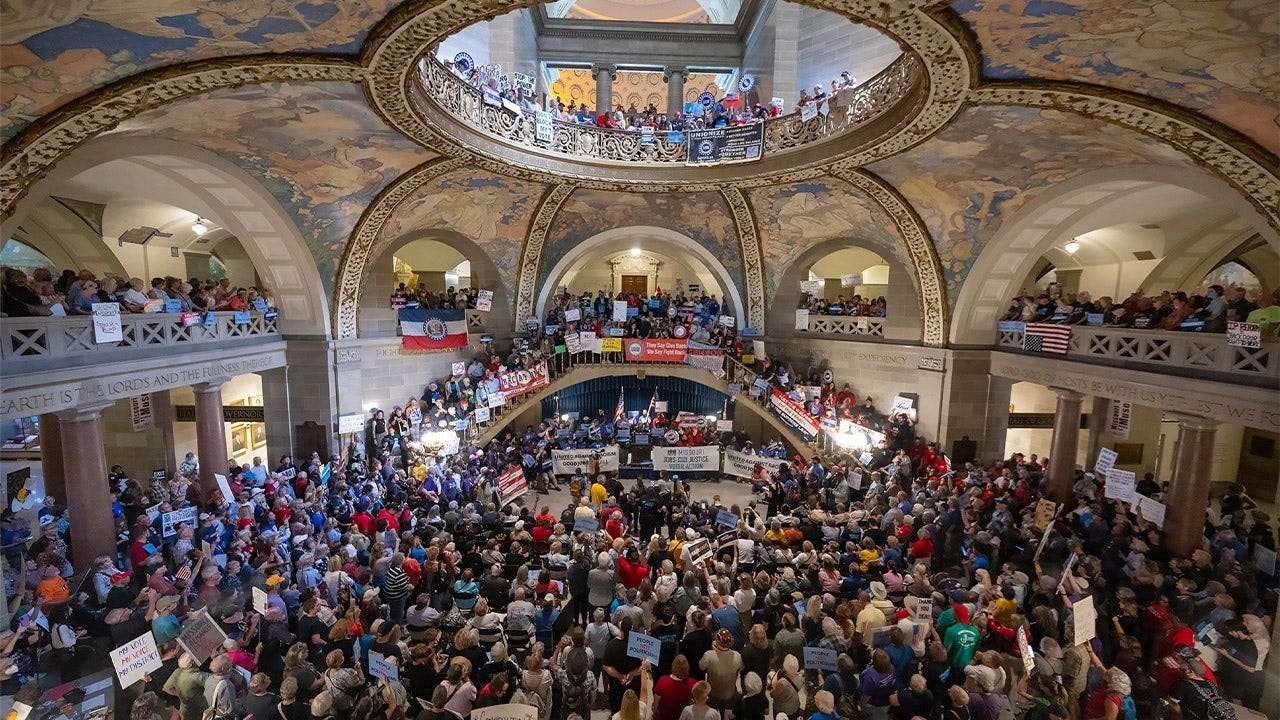
While Democrats melted down over their likely loss of an additional seat in the House, the liberal advocacy group People Not Politicians and its executive director, Richard von Glahn, organized a campaign aimed at forcing the state to hold a referendum on the bill and sued the state to prevent the 2025 map’s use in the midterm election.
The case was kicked up to the Missouri Supreme Court, which unanimously ruled on Sept. 3 that the map must be approved by voters in a November referendum before being used — despite Missouri Secretary of State Denny Hoskins previously determining that “the Missouri Constitution does not authorize a referendum on congressional redistricting plans passed by the General Assembly.”
President Donald Trump said in response to the Sept. 3 ruling, “This is a Dark Day for ‘Justice’ in Missouri!”
However, an 8th Circuit Court of Appeals panel comprising three Republican-appointed judges delivered Republicans a win on Monday, ruling that “Missouri’s current plan to use the 2022 map in the November 2026 general election violates the Constitution. Only use of the 2025 map complies with the Constitution and federal law.”
RELATED: CNN analyst pours cold water on Democrats’ dream of a political takeover in November
Tribune News Service/Getty Images
The appellate court’s ruling is in response to a lawsuit filed against the state earlier this month by Rep. Robert Onder (R), Republican congressional candidate Richard Brattin, and a pair of voters. The lawsuit argued that the use of the 2022 map in the November 2026 general election would transform their congressional districts from the August primary election, thereby violating the Elections Clause and the Equal Protection Clause.
U.S. District Judge Stephen Clark, a Trump appointee, found that the plaintiffs were likely to succeed on their claims and blocked Missouri from using any congressional map other than the 2025 map advanced by HB 1; however, the U.S. Supreme Court paused Clark’s order.
To the liberal group’s chagrin, the 8th Circuit affirmed the district court on Monday, noting in its majority opinion that “if the 2022 map is used in the November 2026 general election, some Missouri voters will have more say than others on who represents them in Congress.”
The court noted, for example, that:
more than half of the Missourians living in the Fifth Congressional District under the 2025 map used in the August 2026 primary election — 57% — will find themselves in other districts if the 2022 map is used in the November 2026 general election. … As a result, a majority of residents in the Fifth Congressional District had no voice in who will appear on their November 2026 ballot; they will be forced to choose from nominees selected by a minority of residents in the district as well as voters who are no longer in the district.
The court noted further that using the 2025 map would “lead to the least amount of confusion for voters subjected to a string of changes this month.”
The 8th Circuit has given the U.S. Supreme Court until Monday at 5 p.m. to weigh in. Absent an intervention from the high court, Secretary Hoskins and local election authorities have been directed to begin implementing the 2025 map.
Richard von Glahn said in a statement obtained by the New York Times, “Officials should stop wasting taxpayers’ money on pointless legal action and instead focus on administering our elections.”
Von Glahn noted that he will file an emergency appeal to the Supreme Court.
Like Blaze News? Bypass the censors, sign up for our newsletters, and get stories like this direct to your inbox. Sign up here!
Read the full article here



![JD Vance Accidentally Gives the Far Left a Hilariously Stinky New Name [WATCH]](https://www.lifezette.com/wp-content/uploads/2026/09/2026.09.22-11.53-lifezette-6ab26c3ea9871.png "JD Vance Accidentally Gives the Far Left a Hilariously Stinky New Name [WATCH]")