
Summary and Key Points: The US Navy began seeking a successor to the P-3 Orion in 1980, as added equipment weighed down the airframes and shortened their service lives. Its first answer, Lockheed’s P-7, a turboprop based on the P-3, ran over budget and was canceled. In 2000, the Navy tried again, and Boeing won with a radical idea: an all-new patrol aircraft built on the 737-800 airliner. The result, the P-8 Poseidon, cruises near 500 knots at up to 41,000 feet, can refuel in flight, and shares more than four-fifths of its parts with the commercial jet.
Boeing’s P-8 Poseidon Is A Warrior In the Sky
As early as 1980, the US Navy began looking ahead to the replacement aircraft that would fill the shoes of the Lockheed P-3 Orion, the premier Maritime Patrol aircraft in the world with more than 6 million flight hours in the logbooks.
Adding equipment increased the Orion’s weight, placing additional stress on the airframes and shortening their service life.
In 1989, Lockheed was given the first crack at the new aircraft, leveraging its long history with the P-3, under a fixed-price contract for what would become the P-7. It would be based on the P-3, still with turboprop engines.
It should have worked; Lockheed had more than 60 years of experience with this type of aircraft for the Navy, but it didn’t.
The Navy was looking for a more cost-effective replacement for the P-3, but the aircraft Lockheed proposed was over budget, and what the Navy wanted in terms of equipment, powerplants, and capabilities simply would not work in their P-7 turboprop version.
Ultimately, the contract was canceled, and the Navy kept the workhorse P-3 in service.
In 2000, the Navy opened a new contract for bid.
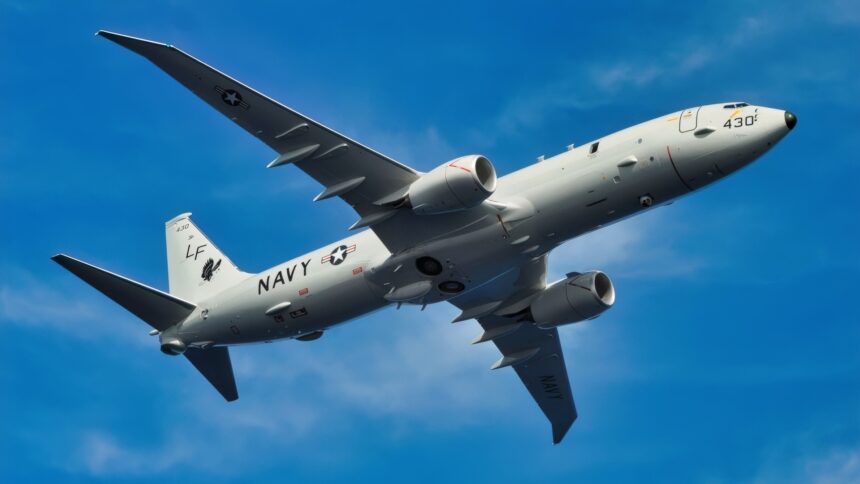
PHILIPPINE SEA (Oct. 1, 2019) Lt. Levi Ellis, left and Lt. Bradley Woods pilot a P-8A Poseidon assigned to Patrol Squadron (VP) 47 as part of a sinking exercise (SINKEX) during Exercise Pacific Griffin 2019. Pacific Griffin is a biennial exercise conducted in the waters near Guam aimed at enhancing combined proficiency at sea while strengthening relationships between the U.S. and Republic of Singapore navies. (U.S. Navy photo by Mass Communication Specialist 1st Class Nathan Carpenter/Released)
Lockheed proposed an updated P-3 they were now calling the Orion 21, but Boeing offered a radical departure: an all-new aircraft based on the 737-800 passenger airliner.
Over Land And Sea, Eyes in the Sky
The promise of an airliner platform for the Navy’s new Maritime Patrol Aircraft was game-changing.
Boeing’s P-8 could cruise at 41,000ft at almost 500 kts.
With a combat radius of 1,200 nm, once there it could be refueled in flight and remain on station almost indefinitely.
Its sheer size meant greatly expanded capabilities beyond the expected anti-submarine warfare and anti-surface warfare roles.
The P-8 was built to be capable of Integrated ISR (Intelligence, Surveillance, and Reconnaissance).
The new P-8 could act as a battlefield command-and-control platform, coordinating and sharing its sensor data with air, ground, and sea forces to acquire and engage targets even beyond the range of its own weapons.
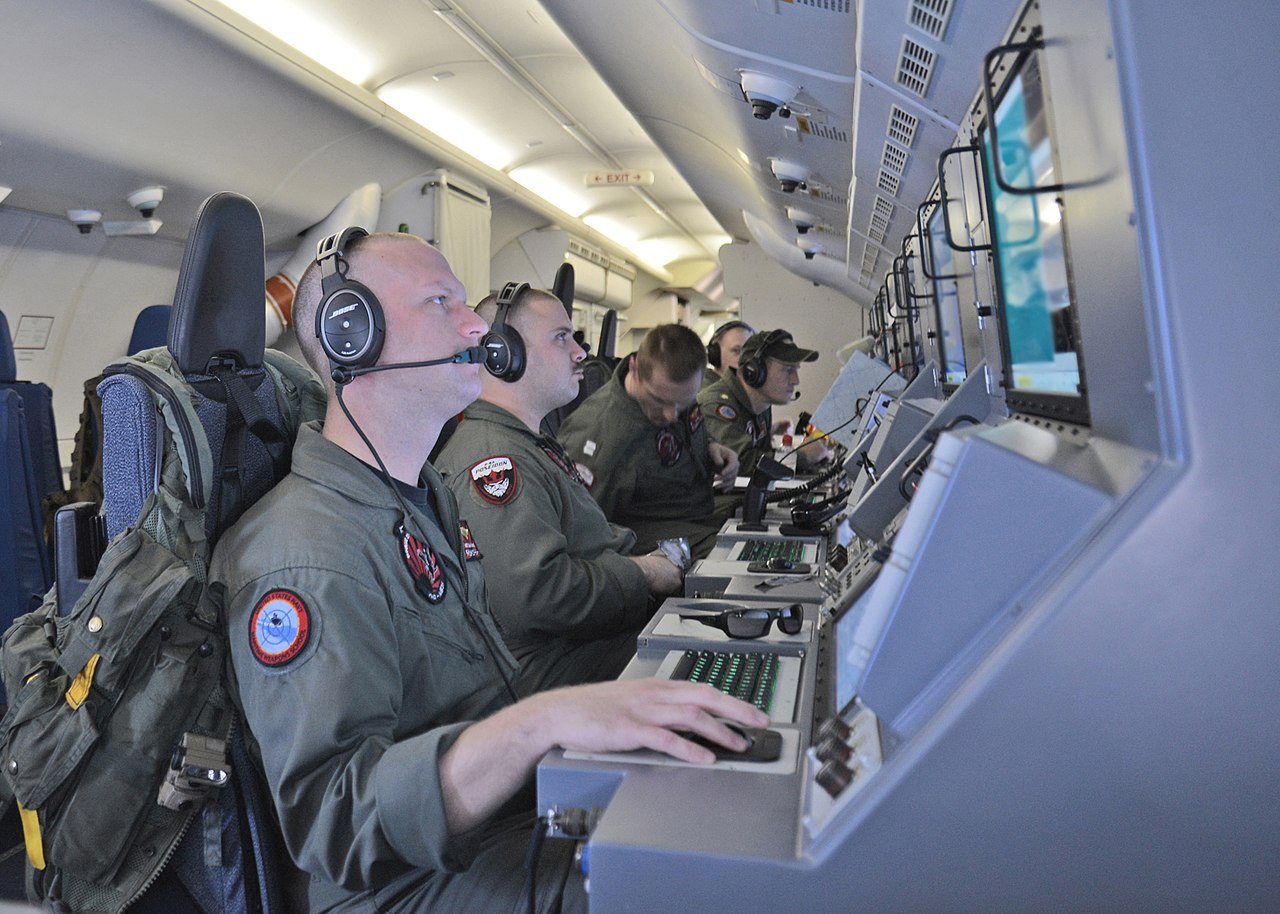
(March 16, 2014) Crew members on board a P-8A Poseidon assigned to Patrol Squadron (VP) 16 man their workstations while assisting in search and rescue operations for Malaysia Airlines flight MH370. VP-16 is deployed in the U.S. 7th Fleet area of responsibility supporting security and stability in the Indo-Asia-Pacific. (U.S. Navy photo by Mass Communication Specialist 2nd Class Eric A. Pastor/Released.
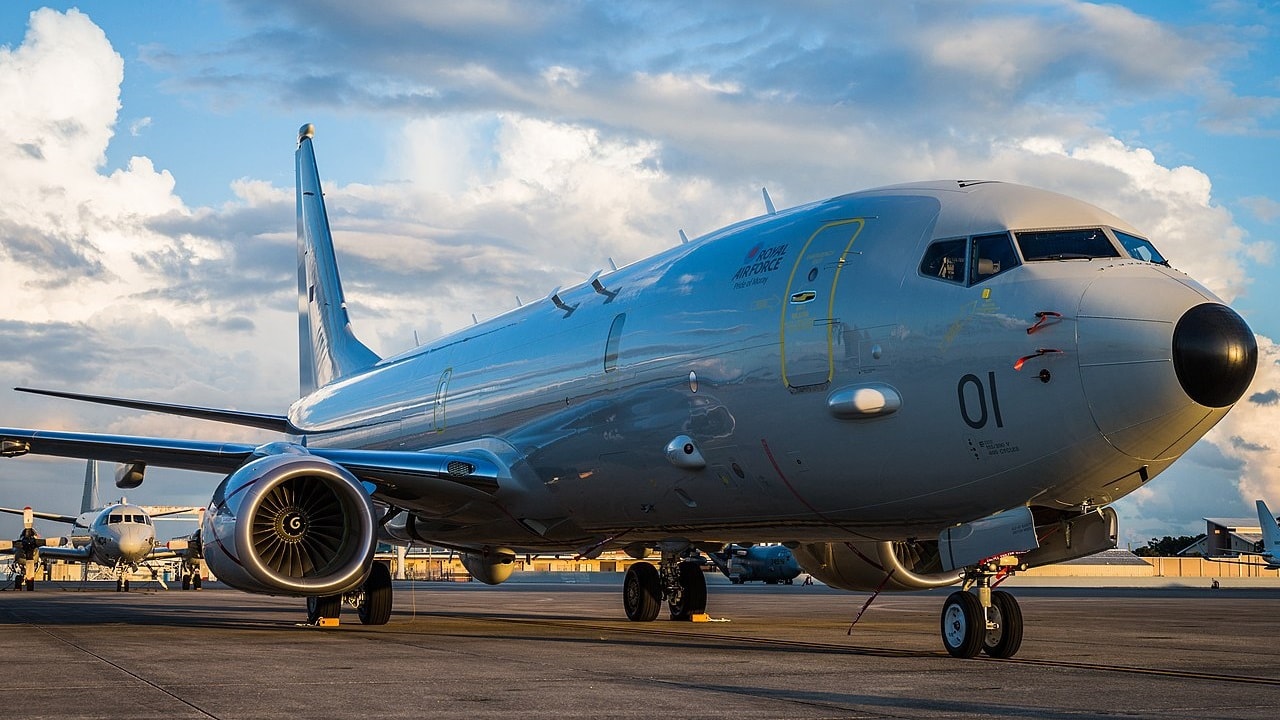
P-8 Poseidon. Image Credit: Royal Navy.
Its custom-built AN/APY-10 Radar system has synthetic aperture radar (SAR) and inverse synthetic aperture radar (ISAR) modes. In practical terms, this allows the P-8 to see video-quality images of the ground through rain, clouds, and fog.
If a submarine surfaces at night to look around, the Poseidon’s radar can detect the periscope and the wake it leaves behind, while the P-8 is at 30,000.
This radar works equally well over land, enabling the Poseidon to serve as a battle space command aircraft. Its secure data-link communications system allows it to instantly broadcast what it sees from the sky to other units and command in real time. It can also transmit its targeting data back to ships and even ground units, allowing them to employ ordnance on targets themselves.
A certain number of P-8s (the number is classified) are fitted with the AN/APS-154 Advanced Airborne Sensor(AAS).
This is an electronically scanned array system. At least sixteen P-8s are equipped with this system so far.
The AAS has a pod mounted beneath the lower front fuselage that deploys as needed.
It combines a high-resolution camera, which can overlay the radar image, enabling pretty amazing capabilities, such as “see” the wake left behind by a submarine while it is underwater.
This system also offers a lock-and-track capability on moving ground targets. This feed can be transmitted to other units in real time for their review or to guide weapons toward that moving target, all while the P-8 remains undetected many miles away, cruising at high altitude.
The latest Increment 3, Block 2 upgrade to the P–8 features some considerable improvements in an aircraft build with upgrades in mind.
Pings And Returns That Give You Away
New Multistatic Active Sonobuoys have been added.
One buoy is actively pinging while two or more are dropped to receive the echo of those pings.
These returns to the listening buoys create a very accurate location picture of the submerged submarine’s speed, depth, and course.
This dramatically reduces the time it takes to position the P-8 to drop a torpedo in front of the submarine, assuring that whether the target tries to dive or turn to evade, it still “eats the fish” in its forward torpedo room, where you really don’t want a torpedo to hit you if you’re a submarine.
Mk54: The Flying Torpedo
Previous versions of the P-8 had to release their weapons at only a few thousand feet. This created a window of vulnerability for a submarine to perhaps detect the P-8 and launch a surface-to-air missile at it.
The Block 2 will now be able to drop a Mk 54 torpedo from high altitude. The torpedo then extends its wings to maneuver toward the target, where it finally deploys its parachute to enter the water and speeds toward the submarine at over 40 kts.
The All Sensors View
The Block 2 will be able to combine and process information from its radar, electronic surveillance, Electro-Optical Infrared, and sonobuoy data into a combined sensor track plot that can be shared with other Poseidons, ships, and command units with minimal delay.
This allows multiple sets of eyes to review the data while the target is being prosecuted, helping ensure it’s the right target to hit and not one of our own submarines.
Yes, We Have That Part in Stock.
Since the new P-8 is based on the 737-800 airliner, 84% of its parts are common to both the military and commercial versions.
This economy of scale would result in significant savings on parts and maintenance over the aircraft’s expected 25-year lifespan.
As new and improved parts became available for the airliner version, they would also be migrated to the P-8.
Later improvements in engine designs would also be able to migrate, along with the aircraft’s ability to send secure telemetry data on engine performance back to their squadron maintenance department and Boeing in real time. It’s pretty handy for the guys in the hangar to know what might need fixing on an aircraft before it even gets back from its mission, so they can shorten turnaround times for its next mission.
The P-8 Poseidon had very big shoes to fill, replacing the venerable P-3 Orion, which had a 60-year service record. So far, the evolution of the P-8 shows it’s able to incorporate new sensor and weapons technology, which may give it a similar lifespan.
Specifications
General characteristics:
Crew: Flight: two; Mission: seven
Capacity: 19,800 lb (9,000 kg)
Length: 129 ft 5 in (39.47 m)
Wingspan: 123 ft 6 in (37.64 m)
Height: 42 ft 1 in (12.83 m)
Empty weight: 138,300 lb (62,730 kg)
Max takeoff weight: 189,200 lb (85,820 kg)
Powerplant: 2 x CFM56-7B27A turbofans, 27,300 lbf (121 kN) thrust each
Maximum speed: 564 mph (907 km/h, 490 kn)
Cruise speed: 509 mph (815 km/h, 440 kn)
Combat range: 1,381 mi (2,222 km, 1,200 nmi) ; 4 hours on station
Ferry range: 5,200 mi (8,300 km, 4,500 nmi)
Service ceiling: 41,000 ft (12,496 m)
Armament:
11 hardpoints (internal bay with 5 hardpoints / 6 external hardpoints)
for a variety of weapons:
About The Author: Sean Spoonts
Sean Spoonts is the former Editor-In-Chief of SOFREP.com. He is a military analyst, writer, and commentator whose work has appeared in Newsweek, CNS News, Ukrinform, and various military/veteran media networks and professional publications, including the Military Intelligence Professional Bulletin. He is a U.S. Navy veteran, having served as an Aviation Anti-Submarine Warfare Operator and Search and Rescue Helicopter Aircrewman.


![Trump’s Combative Style Puts the Next Generation of MAGA Leaders to the Test: Victor Davis Hanson [WATCH]](https://www.rvmnews.com/wp-content/uploads/2026/09/2026.09.28-11.33-rvmnews-6aba508307048.jpg "Trump’s Combative Style Puts the Next Generation of MAGA Leaders to the Test: Victor Davis Hanson [WATCH]")
![John Fetterman Predicts Internet Hysterics After His ‘Republican Party’ Slip [WATCH]](https://www.rvmnews.com/wp-content/uploads/2026/09/2026.09.28-07.40-rvmnews-6aba19d9b2600.jpg "John Fetterman Predicts Internet Hysterics After His ‘Republican Party’ Slip [WATCH]")