

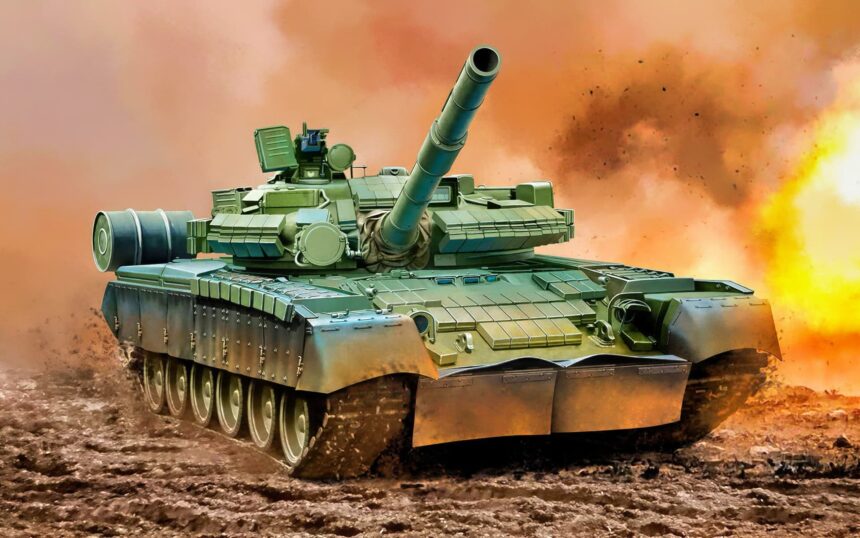

The T-80 has always been regarded as the black sheep of Soviet tanks. Originally hailed as the most advanced Soviet-era tank, the T-80’s reputation deteriorated sharply after the Cold War ended because of its higher operating costs and poor performance in the First Chechen War. However, in the 1990s, the design bureau at Omsktrasmash (KBTM) unveiled an unusual T-80 variant designated Object 640.
This new tank sported an entirely redesigned turret and a sleek black coat of paint.
T-80 Tank. Image Credit: Creative Commons.
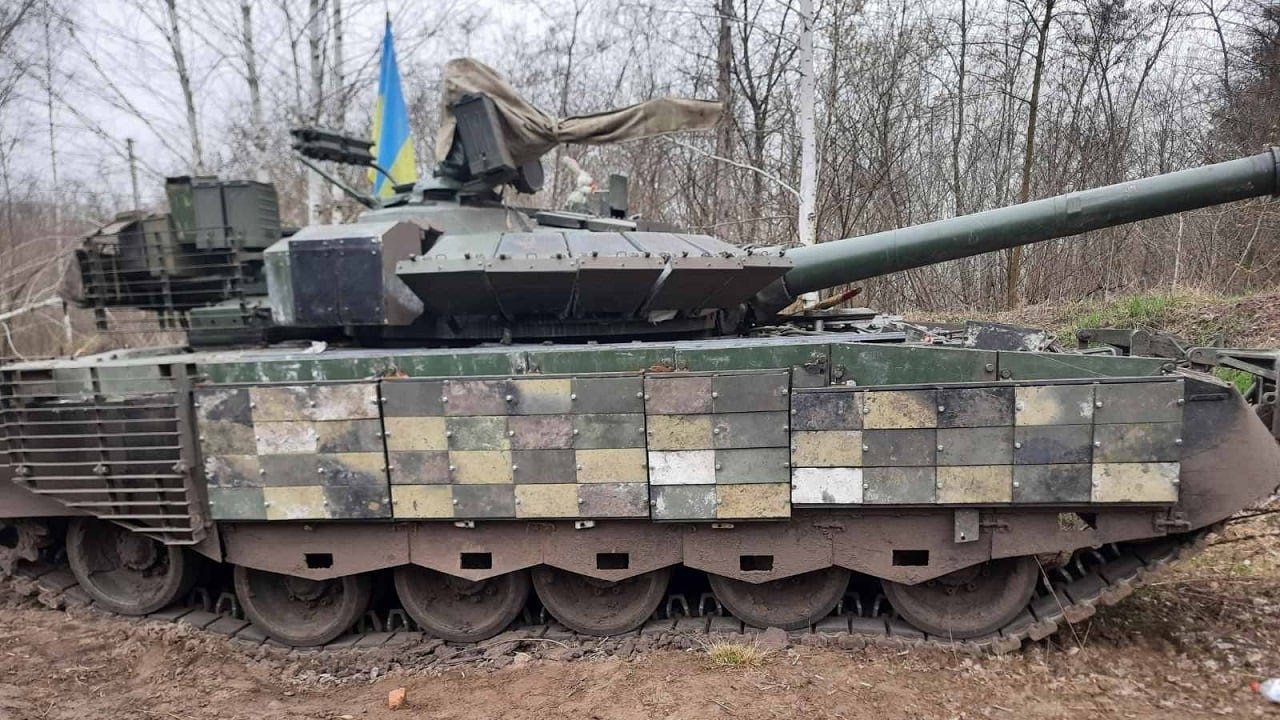
T-80BVM ‘Bunny’ Tank
The developers named the tank the “Black Eagle” thanks to its dark coloration. Although the design had potential, the project was ultimately canceled after it failed to attract any customers.
Trouble at Omsktransmash
To understand the Black Eagle, it helps to understand the politics surrounding Russia’s tank manufacturers at the time.
Before the end of the Cold War, three primary tank design bureaus existed: the Morozov Design Bureau (KMDB) in Kharkiv, the Kartsev-Venediktov Design Bureau (OKB-520) in Nizhny Tagil, and KBTM in Omsk.
When the USSR collapsed, KMDB transferred to the newly independent Ukraine, leaving only OKB-520 (part of Uralvagonzavod, UVZ) and KBTM (part of Omsktransmash).
KBTM primarily manufactured the T-80, while UVZ primarily manufactured the T-72. Naturally, the two shared an intense rivalry as they battled for funds.
Not long after the USSR collapsed, Omsktransmash faced bankruptcy.
Tank orders from the Russian Army had come to a screeching halt, while the company’s attempts to attract international customers proved unsuccessful.
Things only worsened after the First Chechen War and the T-80’s poor performance.
During the war, poor training of Russian conscripts combined with poor tactics from high command led to high casualty rates among Russia’s tank forces.
These issues were blamed on the T-80, which was criticized (often unfairly) for its poor design.
UVZ used the Chechen wars to market its new design, the T-90 (originally intended as a modernization package for the T-72).
With the company on the verge of bankruptcy and interest in the T-80 waning, the designers at KBTM put their heads together in a last-ditch effort to gain some customers.
The Black Eagle: KBTM’s Swan Song
The design for Object 640 actually originated at the Leningrad-Kirov Plant (LKZ) in the 1980s.
However, when LKZ went under, KBTM in Omsk received ownership of the tank documents.
In terms of design, the Black Eagle incorporates several innovative features that set it apart from other Soviet/Russian designs.
The tank is based on a lengthened T-80U hull, but features a completely redesigned turret.
The new turret has an exceptionally low profile and incorporates next-generation Kaktus explosive reactive armor (ERA).
The Black Eagle abandons the traditional Soviet carousel-style autoloader in favor of a bustle autoloader in the turret rear, with blowout panels in case of ammo cook-offs.
The turret is not unmanned, but the crew is completely isolated from any ammo and fuel, which, in theory, would have increased crew survivability exponentially.
The Black Eagle prototype was powered by a GTD-1250 gas turbine engine, the same one used by the T-80U, but KBTM had plans to equip the tank with a more powerful GTD-1400 turbine, which offered 1400 horsepower.
The tank retained the traditional 2A46M4 125mm smoothbore gun, although some sources claim plans to implement a 152mm gun.
The hull front and sides were fitted with Kontakt-5 ERA, and the turret reportedly carried launchers for the Arena Active Protection System (some sources claim Drozd-2).
Plans also included a remote-controlled 12.7mm machine gun on the turret roof for the production variant, but they were never realized.
The tank was also reportedly equipped with advanced fire-control systems (FCS) for better accuracy, and the gunner had thermal imagers, allowing day-and-night operations.
A Neat Concept That No One Wanted
From 1997 to 1999, Omsktransmash desperately marketed the tank, hoping to attract customers.
The Black Eagle made its first appearance at the VTTV arms exposition in Omsk and later at an arms exposition in Siberia.
The tank ran several obstacle courses and was shown off for photo ops.
The hope was to drum up support for the tank and secure a few orders, if not from the Russian MoD, then from some foreign customer.
Unfortunately, no such orders materialized.
The Russian Army was not interested in the Black Eagle or any variant of the T-80, for that matter.
The T-80 took so much blame in Chechnya that the Russian MoD halted procurement of any new tanks with gas-turbine engines.
This decision was the death knell for the Black Eagle and for Omsktransmash as a company.
In 2002, Omsktransmash filed for bankruptcy, after which UVZ absorbed it in 2004.
The T-80 remained unpopular with the Russian MoD for years, until 2017, when it introduced the T-80BVM, a heavily modernized version of the tank.
The Black Eagle was officially canceled in 2009, along with UVZ’s Object 195, in favor of a new tank under the designation “Armata,” which, of course, refers to the T-14.
Some say the T-14 incorporates elements of the Black Eagle, but that is probably untrue.
Object 640 and the T-14 share almost nothing in common, either physically or conceptually.
The Black Eagle was a one-of-a-kind tank that was, in many ways, superior to the T-80BVM that succeeded it.
Some elements of Object 640 appear on the “Burlak” combat module, which features a similar shape and bustle autoloader.
However, it is unclear whether the Russian Army is interested in the T-80 Burlak.
About the Author: Isaac Seitz
Isaac Seitz, a Defense Columnist, graduated from Patrick Henry College’s Strategic Intelligence and National Security program. He has also studied Russian at Middlebury Language Schools and has worked as an intelligence Analyst in the private sector.

![Vought Makes the Economic Case Against Illegal Aliens [WATCH]](https://www.rvmnews.com/wp-content/uploads/2024/06/2024.06.02-03.16-rvmnews-665c8ce10e49a.jpg "Vought Makes the Economic Case Against Illegal Aliens [WATCH]")