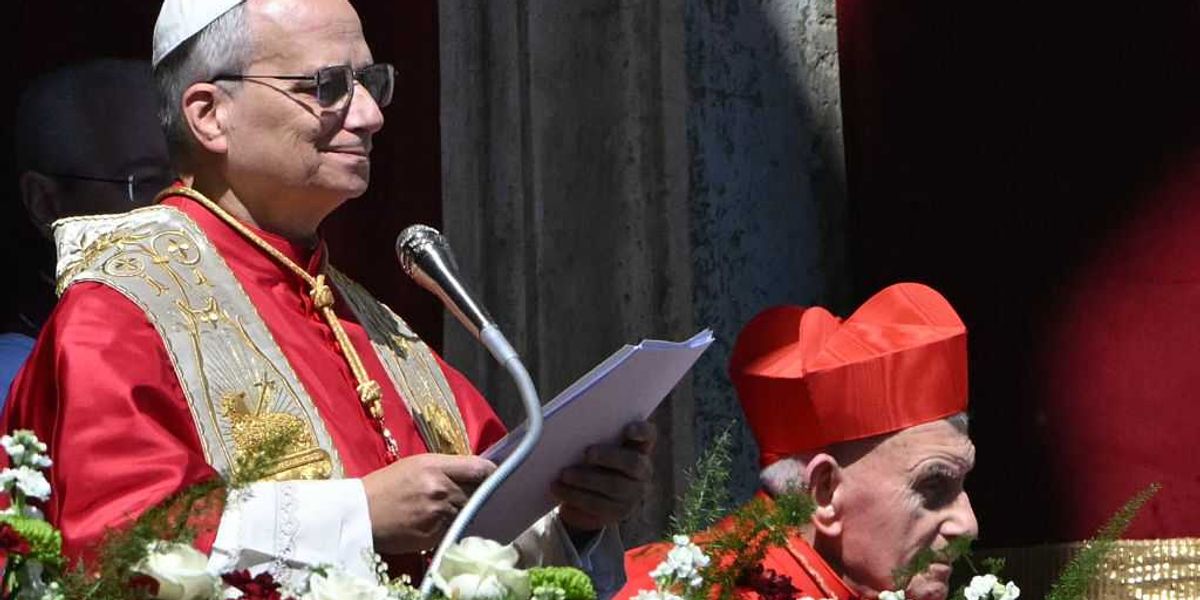

Poping ain’t easy. After the turbulence of the Benedict and Francis papacies, during which the Vatican largely wrestled with internal challenges, the unique and contested authority of the bishop of Rome finds all of Christianity at an uncanny crossroads.
Just since Leo’s ascension, AI has developed to a point that — for many millions of people worldwide — intuitively underscores the failure of modernity’s greatest power structures to justify humanity’s continued existence and our continued individual existence as human beings. Science, economics, ideology, art, philosophy, ethics — none of these grand pillars of modern life can any longer give a defense of humanity adequate to bring silence and stillness, or even a “strategic pause,” to the juggernaut.
Already, of course, there are instant criticisms.
Desperate for something to cling to in the storm, many find themselves thirsting for exactly what modernity seemed to tell them to abandon: a guiding spiritual authority over their personal and social lives, one they are sure they can trust as a matter of life and death. With so many of the cults and sects born in the modern age fizzling out or mid-collapse, the obvious place to turn is the nemesis of the self-determining modern person: so-called “organized religion,” which for most in the West, especially America, still means the Christian church.
The depth of cognitive discomfort and embarrassment required of so many to return to the one place they had been convinced most to walk away from is so intense that the pressure on would-be spiritual authorities is reaching historic proportions. How to speak in a way neither too harsh nor too gentle? How to communicate effectively in an era of communication overload and parasocial relationships at scale? How to take needful risks of rhetoric and persuasion without provoking a devastating backlash, without being totally misunderstood, without becoming just another huckster cleverly hooking people with yet another sensationalistic, over-optimistic or over-pessimistic scenario?
Pope Leo, among many others of lesser public exposure, confronts all these questions and more. And in one document (so far), “Magnifica Humanitas,” he is expected to somehow answer them all or at least point the way to an answer as grand and comprehensive as the cyber ultimatum — justify yourself or say goodbye — being thrown down at the trembling feet of the human race.
Great expectations
This is obviously way too much weight to be piled atop one letter from one person — even this 50-page letter (an encyclical, addressed to the bishops of the Church in communion with Rome) and this person, the first American pope and the first with a degree in mathematics. It could have been guessed that Leo himself is cognizant of the good and not-so-good reasons for these towering expectations, and in this respect his much-hyped encyclical does not disappoint. It is a masterful exercise in managing constraints to preserve freedom of movement for a few carefully chosen steps. Leo had to show that his approach to the question of technology flowed with not only his predecessors but the Church as a whole, reaching back to its ancient origins. He had to speak in terms Christians generically could at least understand and find in the text some basis for sympathy and respect. He had to affirm his office’s claim to spiritual authority, and the Catholic Church’s and its tradition, without much further alienating any significant audiences, but while paying special homage to the constituencies he believes are key to mounting a successful bid for spiritual authority of any kind over AI-age technology. And he had to extend an olive branch of sorts to at least some of the most powerful of the AI technologists — a treacherously political task, given the increasingly naked opposition he faces from the Thiel/Palantir wing of tech and the increasingly naked worshipfulness toward AIs shown by tech’s effective altruist wing.
All this he managed to do, focusing his remarks on the core Christian understanding that humanity is alone the image of God on Earth, made capable by Christ of attaining to the very heights of sacredness intended for us by the Father. This purpose, this being, however deeply marred by the Fall, preserves for us individually and together a magnificent grandeur that nothing made by our own mortal hands can possibly surpass. Only by using our tools to degrade ourselves to radical new lows can those tools establish over us an overawing mastery that appears in our disfigured and diminished state to be godlike — to be, in fact, the real deity, the only deity.
RELATED: AI ‘doomers’ suffer from their own weird god delusion
ArtMarie/Getty Images
To avoid this fate worse than death, Leo brings the reader to the Catholic social teaching tradition. In sum, that teaching describes our inalienable sacredness in terms of a universal and particular human dignity that must be protected and cultivated among all, even and especially the most wretched, through the affirmative protection of full access to life’s ancient fundaments (work, rest, shelter, movement, family, etc.) and newer social staples (intellectual property, software, hardware, etc.). Rather than a set of principles, Leo shows the teaching as an embodied and active social practice, one that harbors and manifests the human grandeur bestowed by God as a common good that we, and the Church, are duty-bound to sow into.
Lovers and haters
Already, of course, there are instant criticisms. The feed has begun to fill up with many clever and incisive critical commentaries of “Magnifica Humanitas.” It is asserted that Leo’s cozying up to Anthropic is both cynical and naive. It is claimed that the pope spends so much time on social organization that he fails to dig into the fundamental questions about how a person is supposed to locate his own personal significance or identity apart from the community or the cyber collective. Some accuse Leo of simping for the political left by defending illegal “migration.” Others take issue with his insistence on a clear phenomenological and ontological distinction between the capabilities of humans and the capabilities of AIs. The list goes on and on.
Above and beyond all these objections, however, it would simply be absurd to think that any pope, making a respectable go at fulfilling even only his “first among equals” role ascribed before the schism to the bishop of Rome, would not issue a theological and anthropological “effort post” on the present technological situation that looks more or less like “Magnifica Humanitas.” While Leo’s repeated emphasis on the conciliar and synodal character of the Church could uncharitably be seen as mere theological window dressing for socialist-style social justice, Orthodox and high-church Protestant Christians, to take a few examples, could see at a higher level a papal recommitment to an embodied experience and understanding of spiritual authority that is both well grounded and well distributed, not concentrated at a single earthly point from which every drop of trustworthy guiding must radiate down.
Yet it is true that Leo chose his emphases for reasons not all Christians or Americans would prefer to privilege most, and in the spirit of developing some of the more useful themes left outside the encyclical, I would venture — as someone who covered all these issues over five years ago, complete with passages heavily citing the same Romano Guardini quoted in “Magnifica Humanitas,” in my book “Human Forever” — a few additional reflections.
Frontier observations
Firstly, Leo makes much use of a contrast between two forms of building — that of the Tower of Babel, which seeks to consummate human pride by tooling a total, united identity, and that of the walls of Jerusalem, which were patiently reassembled under the repentant leadership of Nehemiah. Some people, especially exceptional ones, will always seek to build for the whole of humanity by building at scale for a whole-of-humanity use case, and indeed this is not the only or the crucial modality. At the same time, the metaphor of rebuilding Jerusalem suggests a unity of the city of God and the city of man that many will experience as unattainable even on a more patient timeline. Historically, Christians in this position have ventured to society’s frontiers, “empty” spaces where the barest habitations can be prepared to protect and nourish the cleansing of the personal heart and the prayer for the salvation of the human race. And, historically, these habitations, which grew into monasteries, not infrequently became the seeds of villages and townships — the city of God the germ of the city of man. Ours is a moment perfect for the building of monasteries, into which many who feel incapable of living in the world will flow if they are not enclosed in a system of “assisted suicide” at scale.
Secondly, work, value, and society — these relational things at the center of Leo’s presentation of human worth — take on still higher stakes when energy, memory, and money increasingly converge, as they are now clearly doing. Obviously a tool that asserts a monopoly on the choice of tools — where “everything’s computer,” as Trump says, and AI is “the only thing we have,” as Thiel says — is not neutral. More interestingly, however, what choice of tools do we have to cultivate and sustain a socioeconomic life richly rooted in the full complement of salutary architectures? Today, any worthwhile answer to this question has to begin with Bitcoin — where the unity of energy, memory, and money is manifested in a tool that isn’t AI and that just about anyone can start using right now to enable friends, family, parishioners, and even monks to build and strengthen one another without relying on top-down, centralized control. Indeed, if Bitcoin is not used in this way, it is easy to see how it will be seized upon to undergird even stronger and more sweeping forms of top-down control.
Thirdly, Leo recognizes the limitations of any papal encyclical to address these matters. How to know who to trust in seeking and receiving authoritative spiritual wisdom is a matter increasingly hard to settle from a primarily or mainly intellectual approach, such as considering the persuasiveness of a person’s presentational management of concepts, terms, and ideas. So does the risk of hinging humanity’s prospects on intellectual persuasiveness become acute, driving the seeking and the receiving deeper into the direct experience over time of face-to-face relationships with persons not legible from the increasingly disembodied “aerospace” of the field of intellectual presentation. Subsidiarity as a “principle” precipitates ultimately into relational and personal practices — beginning with their grounding not just on bottom-up practices of fraternity, but, even more fundamentally, on the rock of one’s own personal and interior humbled attention toward the moment-to-moment effort at cleaning out the chamber of the heart enough to receive the Holy Spirit.
Finally, while harmony between us and our own tools is not a pipe dream, it is a difficult matter of balance and degree tested by the deepest honesty about what rationales lurk in the hidden recesses of our hearts. Free will must involve trade-offs, often stark while rarely utterly absolute. The gradations thereof pertain increasingly to accepting that all choices in favor of merely human means at the expense of divine means make debits of treasure that can and do compound. The joyful sadness of accepting the prospect of divine forgiveness for the infirmity involved — and the dedication of the will to keeping this weakness in mind, even as our more merely human means are used even or especially unto the human good — is increasingly essential to maintaining a relatively more harmoniously balanced relationship between human-made and divine-made (or begotten) means.
Read the full article here



![Harmeet Dhillon Says Courts Aiming to Derail Midterm Election Rules [WATCH]](https://www.lifezette.com/wp-content/uploads/2025/12/2025.12.20-07.55-lifezette-6946566962585.jpg "Harmeet Dhillon Says Courts Aiming to Derail Midterm Election Rules [WATCH]")