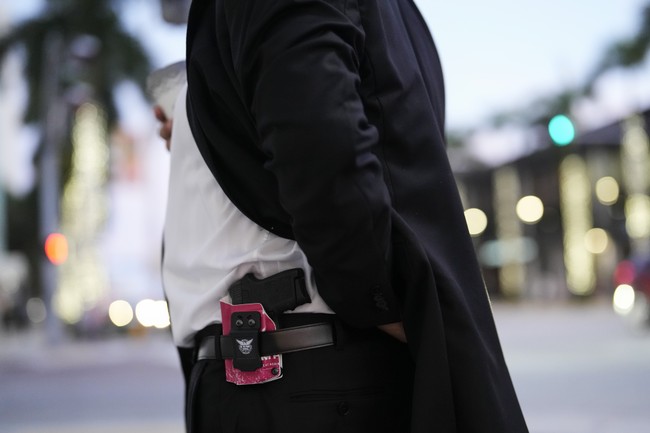

When Montgomery County, Maryland recently amended its concealed carry laws to comply with a state Supreme Court decision, the county left in place some “sensitive areas” that are legally dubious, at least from a Second Amendment perspective.
The county bans lawful carry within 100 yards of a “public assembly”, which includes parks, places of worship, schools, libraries, courthouses, legislative assemblies, recreational facilities, multipurpose exhibition facilities, and polling places. Though the state Supreme Court says that ban doesn’t conflict with Maryland’s constitution, a rabbi in Montgomery County has filed a lawsuit arguing the prohibition violates his right to keep and bear arms… and the Justice Department is now threatening its own lawsuit unless the county rescinds the ban.
Rabbi J. Menashe Shapiro and the Silver Spring Jewish Center, Inc. allege Montgomery County’s Expedited Bill 23-26 violates their First Amendment right to free exercise of religion as well as various aspects of the Second and Fourteenth Amendments’ right to keep and bear arms.
Citing the October 7, 2023 antisemitic terrorist attacks against Israel, Shapiro and company believe the right to carry applies to vulnerable communities like Jewish Americans namely for self defense purposes.
The lawsuit accuses the Montgomery County government of making it impossible for Shapiro to even walk to his synagogue without potentially violating the law.
“The only path between his home and his synagogue requires him to walk within 100 yards of two public schools, two private schools, two parks, and three other houses of worship—each one a “place of public assembly,” the lawsuit states.
Shapiro specifically mentions how on the Sabbath and Jewish holidays, he’s required by Jewish law to walk to the synagogue for communal prayer multiple times daily.
While Shapiro’s lawsuit, brought with the help of the New Civil Liberties Alliance, challenges the county’s ban on lawful carry in places of public assembly, Assistant Attorney General Harmeet K. Dhillon specifically called out the ban at or near houses of worship and warned a lawsuit is incoming unless the county makes changes.
History teaches us that people are particularly vulnerable to armed attacks during worship. That is why @CivilRights Division @TheJusticeDept is acting quickly to challenge Montgomery Co., MD’s law disarm congregants in houses of worship that permit firearms. pic.twitter.com/z85r04ohbW
— AAGHarmeetDhillon (@AAGDhillon) July 30, 2026
While Maryland state law has its own expansive list of “gun-free zones” that are being challenged in court, it does not outright ban concealed carry in houses of worship. Instead, it expressly allows local governments to enact bans on carry within 100 yards of a public assembly, which includes a house of worship.
U.S. District Court judge in Maryland has previously upheld the prohibition, but the Fourth Circuit Court of Appeals has not weighed in directly on the issue. Other circuit courts, like the Ninth Circuit, have determined that such a ban does violate the Second Amendment, so Montgomery County’s ban on church carry in particular and “places of public assembly” are ripe for court review.
By defining those places so broadly, Montgomery County has prohibited the lawful bearing of arms in large swathes of the county. The Supreme Court warned against that practice in Bruen, and in Wolford the Court also hinted that prohibitions on carry in “many places that people routinely visit in the course of their daily routines” are also vulnerable to legal challenges.
SCOTUS has also suggested that simply declaring a place “sensitive” without any additional security measures in place isn’t good enough. The parks, libraries, recreational facilities, and multipurpose exhibition facilities where carry is banned likely do not have any metal detectors or other specific security features to protect visitors, yet those visitors are unable to protect themselves.
Additionally, houses of worship are private, not public property, but even if the leaders of a church or synagogue want to allow lawful carry on the property they’re not allowed do so under Montgomery County’s law.
In its decision granting a preliminary injunction against California’s similar ban, the Ninth Circuit found no evidence of any historical analogue around the time the Second Amendment was adopted. Instead, they noted that “several States and two territories prohibited firearms at places of worship” shortly after the ratification of the Fourteenth Amendment.
In particular, in 1870, Georgia prohibited firearms at any “place of public worship”; that same year, Texas prohibited firearms at any “church or religious assembly”; in 1875 Missouri banned firearms at any “church or place where people have assembled for religious worship”; in 1878 Virginia banned guns at “any place of worship while a meeting for religious purposes is being held at such place”; in 1889 Arizona banned firearms at “any church or religious assembly”; and in 1890 Oklahoma enacted the same prohibition.
That wasn’t good enough for the Ninth Circuit panel, which argued that “those regulations do not evince a historical tradition similar to the tradition of regulating firearms at sensitive places.”
For polling places and other locations, the Supreme Court noted the existence of at least one colonial regulation on point. And the bans on firearms at schools began in 1824—a few decades after the ratification of the Second Amendment and nearly a half-century before the ratification of the Fourteenth Amendment.
In short, Montgomery County’s ban on lawful carry in houses of worship is on shaky legal ground. Given the anti-gun attitudes within the county government, my guess is that Rabbi Shapiro is going to have some company and the DOJ will also end up filing suit.
Editor’s Note: The radical Left will stop at nothing to enact their radical gun control agenda and strip us of our Second Amendment rights.
Help us continue to report on and expose the Democrats’ gun control policies and schemes. Join Bearing Arms VIP and use promo code FIGHT to receive 60% off your membership.
Read the full article here


![Dem Darling Bails On Governor Race as Party Fears Damaging News [WATCH]](https://www.rvmnews.com/wp-content/uploads/2026/07/2026.07.31-10.00-rvmnews-6a6c7253d809a.jpg "Dem Darling Bails On Governor Race as Party Fears Damaging News [WATCH]")