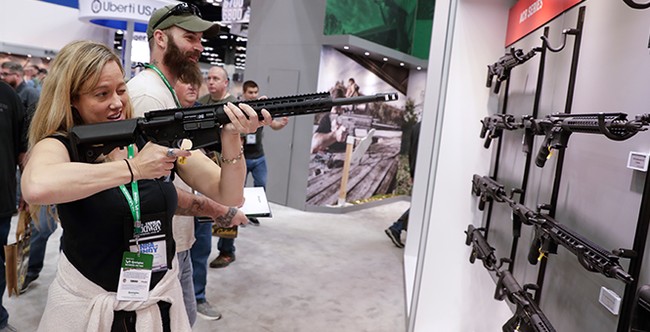

Everyone in the Second Amendment community is rightly overjoyed that at long last, the Supreme Court will be deciding whether so-called “assault weapon” bans are constitutional. These bans on some of the most common guns in the country exist in about 10 or so states and prevent millions of Americans from owning AR-15s and similar rifles.
SAF is particularly ecstatic given that both cases granted review – Viramontes v. Cook County and Grant v. Higgins – are cases in which the organization is a plaintiff.
The question presented, which the Court will answer, is: “Whether the Second and Fourteenth Amendments guarantee the right to possess AR-15 platform and similar semiautomatic rifles.”
The Supreme Court has already begun laying the groundwork for that victory in its recent ruling in Wolford v. Lopez. There, the Court further clarified what constitutes an “arm” for Second Amendment purposes.
“Arms,” the Supreme Court explained, are “implements used for offense and defense.” While some courts had astonishingly ruled that guns like the AR-15 are not even “arms” because they were more useful for military uses rather than personal self-defense, that line of argument appears to be extinct after Wolford.
Still, other questions do remain. In granting cert on the AR-15 question, the Supreme Court has foregone, at least for now, the magazine question. Duncan v. Bonta and Gators Custom Guns v. Washington, cases dealing with state-level bans on magazines that hold over 10 rounds of ammunition, were neither denied nor granted for now. They will be presumably held pending the ruling in Viramontes, then sent back down for further proceedings in light of that ruling.
The extent to which the Supreme Court’s analysis goes into the constitutionality of specific “features” is thus critical. It will not be enough to just rule that a flat ban on AR-15s and similar rifles is unconstitutional; most such bans are features-based.
For example, while Cook County bans AR-15s and AK-47s by name, they also ban any semiautomatic rifle with the ability to accept a magazine holding more than 10 rounds of ammunition if it has a pistol grip, a folding or telescoping stock, a muzzle brake or compensator, and more. If the Supreme Court does not rule that these common features are protected as well, then any ruling will be easy for antigun states to continue to circumvent. Fortunately, the petition in Viramontes made that issue clear, so it seems as though it will be dealt with.
But other issues will still remain. For example, what of suppressors? Just recently, the Fifth Circuit ruled in U.S. v. Comeaux that suppressors are arms. “Because silencers are used in self-defense ‘to cast at or strike another,’” the panel explained, “they are Second Amendment ‘Arms.’” While the government argued suppressors are not “arms” because they are not necessary to the functioning of a firearm, the Fifth Circuit rejected that argument because arms “need not be necessary for a firearm’s functioning but instead must only ‘facilitate armed self-defense.’”
The Fifth Circuit’s ruling creates a split with other courts, meaning the Supreme Court may need to take up the issue, particularly as some states like California and New York continue to maintain total bans on suppressors. The Supreme Court’s upcoming delineation on what is and is not an “arm” may come into play.
Other cases, like those dealing with California’s handgun roster, may also be affected. That situation is the reverse in that the state requires unwanted features be added to handguns (chamber load indicators and magazine disconnect mechanisms) before they can be sold in the state.
Finally, if the response to Bruen from antigun states is any indication, the Supreme Court may want to preempt efforts to undermine their ruling. States that previously had total bans will replace them with extensive and costly licensing and training requirements to try and dissuade people from exercising their right to buy an AR-15 or similar rifle in the first place.
That is exactly what they did with CCW permitting after Bruen, and they will turn to the same tactic again. A warning from the Supreme Court on this point may go a long way in defeating such efforts.
Overall, the fact the Supreme Court agreed to hear two SAF “assault weapons” ban cases is monumental. The ripple effects these rulings may have on Second Amendment infringements nationwide could very well determine more than just that one issue. We remain cautiously optimistic the right to keep and bear arms will certainly be strengthened with any ruling the Court hands down and look forward to arguing our case in front of the highest court in the land.
Editor’s Note: The radical Left will stop at nothing to enact their radical gun control agenda and strip us of our Second Amendment rights.
Help us continue to report on and expose the Democrats’ gun control policies and schemes. Join Bearing Arms VIP and use promo code FIGHT to receive 60% off your membership.
Read the full article here