


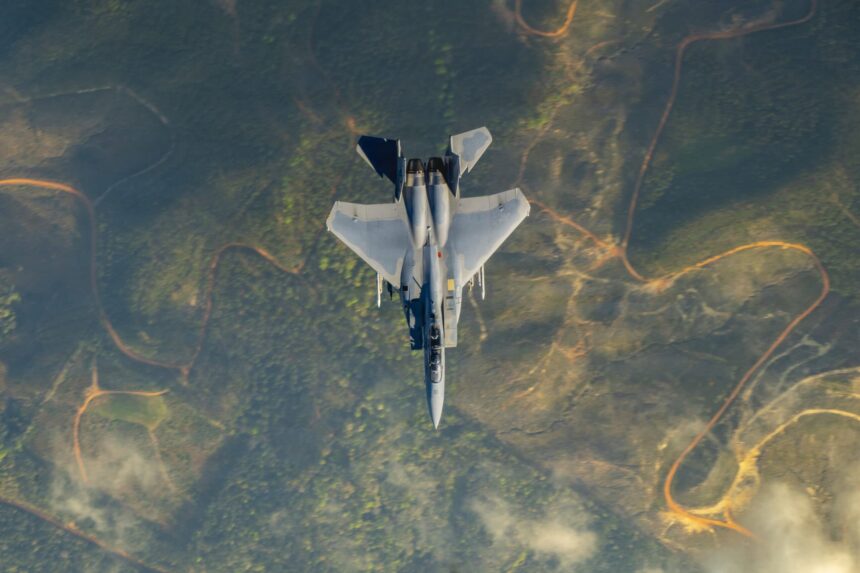

Summary and Key Points: The 142nd Wing at Portland spent decades flying the F-15C/D — an air-superiority aircraft built to intercept, not to bomb. Converting to the F-15EX Eagle II means learning a mission the unit has never had. Its pilots went through a nine-month course and wrote a local syllabus; its weapons loaders trained on Strike Eagles at Nellis before they could certify anyone at home. In May, the wing dropped practice rounds at Mountain Home. Late last month it dropped live ones at Nellis.
Here Comes the F-15EX Eagle II by Boeing
The Defense Visual Information Distribution Service (DVIDS) just published imagery from the Air National Guard.
The pictures mark a major move in what some new multirole fighter jets have publicly done so far.
The images show the 142nd’s F-15EXs at Nellis for about three weeks, from late August through early this month, to support the Air Force Weapons Instructor Course.
This time they reached a “historical milestone” by dropping live bombs out of an operational F-15EX for the first time ever.
This is indeed a major deal for the 142nd Wing. The Portland outfit had historically been trained to operate the F-15C/D, an air-superiority type meant for speed and radar, and for defending U.S. airspace, not for overseas bombing campaigns.
F-15EX. F-15EX. Image Credit: Boeing.
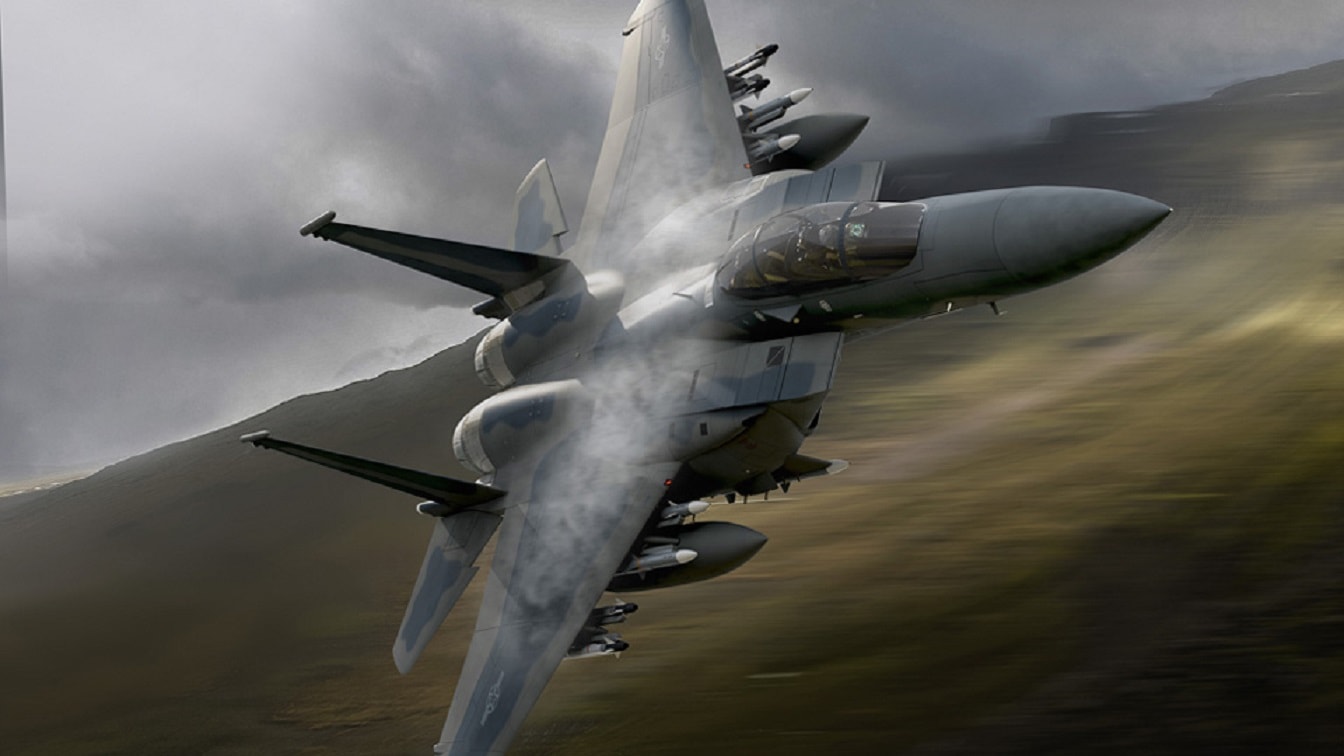
F-15EX Eagle II artist rendition. Image Credit: Boeing.
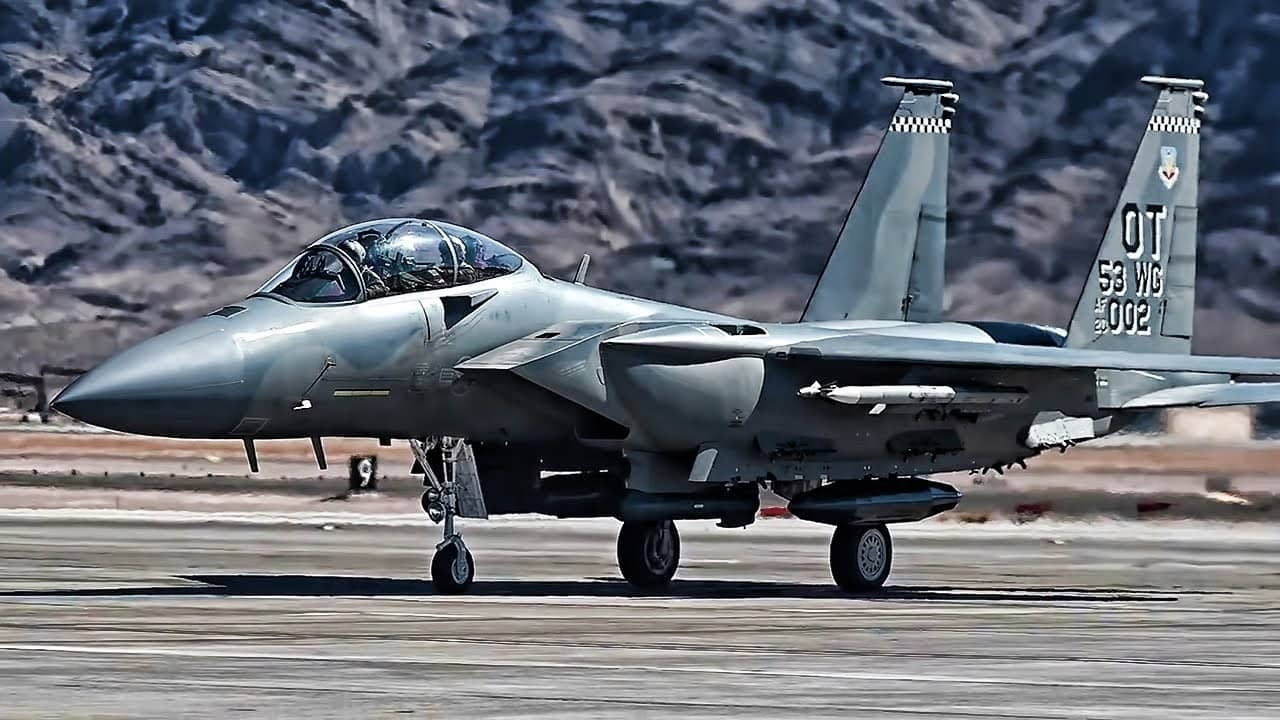
F-15EX Eagle II. Image Credit: Creative Commons.
The Military Times notes that the Nellis images displayed AN/AAQ-33 Sniper pods and 500-pound Mk 82s.
The War Zone has also released spotter images of an F-15EX carrying a 2,000-pound Mk 84 in the same area. The Air Force has not publicly announced just how many live bombs it released during this period.
The Idaho Test
A less theatrical test also played out in Idaho in July.
The wing said its crews visited Mountain Home AFB this May to drop 24 BDU-50 and 12 BDU-56 practice rounds and numerous practice bombs.
This test marked the first-ever time these jets had loaded and dropped any kind of bomb.
Maj. Jesse Loya was among three pilots with prior air-to-ground experience; after a nine-month course in the tactics and science of the matter, he and the others put together a local syllabus for the rest of the wing.
Then there was the weapons shop.
Tech. Sgt. Tyler Phelps and a few other loaders traveled to Nellis earlier in the year to get certified in bomb loading with the 59th Test and Evaluation Squadron’s F-15E Strike Eagles.
When they returned to Portland, they put the airmen headed to Mountain Home through their paces. “A completely new capability,” is how Col. Joshua Hovanas, who commands the 142nd Operations Group, put it.
In the wake of the Idaho drops, he was quick to add that the unit was “just getting started” on its way to being “a premier multi-role fighter squadron.”
F-15EX’s ‘Unmatched Payload’
And “multi-role” is the operative term here. Boeing touts the F-15EX for its “unmatched payload, range and speed.” The jet comes equipped with an all-glass cockpit, digital fly-by-wire, an open mission systems architecture, AESA radar, and the Eagle Passive/Active Warning Survivability System (EPAWSS).
By Boeing’s reckoning, it can carry a 29,500-pound payload, such as up to 12 AMRAAMs or another combination of large ordnance.
Iran War Puts Tech to the Test
Some of the air-to-air credentials have already been put to the test.
A release from Wright-Patterson Air Force Base noted earlier trials had confirmed the Eagle II could “carry and employ” a 12-missile loadout.
Then there are its bomb runs. It is no F-35; the F-15EX is not stealthy and cannot yet be considered an operational substitute for the F-15E Strike Eagle in the strike role.
CBS’ 60 Minutes recently detailed the April incident over Iran when a U.S. F-15E was shot down by a shoulder-fired missile while hitting industrial targets linked to Iranian drone and missile operations.
Adm. Brad Cooper was candid about the situation. “We had air superiority and had flown some 13,000 missions, but clearly we weren’t flying over Kansas,” he said.
The weapons systems officer on that flight, call sign Bravo, likened the hit to “getting hit by a freight train.” Badly hurt after ejection, he made his way up a 7,000-foot ridge as the Iranians closed in. “Never let a lack of motivation put you on Iranian TV” was the thought that drove him until pararescue found him. “Let’s go,” was all he had to say.
Of course, that was an older F-15E and not the EX. But it illustrates what air-to-ground work entails.
This isn’t just a question of how bombs get hauled but how crew, sensors, and other technology all work together. This makes the Eagle II’s rear set one of its key features.
Do F-15EXs Need More than One Pilot?
The Air Force has previously considered operating the F-15EX with a lone pilot.
The jet still has two seats, like the other aircraft in the wider F-15E “family.” As the erstwhile 142nd Wing commander Col. Michael Kosderka informed The War Zone magazine: “We can start talking about putting all kinds of air-to-ground capabilities into the airplane, potentially putting WSOs or other experts in the backseat as well to have us do any number of multi-role capabilities that it’s just physically not possible to in the C model.” He said this means that “the X has tremendous growth capability.”
On the sensor side of things, there is also change afoot.
Last fall RTX said that Raytheon had launched the APG-82(V)X. This gallium nitride-enhanced radar was set to boost range, processing speed, and air-to-air and air-to-ground capabilities.
Dan Theisen, who heads up Advanced Products and Solutions at Raytheon, said the cutting-edge radar would permit aircrew a valuable “first-look, first-shoot advantage.”
Kadena Air Base said the first F-15EX bound for Kadena was transported from Boeing’s plant in St. Louis to Portland on Sept. 3 for final preparations before the move to Japan.
Brig. Gen. John Gallemore of the 18th Wing said they were “ready to welcome the F-15EX,” and that his staff will “fly, maintain and employ it from Japan.” More jets are set to arrive by fiscal 2027.
Air & Space Forces Magazine reported that Seymour Johnson Air Force Base is set to receive its hotly anticipated F-15EXs after the relevant congressional authorization is granted.
Older F-15Es will be relocated only after this change.
Meink said the service has no plans to reduce Seymour Johnson’s F-15 missions before the replacement jets arrive.
The plans are not guaranteed to go smoothly, however.
The Air Force seems set on expanding the F-15EX fleet from 129 to 267 jets, a process that will require significant time and effort.
A recent Pentagon acquisition report stressed that the military needed to prepare adequately for the costs, timelines, and high-pressure supply chains required for its plans.
The program has also been placed somewhat on the back burner due to strikes by Boeing’s St. Louis employees, which ended last November.
About the Author: Georgia Gilholy
Georgia Gilholy is a journalist based in the United Kingdom who has been published in Newsweek, The Times of Israel, and the Spectator. Gilholy writes about international politics, culture, and education.

![Key Talking Point Cooked in About a Minute [WATCH]](https://www.lifezette.com/wp-content/uploads/2026/09/2026.09.17-11.35-lifezette-6aabd073a99e5.jpg "Key Talking Point Cooked in About a Minute [WATCH]")




![Bombshell House Report Accuses ActBlue of a Massive Fraudulent Donation Cover Up [WATCH]](https://www.rvmnews.com/wp-content/uploads/2026/09/2026.09.17-09.46-rvmnews-6aabb706bc570.jpg "Bombshell House Report Accuses ActBlue of a Massive Fraudulent Donation Cover Up [WATCH]")