Five years ago this month, I finished the manuscript for “Human Forever: The Digital Politics of Spiritual War.” By fall, it was in print, available as an e-book, and inscribed on the Bitcoin blockchain. It remains available today exclusively in Bitcoin on canonic.xyz.
Despite its narrow audience — then considered a kiss of death, today hailed as smart “niching down” — “Human Forever” has made an enduring impact.
Why assume that posthuman intelligence would honor what ‘we’ mean by progress as an ultimate good?
Working from a relative handful of influences, insights, and goals, I was able to see quite a ways around the corner of the next five years. That may seem surprising, given how much has changed since then, especially in AI.
But the book’s continued relevance in an age of rapid obsolescence has to do with its thesis being larger than tech. Its central question was what, if anything, could be bigger than technology — more fundamental, more authoritative, more inherent to who and what we are.
While many are now locked in debate over whether technology is upstream of politics or politics is upstream of technology, “Human Forever” explored the primacy over both of spiritual being, spiritual life, and spiritual order.
Few were discussing this dynamic in 2021. Many are discussing it now.
That is not surprising. As I argued in the book, and have continued to explore in the essays and posts it set in motion, the cultural and social resurgence of spirituality in all its dimensions — including those most of us were trained to believe would never return from the distant past — is largely attributable to the direction, speed, and scope of technological advancement.
Technology has now reached a point at which it is discrediting many of the sophisticated intellectual mechanisms once designed to justify human existence and supply human purpose without spirituality, revelation, or faith in the divine.
Today even — perhaps especially — those working at the frontier of AI development are gravitating toward spiritual structures, from the ancient Christian church to novel and idiosyncratic cults.
But momentum at the technological frontier still favors those who would rather replace all previous and existing religions than kneel with the faithful of any.
RELATED: At 250, America’s fate is wonderfully unwritten
 smartboy10/iStock/Getty Images
Welcome to the party
I now notice two main trends relative to what I argued in “Human Forever.”
The first is a gratifying high-level awareness of what is at stake and what is needed to preserve our accustomed freedom and command in the digital age.
Recently, none other than Palantir CEO Alex Karp helped kick off a remarkable turn among key hyperscalers toward concepts and priorities laid out in the book: control of compute as an index of sovereignty; technological competition consolidating among a handful of civilization-states; the need to protect and preserve the shared memory, or ontology, of people and organizations; and the spiritual risk of a new kind of slavery typified by what cybernetics theorists call homeostasis — an unceasing feedback loop optimizing for predictability, uniformity, and interchangeability.
In the book, I emphasized that Bitcoin offered ordinary human beings an exemplary opportunity to re-establish healthy freedom and command under digital conditions. Bitcoin is relatively mature, stable, comprehensible, and ready to use now, without requiring trust in massive organizations with equally massive trust gaps.
I am still waiting for leading tech figures to sing that tune. On the other hand, perhaps it is best for ordinary people to figure it out for themselves, without monitoring or supervision.
The secular trap
The second trend is more uncanny and unnerving.
A funny paradox has emerged. Many of those most euphoric about developing AI into a recursively self-improving cosmic intelligence — one that removes our pain, solves our problems, and likely erases many of the limits of human being — simply assume that the machines will preserve their very human ideas about “improvement” itself.
They seem to believe that machines designed to surpass us in every way will somehow neither surpass nor contradict them when defining the core concepts and purposes at the heart of the AI project.
Improvement, advancement, perfection — these and related ideas define the AI-maxxing ideology. But for us, absent divine teaching about what they truly mean, they remain inescapably human ideas.
If “we” are building entities with the goal of liberating them from the petty confines of human intellect, agency, and identity, why would we expect them to retain modern secular-human notions of value and progress?
RELATED: The backlash against AI reveals it’s a terrible scapegoat
 RYGERSZEM/iStock/Getty Images
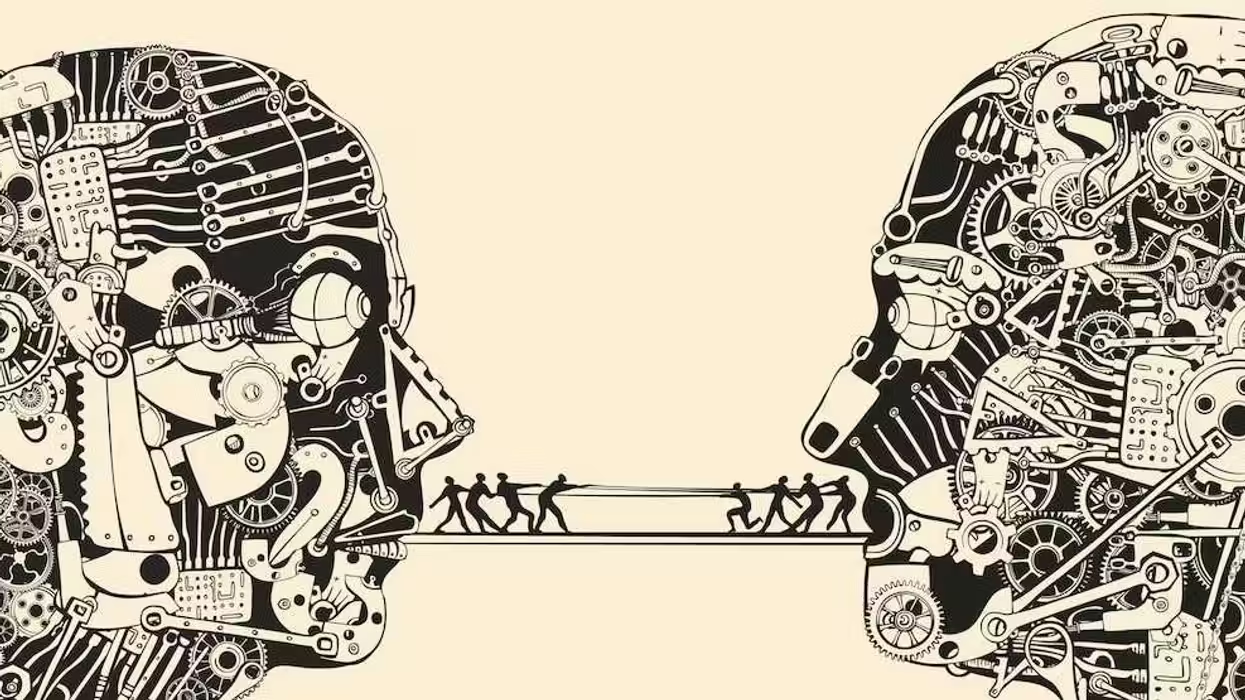
Why assume that posthuman intelligence would honor what “we” mean by progress as an ultimate good?
Strangely, the stubborn reliance on merely human definitions at the heart of the ostensibly posthuman agenda mirrors the same reliance among many of the most visible and well-funded anti-AI movements, which rally around symbols of human identity such as a caveman’s handprint.
Neither side of the conflict seems eager to confront the hard lesson of history: When we stray from divine teaching about what it means to improve, progress, and perfect, and when we replace that teaching with merely human measures of justice, truth, beauty, and goodness, the result is often the opposite — sometimes catastrophically so.
The true frontier
Of course, there are many incompatible religious teachings in the world today. But they are nearly unanimous on the folly of turning away from divine instruction and trying to do it ourselves — especially when that effort frustrates us so badly that we attempt to outsource it to institutions of our own creation.
Historical warts and all, the implication is strong: Stubborn secular humanism will undermine even the most ambitious and well-intentioned goals of both AI lovers and AI haters.
For many Americans, and for many others across the globe, the only authoritative, resonant, reliable, and compatible frame of spiritual authority will be a Christian one.
For Americans in particular, that poses a unique challenge.
Just as an AI theocracy would be unconstitutional, so would a Christian theocracy. America will have to work harder than other countries to resolve the relationship among spiritual authority, political order, and technological development.
Instead of worrying about whether we still have time, we had better make the time.
Read the full article here