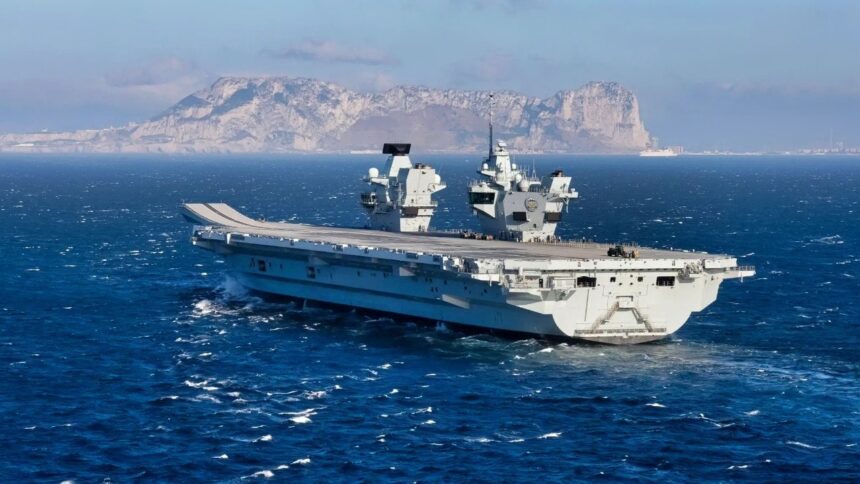

Those understandably concerned about the woes plaguing the U.S. Navy’s Nimitz-class to the Gerald R. Ford-class aircraft carriers need to put things in perspective and count their blessings: those problems are downright tame compared with those afflicting their counterparts in Great Britain’s Royal Navy, the Queen Elizabeth-class carriers.
Indeed, instead of harkening back to the days of yore when “The sun never sets on the British Empire,” these carriers are most likely making Her Majesty—you know, the vessel class’s blueblood namesake—roll over in her grave.
HMS Prince of Wales Aircraft Carrier. Image Credit: Creative Commons.
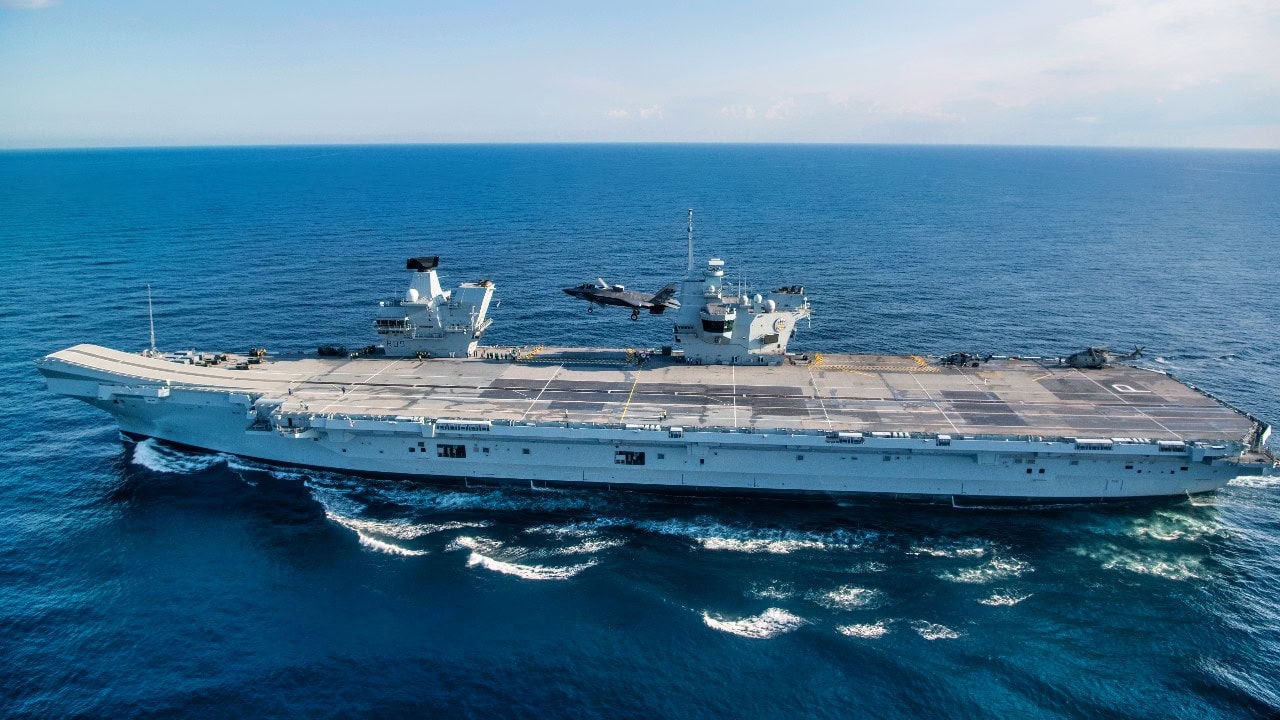
HMS Prince of Wales Aircraft Carrier.
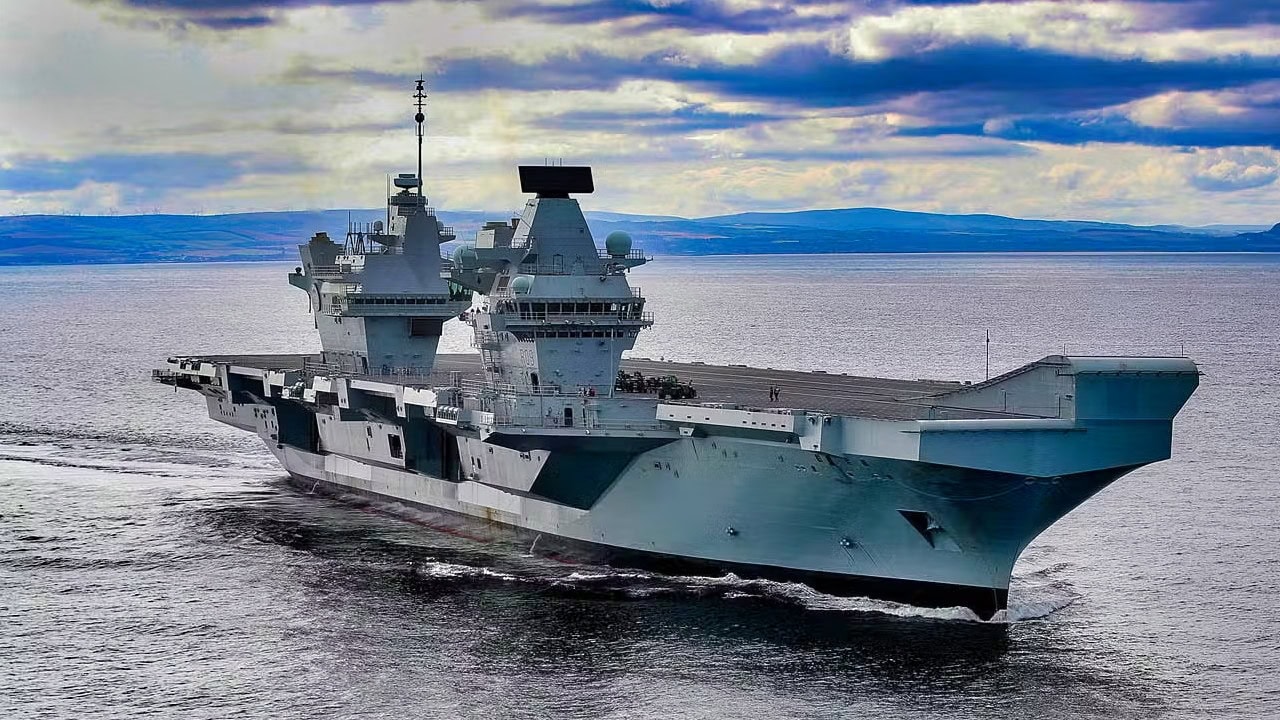
HMS Prince of Wales Aircraft Carrier.
There are currently two ships in the class, namely: the eponymous lead vessel HMS Queen Elizabeth (Pennant No. R08); and (2) her sister ship, HMS Prince of Wales (Pennant No. R09). So then, what are these two flattops’ Top 3 Biggest Problems?
Problem #1: Multiple Mechanical and Monetary Maladies
In particular, faulty propeller shaft couplings forced R08 to miss Exercise Steadfast Defender in February 2024, though R09 was still able to participate.
In a statement apparently meant to rationalize and minimize the embarrassment caused by this incident, a Royal Navy spokesperson told Naval Technology that “It’s not uncommon to have maintenance issues with state-of-the-art ships which contain complex engineering and technology.
Having two aircraft carriers means that HMS Prince of Wales can quickly prepare to deploy in place of HMS Queen Elizabeth.’”
The need to fix issues has added to these ships’ ballooning costs, which shows that it’s not just the U.S. Armed Forces that are afflicted by those ever-present and ever-dreaded cost overruns.
The Elizabeths were originally supposed to cost the equivalent of $2.7 billion USD apiece, but that spiraled upwards to $12 billion for both.
Problem #2: Manpower Maladies
On paper, the Elizabeth-class flattops have a crew complement of 679 commissioned officers and enlisted sailors, not including the air element, and a total berthing capacity of up to 1,600 sailors.
In practice, that impressive capacity has been tempered by a significant shortfall in Royal Navy recruitment and retention.
Simply put, most young Britons don’t see the Royal Navy as an attractive career option.
To quantify that, Royal Navy personnel strength shrank by 4.1 percent from 2022 to 2023, which equated to 1,640 fewer seamen than needed, and by 2025, a measly 27,820 personnel were trained.
Problem #3: Materiel Maladies
As its name suggests, the raison d’etre of an aircraft carrier is to carry military aircraft into the battle zone.
I can already hear you, dear readers, exclaiming “Thank you, Captain Obvious!” But digging deeper than that, we come across another glaring issue: Queen Elizabeth and HMS Prince of Wales are having difficulty fulfilling that basic job description, due to an insufficient number of warbirds to carry in the first place!
More specifically, we’re talking about a shortage of American-made Lockheed Martin “Skunk Works” F-35B Lightning II fighter jets.
The British government initially wanted 74 of these 5th-generation stealth fighter jets, but only about half that number are operational. Gor’blimey, mate, and you thought U.S. Air Force aircraft readiness rates were bad!
What’s In a Name? “Prince of Wales” = an Accursed Warship Moniker?
Not that we at 19FortyFive would ever promote superstition and paranoia, but sailors tend to be a superstitious bunch.
Though I myself was an Air Force puke, I can still vouch for this from my personal experiences as (1) a current Companion of the Order of the Naval Order of the United States (NOUS), (2) a former U.S. Navy contractor at the Pentagon, and (3) having had two cousins who served in the USN.
So then, given that superstition, a lot of seamen may not be surprised a’tall to know that the current warship bearing the name HMS Prince of Wales is having issues. Just look at her WWII predecessor after all…
…On 10 December 1941, the battleship HMS Prince of Wales (Pennant No. 53) and the battlecruiser HMS Repulse (Pennant No. 34) were sunk by an Imperial Japanese Navy (IJN) attacking force of 88 Mitsubishi G4M “Betty” and Mitsubishi G3M Type 96 “Nell” bombers.
To add insult to injury, only three of the IJN warbirds were shot down in exchange, despite the bristling anti-aircraft armament of sixteen QF 5.25-inch Mk. I guns and thirty-two QF two-pounder (40 mm) “pom-pom” guns on Prince of Wales, and seventeen 4-inch and two 3-inch guns on Repulse. In the words of Sir Winston Churchill, “In all the war, I never received a more direct shock … Across this vast expanse of waters, Japan was supreme, and we everywhere were weak and naked.”
Fortunately, the plight of the current HMS Prince of Wales and her sister ship is nowhere near that disastrous or tragic.
But it nonetheless serves as a gloomy reminder of how deep the Royal Navy has metaphorically sunk from the glorious days of “Britannia rules the waves.”
About the Author: Christian D. Orr
Christian D. Orr is a Senior Defense Editor. He is a former Air Force Security Forces officer, Federal law enforcement officer, and private military contractor (with assignments worked in Iraq, the United Arab Emirates, Kosovo, Japan, Germany, and the Pentagon). Chris holds a B.A. in International Relations from the University of Southern California (USC) and an M.A. in Intelligence Studies (with a concentration in Terrorism Studies) from American Military University (AMU). He is also the author of the book “Five Decades of a Fabulous Firearm: Celebrating the 50th Anniversary of the Beretta 92 Pistol Series,” whose second edition was recently published.