


Every time I scroll through the news, mostly my YouTube feed, it’s the same thing talking about food prices climbing, oil prices about to spike, another warning about the economy hanging by a thread since we’ve recently passed 40 trillion in debt, and WW3 at some point. I keep asking myself the same question: Are we preppers and doomsayers just crying wolf again, or is this actually the calm before the storm?
I lean toward the latter, as you may well know. I’ve believed that for a while now, and nothing I’ve seen lately has changed my mind. But, still, it hasn’t happened yet, so maybe I’m just wrong! Or maybe not.
Worse Than The 1930s, Or Not?
I came across another debate recently where people argued both sides of this. Some think the next depression, if it happens, will be way worse than the 1930s; others think we’re overreacting and that we’ve already lived through a preview.
The “not as bad” argument isn’t crazy. COVID gave us a taste of it with massive money printing, interest rates near zero, and government debt ballooning almost overnight. If that’s the playbook, some people think we muddle through again instead of collapsing outright, which may be the case if the powers that be can keep it up. A few also pointed out that Europe is already absorbing a lot of unrest that might otherwise be building here, though I tend to see Europe as the “canary in the coalmine” coming for us with regards to things like immigration.
Anyway, I get the logic. I just don’t buy that it holds up if the next shock is bigger or, more likely more impactful, than COVID was. I say more “impactful” because as bad as the lock-downs and scaremongering were during COVID, we still had most of what we needed, including food, water, power, and so on. Just imagine if, because of never-ending money printing, we just can’t get that stuff any longer at any price? Or, at least, not at a price the majority of us can afford. What does that chaos look like?
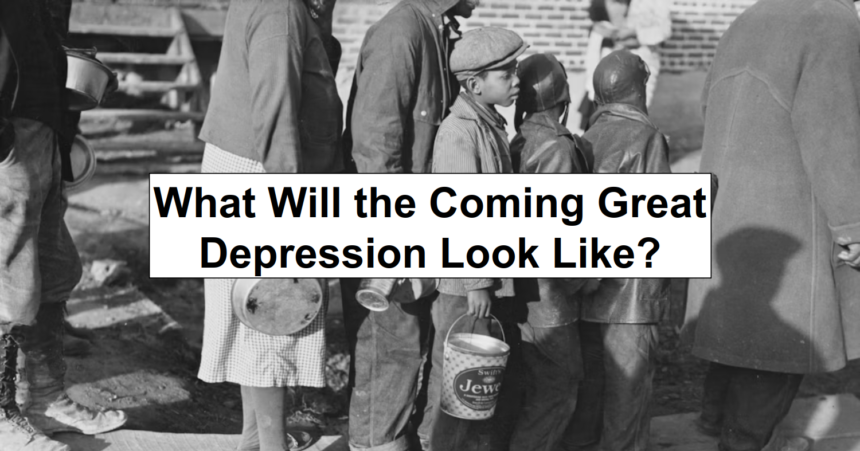
Here’s why the “worse” camp makes a stronger case to me. In the 1930s, a huge share of the country still lived on farms. People knew how to grow food, can it, sew their own clothes, and fix what broke … and that’s when stuff was made to last.
Today, under 2% of Americans live on farms. Most of us couldn’t keep a garden alive past July, let alone feed a family from one for more than a month. (I wrote about these problems in my book, Why We Prepare, if you’d like to know more about it.) And almost everything is literally made with a built-in shelf life, so you and I keep having to buy more.
The population is also far bigger now, over 340 million compared to about 122 million back then. More people means more mouths to feed and less arable land per person to do it with, and that’s to say nothing of the looming fertilizer and diesel shortages.
Back then, there was no safety net. People expected to fend for themselves because there wasn’t another option. Today, a huge number of people rely on EBT and SNAP just to eat. If those systems stop working, even for a few days, that’s when things could turn ugly fast. (I also wrote about how quickly anarchy could spread, and I now believe it could be nearly instantly given the right circumstances.)
Supply chains are another problem the 1930s never had to deal with. There was no just-in-time food distribution system, no continental power grid keeping everything running on a razor’s edge. Nobody had to relearn how to live without those things because they didn’t really exist yet. If they fail now, tens of millions of people would have to figure out survival basics they’ve never needed before and probably wouldn’t care to learn. But, at least, my books would probably sell well. 🙂
Then there’s debt. National debt is over $40 trillion now. Credit card debt sits around $1.26 trillion. Mortgage debt is over $13 trillion. None of that existed at anywhere near this scale in the 1930s. On top of that, FDIC insurance only covers a small fraction of the deposits actually sitting in US banks, somewhere around 1.4%. If banks fail the way they did back then, the government can’t backstop everyone, and my guess is that it isn’t you or me who will take priority, so we’ll lose it all.
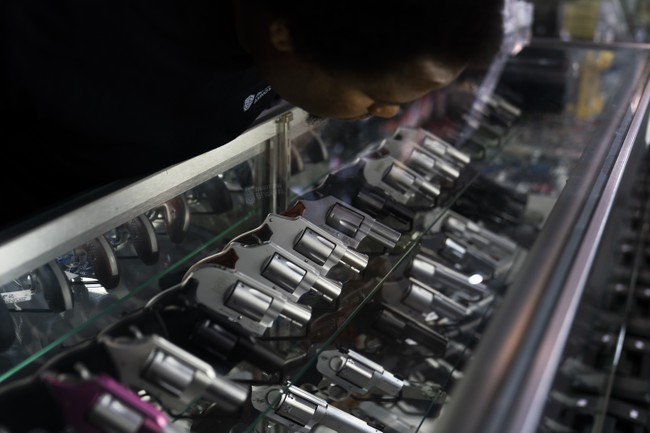
I’ve written before about whether preppers could actually survive a repeat of the Great Depression, and the honest answer is that most of us are less ready than we think, even with stockpiled supplies and plenty of firearms.
What It Might Actually Look Like
If something like this hits, I don’t think it looks like a movie. I think it looks like extended families moving back in together because nobody can afford rent alone. There will certainly be foreclosures on homes and businesses and cars, long lines at food pantries if they will even exist in any sizable number, and banks failing because their assets are other people’s debts, which will only make things worse. I guess we can all look forward to a near-useless UBI check every month. 🙂
Prices could go either way, and that’s part of what makes this hard to prepare for. Some expect deflation as people stop spending, while others expect the opposite, serious inflation from all the money that’s been printed, with Venezuela and Weimar Germany getting brought up as examples of how bad it can get when a currency loses trust. I’ve covered some of what disappears first when inflation spirals if you want the details on that; you can guess where I stand on which way prices go, but again, I’m no financial expert.
Crime is the other piece people bring up a lot: there will be more road rage incidents, much more robbery, and general lawlessness creeping into cities and suburbs that aren’t used to it. Pets will get abandoned when people can’t afford to feed them. Wildlife gets hunted out fast, and probably faster than in the 1930s, since there are a lot more gun owners around now than there were then. But I really don’t know how that will play out because I’m not a hunter, either.
None of this is guaranteed, of course. But it’s the pattern people keep circling back to when they actually think it through instead of just doom-scrolling that’s the scary part. What is it they say about history, that it often rhymes? And if it rhymes anything like the 1930’s, expect doing without the things you want and need, and much worse.
What Our Grandparents Knew
The part of this that stuck with me the most wasn’t the predictions, but the history lessons. As I age, it’s the stories about what people’s grandparents and parents actually did to get through the Depression that stick with me. My grandmothers, one more than the other, kept almost everything. I didn’t understand it as a child; I get it now.
Many of that generation grew nearly all their own food and kept chickens and other livestock. They canned everything they could. They saved scraps most of us would throw away without a second thought, items like nails, buttons, bolts, plastic bags, wax … you name it, got kept. Many traded skills and goods with neighbors instead of relying on cash (and certainly not credit) for everything. Some sent their teenage kids off to work farms for the summer just to make sure they ate, not to ensure they had spending money for the summer.
A lot of those people stayed frugal for the rest of their lives, even decades later, and even after quietly building six-figure investment accounts or sitting on homes worth as much or more. (Both grandmother did this.) These habits never left them. It’s the kind of muscle memory that doesn’t come from reading a blog post, but from living through something hard enough that you never forget the lesson.
What I’d Actually Do
If I’m honest with myself, the advice isn’t complicated. It’s just inconvenient because it means thinking longer-term than most of us prefer to because that means not getting what you want right now. Advice includes:
- Own your land outright if you can, with no mortgage hanging over your head. This also means staying out of debt as much as you can, and don’t get upside down on vehicles or credit cards.
- Learn to garden and can food now, while you still have the luxury of practicing instead of needing it to work the first time.
- Build a real relationship with a local farmer or two for meat, eggs, and produce, not just a folder of bookmarked websites and businesses you never visit. Farmer’s markets a good place to find these folks!
- Keep basic skills alive: sewing, small repairs, simple mechanical work, though such repairs are becoming more difficult to accomplish given how manufacturers engineer obsolescence.
- Store things with practical value, not just cash sitting in a bank. Junk silver, hand tools, garden tools, and so on. You get it.
- Harden your property a little for when times get a bit more scary, at least, enough to make criminals prefer to move on to easier targets.
None of the above guarantees anything. I know that. But it’s the difference between having the ability to adapt (or pivot as some say) when things get hard and finding out the hard way that you suddenly can’t afford a doubling of prices at the grocery store or that little Timmy is going to be without a new pair of shoes for this winter and the next.
I don’t think we’re crying wolf here. I think we’re watching the wolf circle and hoping we’re not about to be lunch. What’s your take on it? Are you seeing the same warning signs, or do you think this is overblown hype on my part?



![Liberal Host Humiliated After Botched Trump UN Fact Check [WATCH]](https://www.rvmnews.com/wp-content/uploads/2026/09/2026.09.23-08.09-rvmnews-6ab3892ee4587.jpg "Liberal Host Humiliated After Botched Trump UN Fact Check [WATCH]")