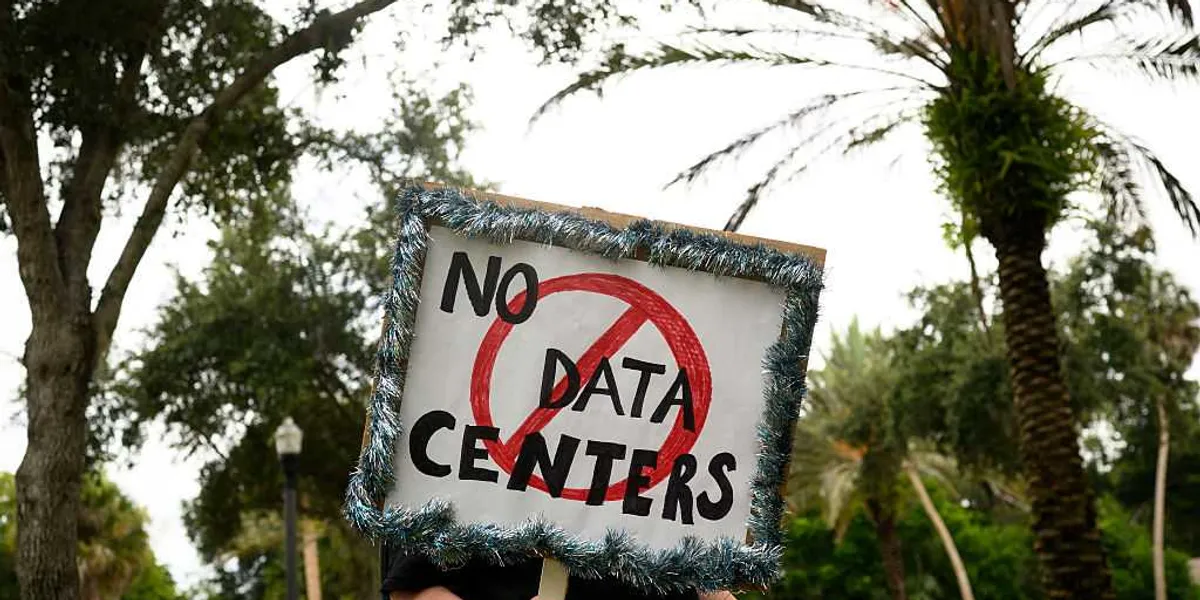

Increasing numbers of Americans are deeply opposed to building more data centers. Over the summer, Pennsylvania Gov. Josh Shapiro (D) imposed the strictest data center rules in the country, New York Gov. Kathy Hochul (D) ordered a statewide moratorium on hyperscale construction, and Gov. Greg Abbott (R) paused new approvals in Texas pending a grid audit.
At the local level, dozens of county and municipal fights have followed no reliable partisan pattern. Polling from Heatmap and Embold, collected by anonymous Substack writer Cremieux, shows data center popularity plummeting over the last year.
Any actions seen as forcing data centers on voters who do not want them will only make matters worse.
Though Cremieux argues the opposition is fundamentally driven by NIMBYism (not in my back yard), I am unconvinced. The polling seems to follow the pattern you would expect if NIMBYism were the primary driver, but posing the problem as a generic national issue produces substantially less opposition.
The arguments most central to the anti-data-center cause, namely complaints about the effect on utility costs, seem to generate an outsized amount of discourse relative to their actual effect. For example, in Virginia — the world’s data center capital and the state where I live — the State Corporation Commission estimated that shifting capacity and distribution costs from households to the large-load rate class would lower a typical residential bill by about 3.4%, or roughly $5.52 a month.
In other words, the effect is something on the order of a Subway sandwich in 2008.
I want to be scrupulous, because the complaints about data centers are often not literally false. Households are indeed suffering from a pecuniary externality created by increased demand. But it is hard to reconcile the mostly muted effects with the surging level of emotional response.
Americans’ growing dislike of data centers stems not from animus toward any single company or product but from a cumulative reaction to the momentous technological changes of the past couple of decades.
Because AI is the latest harbinger of those changes — and offers revolutionary potential — it has inherited our culture’s immune response. This means these problems cannot be adjudicated simply by changing utility regulations or even bribing local communities.
RELATED: The dirty secret behind Big Tech’s data center boom
Michael Siluk/UCG/Universal Images Group/Getty Images
Three further factors have combined with the populist anti-tech feeling to make AI and, by extension, data centers unusually unpopular.
First, AI faces a particularly unfavorable coalition of constituencies. Its association with California and the tech industry has deeply soured much of conservative America toward it, and its association with billionaires and big business has soured many progressives. Even many techies feel personally threatened by the technology.
Second, those most aggressively advocating for data centers are not building them in their own back yards. Palo Alto, where I lived while attending grad school, has spent years fighting small-cell installations. One of the most prestigious retirement homes in the U.S., Channing House, recently fought to have wireless equipment removed from its roof.
In January, the city of Palo Alto wrote to the FCC opposing a rule that would speed up wireless approvals, while at the same time supporting the infrastructure needed to run AI-enabled services, so long as it retains the power to veto unwanted projects.
When the group that appears to benefit most from a technology is also most averse to its consequences, it is natural for the public to wonder what the tech world might be hiding. The anonymous author Polimath, writing in Marginally Compelling, gets closer to the underlying problem by viewing it as another front in the culture war, an outworking of long-simmering discontent with tech culture.
Third, much of the tech world itself seems increasingly concerned about the existential risk AI might pose to humanity. For example, earlier this month, Jacob Coxon, a researcher who spent three years doing pretraining work at OpenAI and then Anthropic, publicly resigned, writing that both companies were racing toward self-improving superintelligence and “gambling with our lives.”
RELATED: America doesn’t need Dario Amodei’s permission to build
 Jason Henry/Bloomberg/Getty Images
Evan Hubinger, an alignment lead at Anthropic, replied that he agreed and put the odds of AI killing everyone within the decade above 10%. From talking to my friends at these labs, the modal person really does seem to think they are summoning the machine god. That prospect naturally feeds public opposition to AI.
Taken together, these factors help explain the public’s anger. The lines of the current debate have already hardened, and the grievances far predate the specific events of the day. Any actions seen as forcing data centers on voters who do not want them will only make matters worse.
But the centers will be built regardless. Demand is so enormous, and suitable locations are sufficiently plentiful, that only a small number of permissive communities, such as Loudoun County, are needed. If localities want to opt out, I see little reason to stop them.
However, the industry could take an important step if it wants to win broad American support.
Specifically, Big Tech should make a visible effort to build data centers near the communities where its executives and employees live. This would give them a way to begin convincing Americans that data centers are an asset worth having, not a liability worth dodging.
Concerns about water and electricity are simply not what most people are worried about, and addressing them will do nothing to solve the larger problem. Since these reasons are selected ex post to justify pre-existing opposition, defeating any single point will merely invite a hundred more.
If you are opposed to data centers, my guess is that saving $5 on your monthly utility bill wouldn’t be enough to change your opinion.
Editor’s note: This article was originally published at the American Mind.
Read the full article here



![Three College Students Hit with Federal Charges Over Alleged Trump Threats Before Campus Rally [WATCH]](https://www.rvmnews.com/wp-content/uploads/2024/09/2024.09.19-03.37-rvmnews-66ec454a00f6e.jpg "Three College Students Hit with Federal Charges Over Alleged Trump Threats Before Campus Rally [WATCH]")
![Trump Announces Massive European Diesel Release After Urgent G7 Meeting [WATCH]](https://www.talkred.com/wp-content/uploads/2026/10/2026.10.01-05.55-talkred-6abdf5cf20ece.jpg "Trump Announces Massive European Diesel Release After Urgent G7 Meeting [WATCH]")