


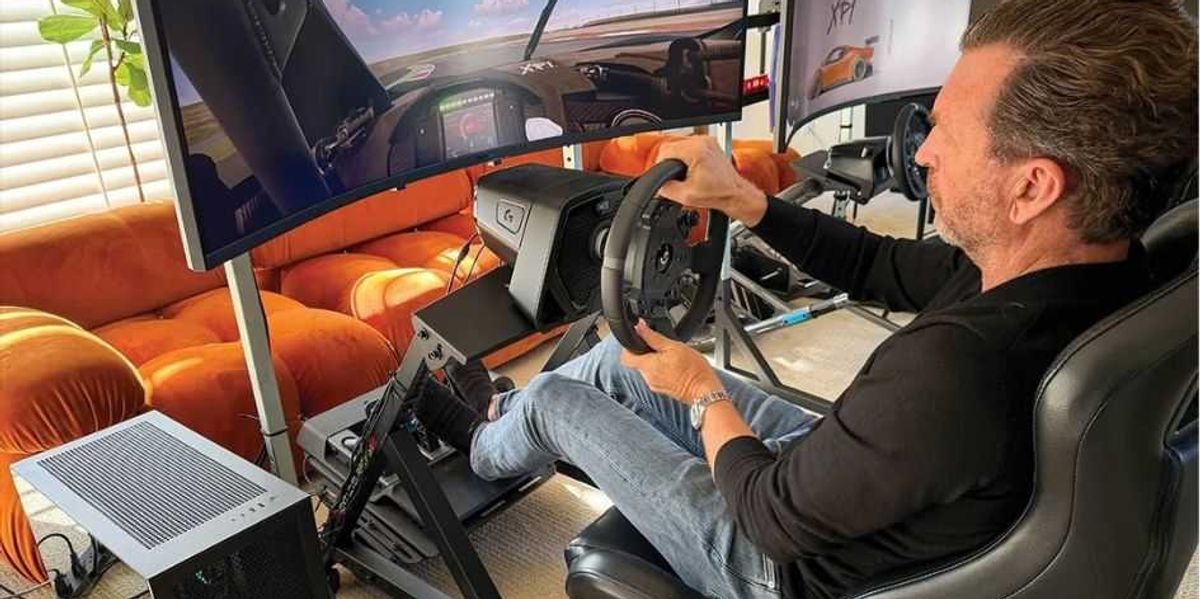

On a recent episode of “The Drive with Lauren and Karl,” we ended up talking about two very different corners of car culture: a hyper-realistic driving simulator developed by our guest, automotive journalist Mike Harley, and the latest wave of Hollywood car movies built around classic, analog machines.
At first glance, those topics have nothing in common.
Traditional sims feel artificial, with exaggerated inputs and inconsistent feedback.
But taken together, they point to something bigger: Driving is splitting into two worlds. One is becoming more digital, more controlled, and more simulated. The other is maxing out on the emotional, physical experience that made people fall in love with cars in the first place.
A new kind of driving experience
Harley is co-founder of Idaho-based Marble Labs, the company behind new driving simulator XP1.
More than 10 years in the making, XP1 eschews the old-fashioned arcade mechanics in order to replicate real driving — how a car responds to steering input, braking, weight transfer, and grip. That may sound like what simulators have always promised, but most drivers know the difference immediately. Traditional sims feel artificial, with exaggerated inputs and inconsistent feedback.
XP1 is trying to change that.
Instead of force-feedback approximations, it uses a physics-based model designed to behave like an actual vehicle. The goal is simple: Make what you’ve learned behind the wheel of a real car carry over naturally into the simulation.
That has promising real-world applications. A teenage driver can practice without risk. A senior driver can regain confidence without the pressure of real traffic. An enthusiast can work on technique — braking, cornering, control — without paying for tires, fuel, or repairs.
And it doesn’t require a five-figure investment. Harley built it to run on a standard PC with a basic, affordable wheel-and-pedal setup.
That matters, because as driving becomes more expensive, more regulated, and in some cases less accessible, simulation starts to look less like a novelty and more like a practical tool.
The limits of going digital
But even as simulation improves, it highlights what can’t be replicated. You can model physics, recreate vehicle dynamics, and simulate environments.
What you can’t fully reproduce is emotion.
That came up repeatedly in our conversation when we shifted from simulators to real-world vehicles — especially performance cars. Automakers like Lamborghini and Porsche have already started pulling back from plans to go fully electric in certain segments, not because they can’t build fast EVs, but because something is missing.
Sound, vibration, feel. In other words, the mechanical connection between driver and machine.
A car that goes from zero to 60 in under two seconds is impressive. But if it does it silently, without drama, without feedback, many drivers — especially enthusiasts — find the experience incomplete.
RELATED: No new cars under $50K? Thank the government
NurPhoto/Getty Images
Hollywood still gets it
If you want to see where car culture still lives, look at what Hollywood is making.
Car correspondent Josh Hancock dropped by to show that studios get that driving is an emotional experience, not just a technical one. The upcoming reboot of “The Rockford Files” is reportedly looking at classic Pontiac Firebirds. The success of “F1” has already sparked a sequel. “Days of Thunder” is returning. New films like “Crime 101” are built around analog cars — Camaros, Challengers, V8 sedans — shot with practical effects, not just digital ones.
Filmmakers understand something the industry sometimes forgets: People don’t connect with cars purely because they are efficient. They connect with them because they feel something when they drive them.
And that’s something simulation, no matter how advanced, is still chasing.
Two paths forward
What’s emerging is not a replacement of one world by another, but a split.
On one side, driving becomes more digital:
- simulators for training and practice;
- electric vehicles focused on efficiency and performance metrics; and
- increasing reliance on software and automation.
On the other side, driving remains physical:
- internal combustion engines, especially in enthusiast segments;
- vehicles designed around feel, not just function; and
- cultural reinforcement through movies, media, and lifestyle.
These two paths can co-exist; in fact, they probably have to.
By reducing costs and expanding access to training, simulations can help drivers improve. But no amount of virtual sophistication can replace the reason people care about driving in the first place.
The bottom line
Technology is changing how we drive — and in some cases, whether we need to drive at all.
But it hasn’t changed why people care about cars.
The rise of advanced simulators like XP1 shows how far digital driving has come. The resurgence of analog car culture in movies shows how much of the experience still depends on something real.
You can listen to the full episode of “The Drive with Lauren and Karl” featuring Mike Harley below:
Read the full article here



![Florida Woman Arrested for Urinating All Over Two Airbnbs, Uploading Videos to Adult Websites [WATCH]](https://www.lifezette.com/wp-content/uploads/2026/03/2026.03.23-10.50-lifezette-69c11b0eabd28.jpg "Florida Woman Arrested for Urinating All Over Two Airbnbs, Uploading Videos to Adult Websites [WATCH]")