


One of the most disturbing social and political trends of the 20th and 21st centuries has been the increasing secularization of American politics and America itself.
It’s hard to say when it began, because the de-Christianization of the West among intellectuals dates back to the 19th century and slowly spread from there, as ideas so often do. Slowly but surely, the First Amendment was reinterpreted to require hostility to religion per se, rather than government neutrality toward any particular sect.
So we have arrived at the point today that “Christian nationalist” has become a buzzword in daily life—an insult hurled by liberals at ordinary people who believe in America, believe in God, and who still believe Western Civilization is worth preserving and defending.
America’s 250th birthday fast approaches in a political environment where the vast majority of liberals say they are not proud to be Americans, where over half of Democrats say they would prefer to live in another country, I think it makes sense to look back at the ideals of our Founders to understand why religion, and Christianity in particular, was vital to the success of the American project, and why the growing hostility to Christianity is so deeply linked to the hostility that many liberals feel to America today.
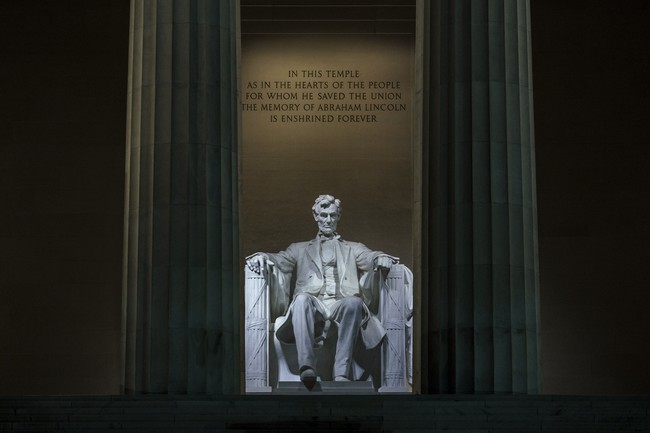
I count Abraham Lincoln among our nation’s founders for a simple reason: he was the president who preserved the Union, of course, but more than that, he did so on the basis of reaffirming the very principles that were first outlined in the Declaration of Independence, pointing past the legal framework of the Constitution to the moral and ideological framework that made it possible.
When we speak of America’s 250th birthday, we are not pointing back to the day the Constitution was ratified, but rather to the signing of the Declaration of Independence. July 4, 2026, is 250 years from July 4th, 1776. Nobody can tell you off the top of their head when the Constitution was finally ratified, nor even what state was last to do so, putting it into effect. (If you need a refresher, and I bet you do—I did!—you can find the info here.)
But we all know July 4th, 1776. It is universally the date we answer when asked when America was founded.
In Lincoln’s Gettysburg Address, the famous line “Four score and 7 years ago” also refers to 1776. America was born that year, not when we became a legal country, but when we united in an idea. And that idea was that our rights come from God.
No man is king because God is King.
Jefferson expressed this ecumenically, but not atheistically. He asserted that Human Rights come from”Nature and Nature’s God.”
Lincoln understood that the real cause of the Civil War was our failure to live up to God’s commandments. He was quite clear about this in his Second Inaugural Address, which was, as was his wont, brief, to the point, and profound.
Everybody remembers the final paragraph, and it is worth repeating, but it is not the one relevant to my thoughts here:
“With malice toward none with charity for all with firmness in the right as God gives us to see the right let us strive on to finish the work we are in to bind up the nation’s wounds, to care for him who shall have borne the battle and for his widow and his orphan ~ to do all which may achieve and cherish a just and lasting peace among ourselves and with all nations.”
Those are beautiful words, and that is why they still ring true today. But the words that preceded them are as important because they explain why Lincoln thought that the war was inevitable and worth fighting.
The relevant passage I am thinking of is this:
“One eighth of the whole population were colored slaves not distributed generally over the union but localized in the southern part of it. These slaves constituted a peculiar and powerful interest. All knew that this interest was somehow the cause of the war. To strengthen perpetuate and extend this interest was the object for which the insurgents would rend the Union even by war while the government claimed no right to do more than to restrict the territorial enlargement of it. Neither party expected for the war the magnitude or the duration which it has already attained. Neither anticipated that the cause of the conflict might cease with or even before the conflict itself should cease. Each looked for an easier triumph and a result less fundamental and astounding. Both read the same Bible and pray to the same God and each invokes His aid against the other. It may seem strange that any men should dare to ask a just God’s assistance in wringing their bread from the sweat of other men’s faces but let us judge not that we be not judged. The prayers of both could not be answered ~ that of neither has been answered fully. The Almighty has His own purposes. ‘Woe unto the world because of offenses for it must needs be that offenses come but woe to that man by whom the offense cometh.’ If we shall suppose that American slavery is one of those offenses which in the providence of God must needs come but which having continued through His appointed time He now wills to remove and that He gives to both North and South this terrible war as the woe due to those by whom the offense came shall we discern therein any departure from those divine attributes which the believers in a living God always ascribe to Him. Fondly do we hope ~ fervently do we pray ~ that this mighty scourge of war may speedily pass away. Yet, if God wills that it continue until all the wealth piled by the bondsman’s two hundred and fifty years of unrequited toil shall be sunk and until every drop of blood drawn with the lash shall be paid by another drawn with the sword as was said three thousand years ago so still it must be said ‘the judgments of the Lord are true and righteous altogether.’
To the modern mind shaped by reading X posts and bon mots, that is a mouthful to digest, but it’s worth contemplating Lincoln’s meaning.
His point is not difficult to discern: America was founded to embrace God’s will for how human beings should rightly flourish, as free human beings. The Declaration of Independence embodied that idea, and the initial pragmatic compromises necessary to pass the Constitution created the inevitable clash between God’s will and the Republic as it was.
The Civil War’s cost—which took the lives of more Americans than every other war we have fought combined—was the necessary price we paid to submit to God’s will. It was a price worth paying to fulfill God’s vision.
Without Christian faith, what price in blood and treasure are men willing to pay for His justice? Pragmatically speaking, wouldn’t it make more sense to just let the United States split in two? What justification, aside from a higher calling, could be given for the unimaginable cost borne by Americans?
Three-quarters of a million Americans, more or less, died during the Civil War. That’s about 2.5% of the country’s population, a figure that is hard to comprehend.
For that matter, could George Washington have held the Continental Army together if all that the soldiers were fighting for was lower taxes on tea or a representative in the British Parliament? Jefferson himself, in the Declaration, reminded us that people do not revolt over small matters. Wars are terrible things, and compared to the average Englishman, Americans were wealthy.
We didn’t fight for better living standards; we fought to establish a domain that fulfilled God’s vision for man: freedom and self-government. .
Both the Civil War and the Revolution were ultimately fought over the American understanding of God’s plan for human beings and the fundamental autonomy and moral worth of each human being. America, Lincoln believed, was not just another country. If it were to truly be one nation, under God, we owed it to God to live by His light and plan for human flourishing.
Lincoln’s point in his Second Inaugural Address was clear: Americans were paying a blood debt to God, and that debt was just, if terrible to bear.
If we shall suppose that American slavery is one of those offenses which in the providence of God must needs come but which having continued through His appointed time He now wills to remove and that He gives to both North and South this terrible war as the woe due to those by whom the offense came shall we discern therein any departure from those divine attributes which the believers in a living God always ascribe to Him.
Lincoln was not blaming the Southerners for the war or demonizing them, as both this passage and his final one make clear. All Americans owe to God a penance for our common sins, and when we expiate them, we will gain His blessings as promised.
John Adams made a similar point when the Constitution was adopted. He understood that for America to work, it must be built on a foundation of virtuous People. Freedom, without virtue to guide it, is little more than a license to pursue sybaritic pleasures.
“Our Constitution was made only for a moral and religious People. It is wholly inadequate to the government of any other.”
Our Founders, including Lincoln here, understood the interconnection between a Liberal Democracy and Christian virtue. Without a deep belief in God, all becomes pragmatic compromise and personal interest. Many have tried to devise non-theistic theories of how to construct free societies without a moral foundation—based on “self-interest rightly understood” alone, but no foundation for freedom is so secure as a faith in God that sustains us when tyranny threatens.
A virtuous people would courageously defend the rights endowed by their Creator and restored by the blood of patriots. But a fearful people would readily cede these rights in exchange for a fleeting sense of security. As Princeton’s Robbie George explains, “[P]eople lacking in virtue could be counted on to trade liberty for protection, for financial or personal security, for comfort … for having their problems solved quickly. And there will always be people occupying or standing for public office who will be happy to offer the deal.”
They say there are no atheists in a foxhole, and that has more than one meaning. Not only are we most likely to appeal to God when faced with imminent death, but most of us are unlikely to risk death without an abiding cause to motivate us.
“Freedom” is an abstraction to many unless it is tied to something more than just “doing what you want.” Man’s lot is not just to be free from constraint, but free to aspire to become something nobler than a smarter ape.
We are made in the image of God. True freedom is living up to that calling, not just enjoying what you do while you are here.
Lincoln understood that; in his eyes, that justified the terrible war that secured America’s place as the most blessed country on Earth, and thus ensured that America would stand astride the world as a Colossus and beacon of freedom 250 years after the Declaration of Independence was signed.
Editor’s Note: Here at HotAir, we’ve been dealing with real government suppression of free speech for YEARS. Despite the threats and consequences, we refuse to go silent and remain committed to delivering the truth.
Help us fight back against government censorship by joining HotAir VIP and using promo code FIGHT to receive 60% off your membership.
Read the full article here

![Dem Rep Melts Down Over SCOTUS Ruling, Says Grocery Prices Will Rise Without Haitian Migrants [WATCH]](https://www.lifezette.com/wp-content/uploads/2025/05/2025.05.28-02.05-lifezette-6837181365230.jpg "Dem Rep Melts Down Over SCOTUS Ruling, Says Grocery Prices Will Rise Without Haitian Migrants [WATCH]")

![Anthropic Drops $40M Into AI Regulation War as Lawmakers Warn of Power Grab [WATCH]](https://www.lifezette.com/wp-content/uploads/2026/09/2026.09.19-14.55-lifezette-6aaea25e512d4.jpg "Anthropic Drops $40M Into AI Regulation War as Lawmakers Warn of Power Grab [WATCH]")