




WHAT YOU NEED TO KNOW
- Gen. Dan Caine said U.S. forces must be prepared to fight from the seabed to cislunar space.
- Space Force acknowledged placing offensive weapons into orbit but has not disclosed their number or type.
- Cold War planners explored lunar bases, Moon based bombardment and weapons designed for soldiers operating on the lunar surface.
- Modern concepts include kinetic and non-kinetic systems for countering satellites, though kinetic strikes could generate dangerous orbital debris.
The top officer in the U.S. military said this week that American troops must be prepared for combat not only on Earth, but also across the vast region extending toward the Moon.
Speaking at the Air, Space and Cyber Conference, Chairman of the Joint Chiefs of Staff Gen. Dan Caine said the military must take steps so it “is prepared to fight, endure and win […] from the seabed to cislunar space.”
Caine’s remarks followed a disclosure from Secretary of the Air Force Troy Meink, who revealed days earlier that Space Force had placed weapons into orbit.
It marked the first acknowledgement that the U.S. military had deployed offensive capabilities in orbit.
Gold. Upgraded. Buy real gold from $1. Store it in America. Sell it with one click.
Space Force has not disclosed how many “space control weapons” were sent into orbit.
It also has not identified what types of weapons were deployed, leaving the nature and extent of those capabilities unclear.
Despite the new acknowledgement, military planners have studied and theorized about armed conflict in space and on the Moon for decades.
This Could Be the Most Important Video Gun Owners Watch All Year
During the Cold War, multiple branches examined ways to transport forces into space, operate beyond Earth and conduct combat missions.
Beginning in the 1950s, the armed forces considered plans to operate from, fight on or even attack the Moon.
Several of those proposals emerged amid the panic generated by the Soviet Union’s launch of Sputnik.
The Air Force proposed establishing a military base on the lunar surface. That concept included what planners called a highly accurate “Lunar Based Earth Bombardment System,” putting the Moon at the center of an imagined military strike capability.
The Army developed its own lunar concept known as Project Horizon.
The plan envisioned a Moon base staffed by several soldiers and protected using weapons specifically designed for conditions on the lunar surface.
During the 1960s, before NASA sent people to the Moon, the Army considered the accelerating pace of spaceflight evidence that such a base could become a realistic possibility. It also examined weapons that soldiers might use there, including pistols powered by springs.
An Air Force film released in 1963 presented another vision of future combat in space.
The animated film depicted small spacecraft resembling fighter jets operating from a docking station and conducting combat sorties in orbit.
Those sweeping lunar military ideas eventually lost favor after the Space Race slowed and the formidable realities of reaching the Moon became clearer.
The concept of armed forces routinely operating from the lunar surface receded with it.
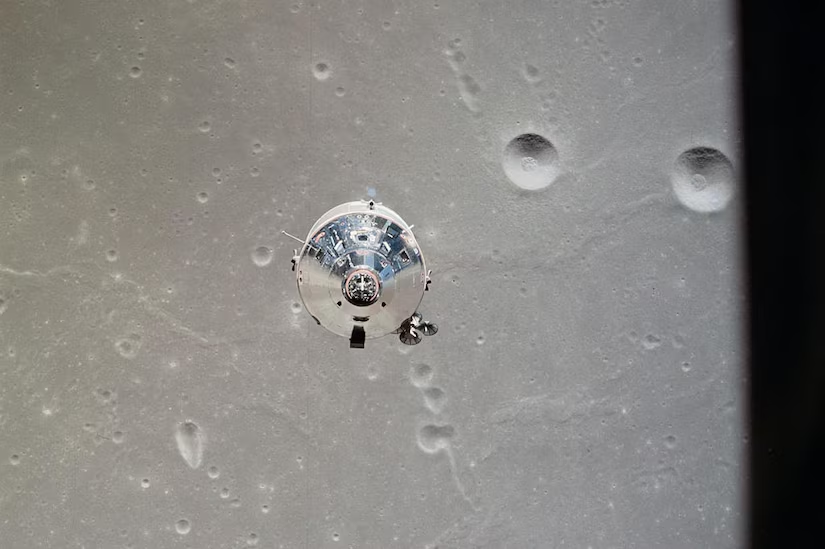
Today’s military discussions have focused more broadly on potential conflict in space rather than combat specifically on the Moon.
In recent months, Space Force leaders have discussed “orbital warfare” while examining methods for defending against hostile satellites.
The type of weapon placed into orbit by the United States remains unclear. Options discussed by the military have included both kinetic and non-kinetic weapon systems, which would approach threats in orbit through fundamentally different methods.
Kinetic systems can use projectiles or explosives against objects in orbit, and such technology is not new.
Anti-satellite systems, also known as ASAT systems, have been under development for years.
Those systems carry a major complication because destroying objects in orbit can generate additional space debris.
That debris could endanger other satellites or spacecraft operating in the same increasingly contested environment.
The United States and other countries have therefore examined non-kinetic alternatives, including electromagnetic jammers and directed-energy systems.
Such weapons could disable an adversary’s satellites without producing a cloud of hazardous wreckage in orbit.
Space Force has acquired systems using those types of non-kinetic capabilities.
However, the systems it has obtained are based on Earth rather than deployed in orbit, unlike the newly acknowledged and still unidentified orbital weapons.
Gold is the oldest answer. SoundMoney makes owning it as easy as the apps you already use.
The opinions expressed by contributors and/or content partners are their own and do not necessarily reflect the views of LifeZette. Contact us for guidelines on submitting your own commentary.
Read the full article here






![The Three Greatest Scandals of the 21st Century [WATCH]](https://www.rvmnews.com/wp-content/uploads/2026/09/2026.09.21-15.15-rvmnews-6ab14a14594b1.jpg "The Three Greatest Scandals of the 21st Century [WATCH]")