
Influential economist Alan Greenspan died Monday morning at the age of 100.
NBC News journalist Andrea Mitchell announced to CNBC that her husband of nearly three decades died from complications of Parkinson’s Disease.
Greenspan headed the Federal Reserve for nearly two decades, and served the second longest tenure — just four months short of William McChesney Martin.
He was appointed chairman in 1987 by President Ronald Reagan and held the position until his retirement in 2006, serving under four presidents; Ronald Reagan, George H.W. Bush, Bill Clinton and George W. Bush.
WASHINGTON, DC – OCTOBER 5: Economist and former chairman of the Federal Reserve Board, Alan Greenspan in his office on October 5, 2007 in Washington, DC. Greenspan, born March 6, 1926 in New York City, is an American economist and was Chairman of the Board of Governors of the Federal Reserve of the United States from 1987 to 2006. He currently works as a private advisor making speeches and providing consulting for firms through his company, Greenspan Associates LLC. (Photo by David S. Holloway/Getty Images)
Greenspan guided the U.S. economy through a series of turbulent and defining moments, including the 1987 stock market crash, the Asian financial crisis, the dot-com boom and bust, and the aftermath of the Sept. 11 terrorist attacks.
He quickly became known for his cryptic public remarks, and became a Wall Street celebrity during the economic expansion of the 1990s, earning the nickname “the Maestro.”

WASHINGTON, DC – DECEMBER 04: Alan Greenspan and TV Personality Andrea Mitchell (R) arrive at the 34th Kennedy Center Honors held at the Kennedy Center Hall of States on December 4, 2011 in Washington, DC. (Photo by Michael Tran/Getty Images)
His infamous 1996 warning about “irrational exuberance” remains one of the most famous phrases in modern economic history.
Greenspan’s legacy was the subject of debate by some economists who argued that some of his policies may have laid the groundwork for the 2008 financial crisis.
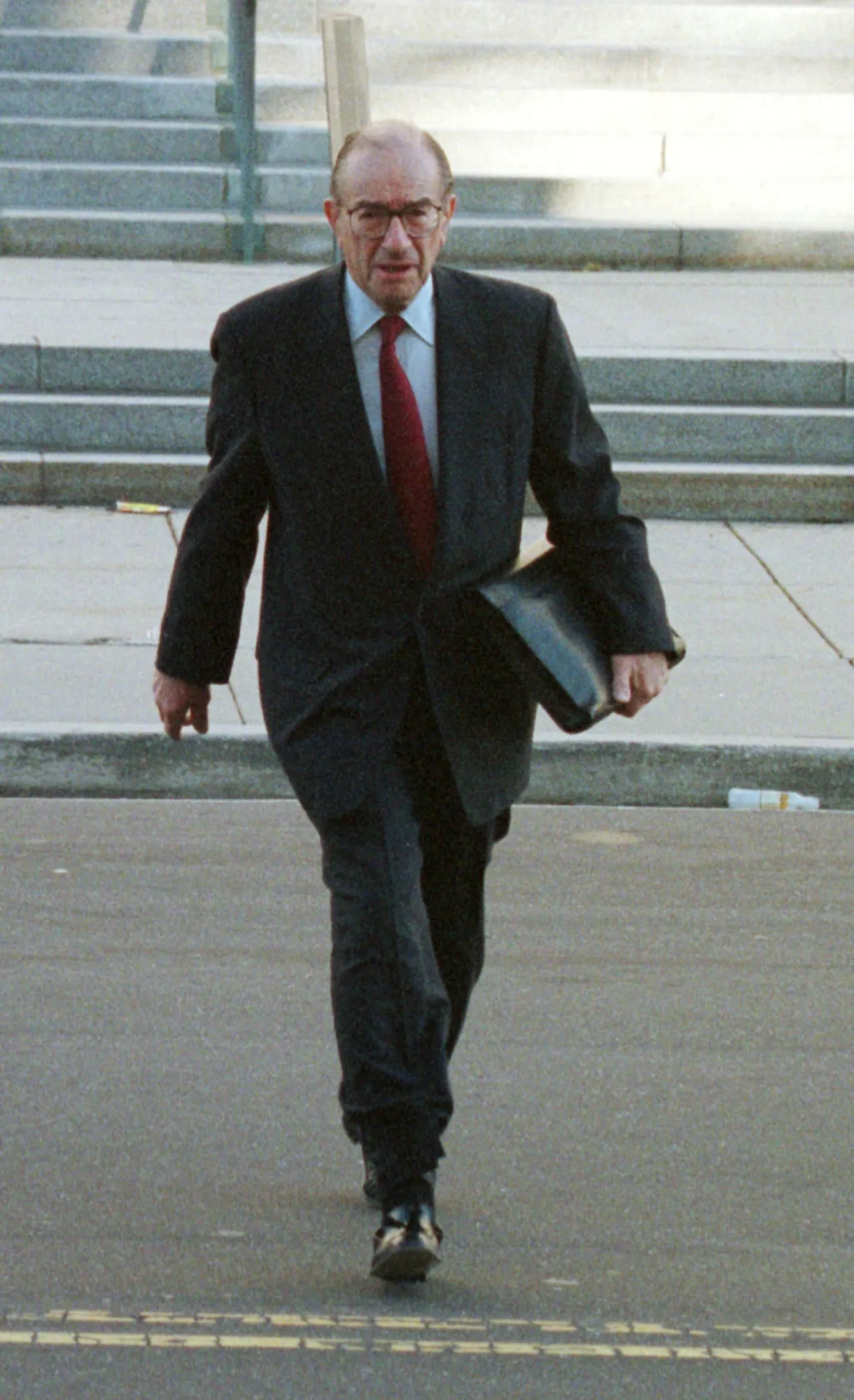
Federal Reserve Board Chairman Alan Greenspan arrives at the Federal reserve building, November 16,1999. The Federal Reserve Board is debating whether the buoyant U.S. economy needs another small increase in key interest rates this year to keep inflation at bay. (photo by Mark Wilson)
He had a profound impact on the global financial market, and was admired for his steady leadership during periods of instability and uncertainty. (RELATED: James Burrows, Legendary Director Of Television’s Most Iconic Sitcoms Including ‘Friends,’ ‘Cheers,’ Dead At 85)
Greenspan left behind a complex, but undeniable legacy as one of the most consequential figures in finance in modern history.
His impact on the global economy will continue to be studied and debated for generations to come.
Read the full article here


![Harmeet Dhillon Issues a Warning to All 50 States Ahead of 2026 Midterms [WATCH]](https://www.lifezette.com/wp-content/uploads/2025/08/2025.08.31-06.25-lifezette-68b4937d36547.jpg "Harmeet Dhillon Issues a Warning to All 50 States Ahead of 2026 Midterms [WATCH]")
![Fair Ride Accident Sends People Flying at the Wilson County Tennessee State Fair [WATCH]](https://www.lifezette.com/wp-content/uploads/2026/08/2026.08.22-15.15-lifezette-6a89bd05052fb.jpg "Fair Ride Accident Sends People Flying at the Wilson County Tennessee State Fair [WATCH]")