


The U.S. Supreme Court issued an order late Monday clearing the way for Louisiana to swiftly redraw its congressional map after finding the current districts unconstitutional in a decision striking down institutionalized racism.
The order clears the way for Louisiana lawmakers to begin redistricting in their state and halt the primary election originally scheduled for May 16 in the wake of the Louisiana v. Callais decision. Despite the start of early voting, Louisiana officials have already moved to delay the congressional races, according to the state’s Secretary of State website.
Justice Samuel Alito, who authored the order, stressed that while such secondary decisions can usually take over a month after the high court issues a judgment, in the case of Louisiana, the justices decided to expedite the order due to the proximity of the 2026 primary and general elections. (RELATED: Supreme Court Strikes Down Institutionalized Racism)
“To permit the losing party time to file a petition for rehearing, the Clerk of Court ordinarily waits 32 days after the entry of the Court’s judgment to send the opinion and a certified copy of the judgment to the clerk of the lower court,” Alito wrote, while noting that “this period is subject to adjustment.”
“The Callais appellees have asked for the Clerk to issue the judgment forthwith so that ‘in the event of a judicial remedy,’ the District Court may ‘oversee an orderly process.’ Appellant Louisiana does not oppose this application. And while the Robinson appellants oppose it, they have not expressed any intent to ask this Court to reconsider its judgment,” Alito added.
Under the new map, it is likely that Louisiana lawmakers will eliminate at least one of the state’s two Democratic-held congressional districts. (RELATED: Trump-Impeaching GOP Senator Reportedly Melted Down Over Not Getting Enough Money)
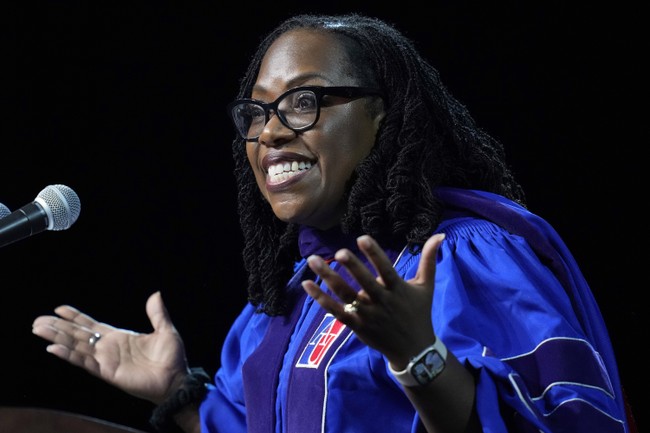
Notably, Alito — writing for the court’s majority — reserved much of his opinion for taking the newest associate justice, Ketanji Brown Jackson, to task over her lone dissenting opinion. “The dissent in this suit levels charges that cannot go unanswered. The dissent would require that the 2026 congressional elections in Louisiana be held under a map that has been held to be unconstitutional,” Justice Alito charged.
Justice Jackson, for her part, accused her colleagues of engaging in political “partiality.” “Not content to have decided the law, it now takes steps to influence its implementation,” she wrote of the majority.
Read the full article here