


The Supreme Court issued an 8-1 decision today that sided with a company, Havana Docks Corporation, which had sued over commercial use of docks which were expropriated after the Cuban revolution.
Havana Docks Corporation built Havana’s piers in 1905 for the Cuban government on the condition that it would operate the port for 99 years. Castro’s government seized the docks shortly after coming to power.
To be clear, Havana Docks Corp. didn’t own the land. It built the docks in exchange for the right to operate them and profit from them for 99 years. But when Castro seized power 54 years later, he expropriated the docks and kicked the American company out. Havana Docks filed a claim for its losses but never had any way to collect.
Before the Communist revolution in Cuba, U.S. companies owned or controlled most of the island’s electricity generation, its telephone system, much of its mining industry, sugar cane fields, and many oil refineries and warehouses. When Fidel Castro rose to power more than 60 years ago, he began confiscating the assets of all American-owned businesses. Most were transferred to state-owned companies controlled by the government.
American investors filed claims with the U.S. government through the Foreign Claims Settlement Commission, an agency at the Justice Department. In 1971, the commission certified the Havana Docks Corporation’s claim of $9.1 million, or nearly $100 million adjusted for inflation, which remains unpaid. In total, the commission certified $1.9 billion in claims held by almost 6,000 claimants, or about $9.3 billion in current value, according to the U.S.-Cuba Trade and Economic Council.
Things finally changed in 1996 with the passage of the Helms-Burton Act. However, activation of the act was left up to each U.S. president.
Lawmakers passed the Cuban Liberty and Democratic Solidarity Act, also known as the Helms-Burton Act, which declared that resolution of the property claims were a key condition for restoring economic and diplomatic ties with Cuba. It included a provision that provided a path for Americans to sue in federal court over the “trafficking” or use of assets seized by the Cuban government — now the key issue in the Supreme Court cases.
But the law gave presidents an on-off switch to suspend the provision and block the lawsuits, which were politically and diplomatically controversial. Presidents of both parties had suspended the provision until the first Trump administration activated it in 2019.
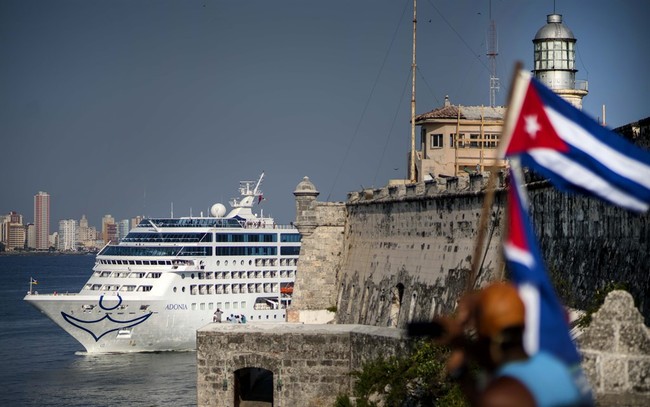
Given the opportunity, the company sued a group of cruise ship operators who had used the docks for commercial profit from 2016 to 2019.
After Trump opted not to renew the suspension, Havana Docks filed a lawsuit in Florida against four cruise lines – Royal Caribbean, Norwegian, Carnival, and MSC. Havana Docks contended that between 2016 and June 2019 the cruise lines had trafficked in property that had belonged to Havana Docks – the company’s right to use and operate the Havana Cruise Port Terminal, which the Cuban government confiscated in 1960.
A federal district judge in Miami awarded Havana Docks more than $400 million. The cruise lines subsequently appealed to the U.S. Court of Appeals for the 11th Circuit, which – by a vote of 2-1 – reversed.
And that brings us to today when the Supreme Court overruled the 11th Circuit in an 8-1 decision.
Writing for the majority, Justice Clarence Thomas explained that the key question in the case is whether, for purposes of the Helms-Burton Act, the “property which was confiscated by the Cuban Government” was Havana Docks’ right to use the docks (that is, the company’s “property interest in the docks”), or whether it was the docks themselves.
The answer to that question, Thomas continued, is that the “property which was confiscated” can refer both to “the plaintiff’s interest in that property” and, more broadly, to the physical property itself – such as the docks in this case. Therefore, Thomas wrote, “confiscated property” such as the docks “is, as it were, tainted—off limits—such that anyone who uses the property can be liable to those who had an interest in the tainted property.”
Applying that analysis to the case before him, Thomas reasoned that “the Cuban Government seized control of ‘property’—the docks that Havana Docks built—in 1960. At that point, the docks were tainted as confiscated property, … ‘the use of’ which the United States sought to ‘deter’” with the Helms-Burton Act. “The cruise lines later used the confiscated docks—property to which Havana Docks owns a certified claim—when they transported nearly a million passengers to Cuba between 2016 and 2019. The Court of Appeals therefore erred in concluding that Havana Docks failed to establish these requirements for” liability under the Helms-Burton Act.
There was a concurring decision from Sotomayor and Kavanaugh expressing concern that the current decision could allow Havana Docks to claim more in compensation than it was owed.
The lone standout this time was Justice Kagan who seems to have essentially agreed with the 11th Circuit that Havana Docks had no right to sue because it’s interest in the docks was always set to expire in 2004.
In her dissent, Justice Kagan agreed that the cruise lines were not liable because Havana Docks’ interest in the property had expired in 2004. The company was similar to a renter with a lease that had expired, she wrote.
“Had the cruise lines used the docks before 2004, Havana Docks would have a good argument,” she wrote, adding, “But the cruise lines did not use the docks until 2016 — years after Havana Docks’ concession was scheduled to expire.”
So that’s it. The timing of this is curious given that we’re currently applying a lot of pressure to Cuba to make a deal that would wind down the revolution in favor of something that could transition to democracy. In theory, this could open the door to a lot more lawsuits.
Editor’s Note: Do you enjoy HotAir’s conservative reporting that takes on the radical Left and woke media? Support our work so that we can continue to bring you the truth.
Join HotAir VIP and use promo code FIGHT to receive 60% off your membership.
Read the full article here


![SNL UK Savagely Roasts Prince Harry, Meghan Markle’s UK Return: ‘Daddy, I’m Home’ [WATCH]](https://www.boredtrashpanda.com/wp-content/uploads/2026/08/2026.08.21-16.42-boredtrashpanda-6a88800352be3-e1787330811159.jpg "SNL UK Savagely Roasts Prince Harry, Meghan Markle’s UK Return: ‘Daddy, I’m Home’ [WATCH]")