

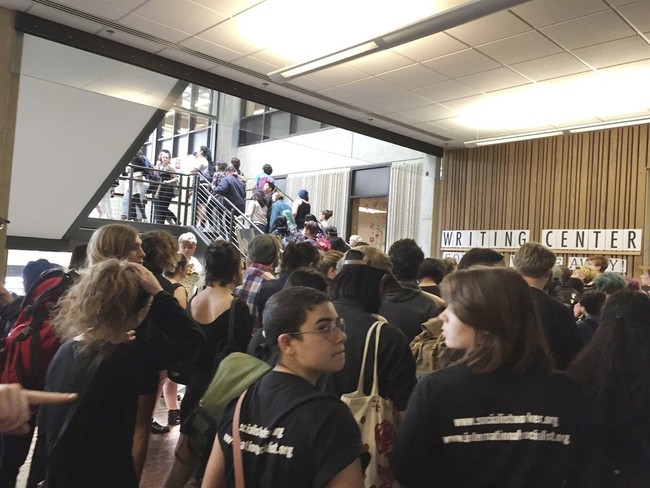

I noticed a few people on X recommending this story at the Atlantic by Tyler Austin Harper. Harper is a staffer at the Atlantic but this story in particular is very personal. It’s basically his first hand account of taking his dream job in academia just as campuses nationwide were going off the rails with wokeness.
Harper describes himself as a light-skinned black man and that turns out to be rather important in this story, primarily because it seems to have greatly influenced how he was treated at Bates College in Maine. He got the job at the very end of 2019, just as the pandemic was being unleashed on the world. And at first he really thought he’d won the lottery. While everyone he knew in academia was struggling, he was offered a tenure-track position with a decent salary.
The town of Lewiston, where Bates College sits, reminded him of the city in Pennsylvania where he’d grown up. But early on one of his neighbors suggested that the town was full of rampant racists. This seemed odd to him but he was starting a new job and didn’t think too much of it. His view of campus wokeness was that it was some kind of Fox News-invented scam. And yet, the direction the school seemed to be going didn’t immediately win him over.
Around the start of the semester, I attended an informal orientation event for early-career Black faculty, where I assumed we would talk about our research interests or simply get to know one another. Instead, the gathering felt more like a combined therapy session and HR seminar. At one point, someone casually rattled off a series of local establishments to steer clear of, vaguely implying that they were filled with bigots. Alarmed by the notion that race relations were so bad in Lewiston that there were places I should avoid eating, I asked why one restaurant in particular had earned a reputation for intolerance. My colleague said that a student of color had worked there and not liked it very much.
One day a fellow professor wrote to him saying that one of his students, a white progressive, had effectively lynched a black student. How? He and his roommates had demanded the black student move out of their shared apartment and threatened to call the police if he tried to enter to get his belongings.
Whatever had happened among those students, and whoever had been at fault, I was sure the conflict was not driven by racial hatred. I was also troubled by the evidence-free assumption that an encounter between a Black liberal-arts-college student and the police was so likely to end in death that calling 911 was tacitly homicidal…
I came to understand the Mason affair as emblematic of the kind of “politics” that dominated at Bates, a place where current and future elites paid—or were paid—for the privilege of cosplaying as radicals, victims, or both. In this upside-down, 133-acre world, an “attempted lynching” was a graver threat to Black undergraduates than student debt, and faculty needed protection from their own students. Some of my colleagues, it seemed, were engaged in an Alice in Wonderland–style reenactment of civil-rights-era struggles, in which glancing racial faux pas and willfully misinterpreted private encounters were treated with the solemnity of nooses swinging from oak trees.
By the fall of 2021, the desire to fully embrace identity politics had taken over the campus.
The dean explained that every department and program at Bates was to complete a racism self-audit. The goal of this project, innocuously called Foundational Dialogues, was to identify areas where white supremacy, “colonial” frameworks, and other forms of bias might be lurking in curricula and major requirements. To facilitate this work, departments were required to bring in an external consultant. Each major would produce a “curricular transformation plan” and deliver the report to the dean’s office.
Given that the transformation plan was mandatory, We didn’t unearth any white supremacy hidden in our astronomy courses clearly would not be an acceptable verdict.
By his third year at Bates, Harper had become convinced that he was basically unfireable because of the current climate on campus. And that meant he could afford to say what he was really thinking. He wound up writing an op-ed for the Boston Globe.
But what really set Harper off was the way the faculty approached hiring. On one occasion he saw them talk themselves into hiring a woman who was clearly not qualified. She was not hired only because the dean, who was in the same field, overruled them. In another case, the they failed to hire a professor who clearly was qualified because another applicant was more “diverse.” Not long after, Harper decided to abandon his academia career completely.
In a consultant-led meeting I attended near the end of my time at the college, one month into Donald Trump’s second term, the small group of professors and senior administrators present was asked to share what it saw as Bates’s greatest strengths and weaknesses. One of my colleagues said that the college’s greatest strength was its commitment to DEI. Another said that the college’s greatest weakness was that it could be even more committed to DEI. Someone lamented that our ties to the Wabanaki Nations could have been stronger.
It’s a lengthy article and I’ve really glossed over some of the highlights, if you can call them that. It’s definitely worth a read if you have the time.
Editor’s Note: President Trump is fighting to ensure America’s kids get the education they deserve.
Help us fight back against Big Government waste and restore power to the states. Join HotAir VIP and use promo code FIGHT to receive 60% off your membership.
Read the full article here

![Colombia Building Collapse Caught on Camera as Massive Quake Takes 111 Lives [WATCH]](https://www.rvmnews.com/wp-content/uploads/2026/08/2026.08.11-14.51-rvmnews-6a7b370301352.jpg "Colombia Building Collapse Caught on Camera as Massive Quake Takes 111 Lives [WATCH]")