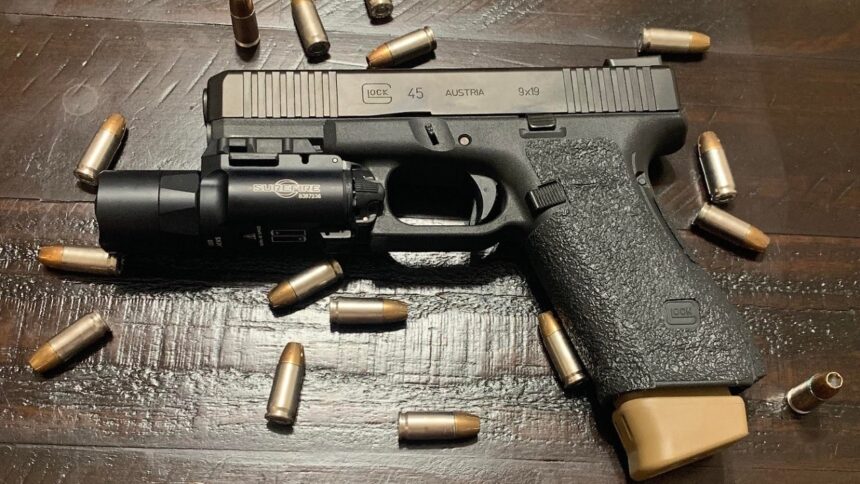

As I’ve mentioned before, Glock model nomenclature can be confusing. While the Glock 17 refers to the magazine capacity, the Glock 45 is chambered in 9mm Parabellum, not .45 ACP. The Glock 45 is a compact pistol. Its slide is 7.44”, just one-tenth of an inch longer than that of a Glock 19, and its overall height is 5.47″, the same as that of a Glock 17. The Glock 45 blends a compact slide with a full-size frame to create a crossover pistol that holds 17+1 rounds of 9mm Parabellum ammunition.
The weapon features a flared magazine well and front cocking serrations for easier reloads and better manipulation. The Compact Crossover in Black is another outstanding pistol.
Glock 45. Image Credit: Creative Commons/Glock Handout.
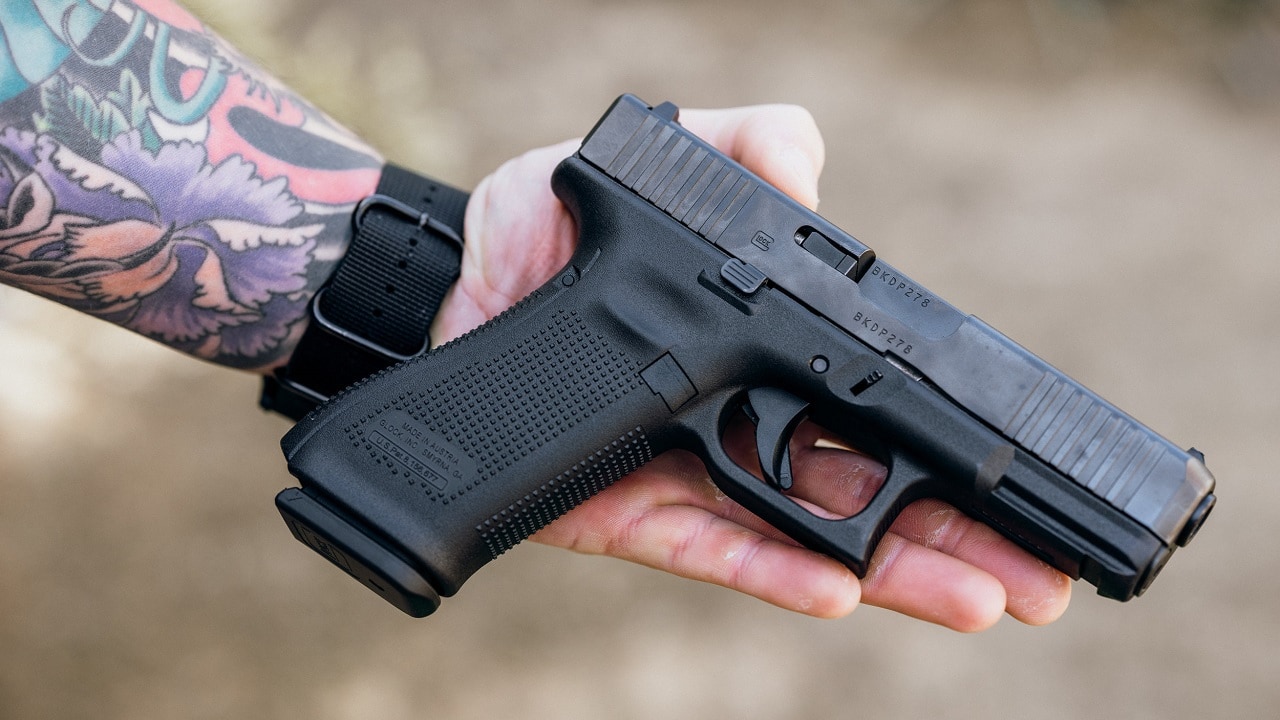
Glock 45. Image Credit: Creative Commons.
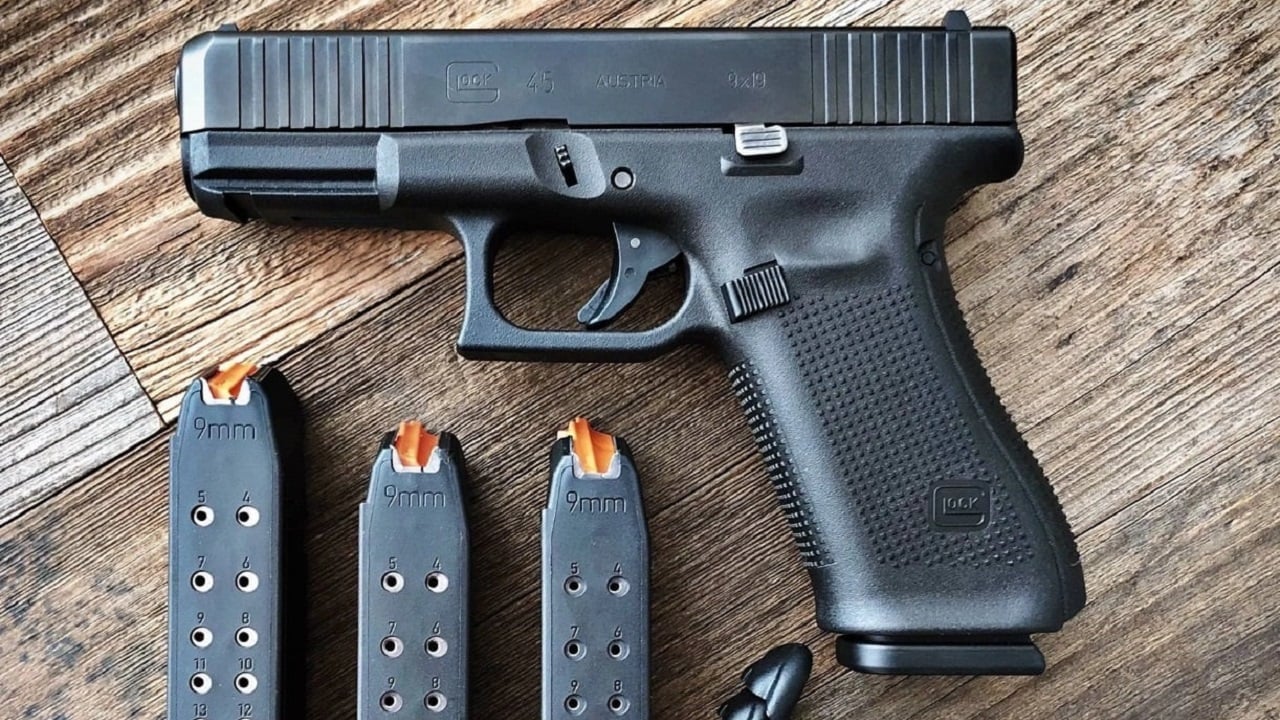
Image of a Glock 45. Image Credit: Creative Commons.
When Glock introduced the original G45 back in 2018, it filled a gap that many duty-minded shooters didn’t realize they wanted filled.
Rather than forcing a choice between the all-day concealability of a compact slide and the shootability of a full-size grip, the G45 combined both into what Glock calls a “crossover” pistol.
The Glock 45 Gen 6 update, arriving alongside refreshed versions of the G17, G19, and G26, doesn’t so much reinvent that formula as sharpen it.
For anyone evaluating a duty sidearm or a concealed-carry piece that still shoots like a full-size gun, the Glock 45 Gen 6 deserves a serious look.
Glock’s Crossover Concept, Refined
The core idea behind the G45 hasn’t changed: pair a Glock 19-length compact slide with a Glock 17 full-size frame.
The result is a pistol with a 4.02-inch barrel and a fairly compact overall footprint, but with the higher 17+1 magazine capacity and the fuller grip of a duty gun.
That combination makes for a very versatile pistol.
A shorter slide is easier to conceal and quicker to bring on target, while a full-length grip gives your support hand more real estate to work with, which translates into better recoil control and faster follow-up shots.
Gen 6 keeps that same architecture, but Glock has added some nice refinements.
The most immediately noticeable is the reworked RTF6 grip texture, which is more aggressive than the Gen 5 texture without becoming abrasive against skin during extended range sessions or long duty shifts.
Combined with a palm swell and forward-set thumb rests, the grip locks into the hand more consistently than earlier generations, particularly for shooters with larger hands who found the old finger-groove-free grip a little too plain.
The Glock 45 Trigger and Optics
Two other Gen 6 changes stand out for duty and carry use. First, the pistol ships with a crisper, angular, flat-faced trigger as standard equipment, not an aftermarket upgrade.
Flat triggers tend to produce more consistent finger placement shot to shot, and most shooters find the break more predictable than Glock’s traditional curved trigger, even if the actual pull weight isn’t dramatically different, which has always seemed to me a bit mushy.
Second, Gen 6 pistols come optics-ready out of the box.
Glock has moved to a more integrated mounting system, replacing the older MOS plate-based setup on some models with a more directly milled approach, though MOS-pattern options remain available depending on the configuration.
For a duty officer or a CCW holder who wants a red dot, this removes a step that previously required either a factory MOS purchase or aftermarket milling.
Many shooters have opted for the Trijicon RMR HD / RMR Type 2, widely considered the gold standard for rugged, duty-ready performance, and it mounts flush via Plate #02.
In addition, Gen 6 also brings front and rear slide serrations for easier manipulation during administrative loading or malfunction clearance, a reversible magazine catch, an ambidextrous slide stop lever, and a flared magwell that speeds up magazine changes under stress, all details that matter more in a duty or self-defense context than they do for a range weapon.
The Glock 45 Is An Excellent Duty Weapon
For law enforcement and security applications, the G45 Gen 6’s case is straightforward. It offers full-size capacity and control in a package that’s easier to run from a retention holster and less fatiguing to carry for a full shift than a true full-size slide.
The 17+1-round magazine capacity matches the G17, so you don’t lose capacity by choosing the shorter slide.
It requires no extra training for anyone who has owned or been issued a Glock.
The optics-ready slide also aligns the G45 with where duty doctrine is headed, as more agencies are moving toward red-dot-equipped sidearms as the new standard rather than the exception.
The G45 As A Concealed Carry Weapon
The CCW case is a bit more nuanced. The G45’s grip length is closer to that of a full-size G17 than to a subcompact like the G26 or G43X, which means concealment under thinner clothing is harder than with a true compact-carry gun.
However, the shorter slide keeps muzzle printing to a minimum, and for shooters who carry appendix or strong-side with a good gun belt and a quality holster, the extra grip length is often a worthwhile trade-off for improved shootability.
It’s a pistol that rewards a “if you can conceal it, carry the bigger gun” philosophy rather than one built around minimal bulk.
Shooters coming from a G19 who want more capacity and a steadier platform without jumping all the way to a G17 will likely find the G45 Gen 6 a natural step up.
Those prioritizing maximum concealability above all else may still be better served by a subcompact.
The Bottom Line Is The G45 Gen 6 Is Just A Better Version
The Glock 45 Gen 6 isn’t a dramatic reinvention, and it isn’t meant to be. It’s an incremental but genuinely useful refinement of a pistol that already solved a real problem: how to get full-size shootability without a full-size footprint.
The improved grip texture, standard flat trigger, and optics-ready slide bring it in line with where expectations for both duty and defensive carry have moved.
The G45 Gen 6 is one of the most compelling options on the market for anyone looking for a duty or CCW pistol.
About the Author: Steve Balestrieri
Steve Balestrieri is a National Security Columnist. He served as a US Army Special Forces NCO and Warrant Officer. In addition to writing on defense, he covers the NFL for PatsFans.com and is a member of the Pro Football Writers of America (PFWA). His work was regularly featured in many military publications



![Meloni Unveils Sweeping Burqa Ban and Migrant Classroom Limits [WATCH]](https://www.lifezette.com/wp-content/uploads/2026/09/2026.09.21-10.37-lifezette-6ab108ec70674.jpg "Meloni Unveils Sweeping Burqa Ban and Migrant Classroom Limits [WATCH]")