
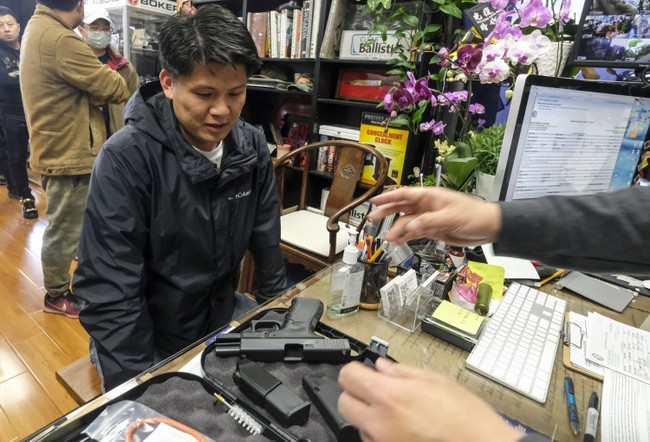

According to the Tenth Circuit Court of Appeals, the 7-day waiting period on gun sales that New Mexico Democrats put in place violates the Second Amendment’s protections on the right to keep and bear arms. What about Colorado’s three-day waiting period?
That’s subject to an entirely different legal challenge, and oral arguments are coming up in district court next week. National Association for Gun Rights’ Hannah Hill highlighted a somewhat unusual agenda for the arguments laid out by U.S. District Judge John L. Kane that suggests he already knows what he wants to decide, but might need some help from the Colorado attorneys with an argument that will stick.
Next Monday, @RMGOColorado’s lawsuit against the CO 3-day waiting period will have oral arguments. The district court judge just published a detailed agenda that reads like a desperate request for CO’s attorneys to find him some grounds to uphold this law. pic.twitter.com/hdKoLtb6IH
— Hannah Hill (@hannahhill_sc) August 19, 2026
Honestly, this should be an extremely easy case for Judge Kane, so long as he’s willing to follow Tenth Circuit precedent. Two years ago, in Ortega v. Grisham, the appellate court concluded that because the right to keep and bear arms necessarily encompasses the right to acquire them, New Mexico had to justify its waiting period by pointing to analogous laws from our nation’s past. It couldn’t do so, at least not to the court’s satisfaction. So the Tenth Circuit concluded:
Cooling-off periods infringe on the Second Amendment by preventing the lawful acquisition of firearms. Cooling-off periods do not fit into any historically grounded exceptions to the right to keep and bear arms, and burden conduct within the Second Amendment’s scope. In this preliminary posture, we conclude that New Mexico’s Waiting Period Act is likely an unconstitutional burden on the Second Amendment rights of its citizens.
Colorado’s waiting period law explicitly creates a “cooling off period.” HB 23-1219, which created the waiting period, states that “[d]elaying immediate access to firearms by establishing a waiting period for receipt of firearms can help prevent impulsive acts of firearm violence,” which is why lawmakers adopted it.
The “how” of Colorado’s waiting period law is almost identical to New Mexico’s as well. Both impose delays on most (but not all) transfers of firearms that would not otherwise exist.
New Mexico and Colorado have both argued that this is a condition on a commercial transaction, and SCOTUS has said those are presumptively constitutional. The Tenth Circuit rejected that argument in Ortega, though, noting that “a seven-day waiting period is not a ‘condition’ on a sale any more than the price of a firearm is. The sale happens regardless, and the waiting period is just an artificial delay on possession.”
Judge Kane is very interested in whether another Tenth Circuit case might give him an out. In RMGO v. Polis, the appellate court upheld Colorado’s ban on the sale of firearms to adults under the age of 21 by concluding that was a condition on a sale. RMGO and Ortega do seem to be at odds with each other when it comes to treating the acquisition of a firearm as an inherent part of the Second Amendment, but the Ortega decision actually pointed out some of the shortcomings in the RMGO decision.
New Mexico and the dissent argue that our decision in RMGO forecloses the conclusion that the Second Amendment is burdened by a waiting period. But we explicitly declined to define “the full scope of concomitants rights, if any, to ‘keep and bear.’” We resolved that case instead by concluding that limiting firearm sales to those over 21 years old was a presumptively lawful condition or qualification. The dissent would do the same today. But it does so without any consideration for what defines a condition or qualification on a commercial sale. It is content to assume that any law which “regulates only the ‘selling and purchasing [of] firearms’” is presumptively constitutional. That shortcut analysis could prop up laws that lay heavy burdens on the rights of ordinary citizens, without a glance at whether the supposed condition or qualification is in any way like others given safe harbor.
In any event, RMGO did not grapple with the full scope of arguments defining conditions and qualifications that we face here, and declined to reach the issues that are most pertinent in this case. Our decision today accords with RMGO.
Even with a presumption, New Mexico would not prevail. Just because a law is presumed constitutional does not mean it is constitutional. It may still be shown to burden Second Amendment rights. As we show below, waiting periods are neither longstanding nor widespread practices, and diverge from history and tradition. Plaintiffs would overcome any presumption of constitutionality.
A three-day “cooling off” period is just as historically unsound as a 7-day delay, and it imposes the same burden on gun owners. Kane might be looking for a way around those undeniable facts, but I don’t think the state of Colorado is going to provide him with a justification that the Tenth Circuit will accept when oral arguments take place next week.
Editor’s Note: The radical Left will stop at nothing to enact their extreme gun control agenda and strip us of our Second Amendment rights.
Help us continue to report on and expose the Democrats’ gun-grabbing schemes. Join Bearing Arms VIP and use promo code FIGHT to receive 60% off your membership.
Read the full article here


![Tennessee Prison Chief Quits After Christa Pike Execution Fiasco [WATCH]](https://www.rvmnews.com/wp-content/uploads/2026/10/2026.10.03-18.50-rvmnews-6ac14e62dde12.jpg "Tennessee Prison Chief Quits After Christa Pike Execution Fiasco [WATCH]")
![Tom Homan Demolishes CBS Reporter with Brutal Immigration Reality Check [WATCH]](https://www.rvmnews.com/wp-content/uploads/2026/10/2026.10.03-16.01-rvmnews-6ac126cf73bde.jpg "Tom Homan Demolishes CBS Reporter with Brutal Immigration Reality Check [WATCH]")