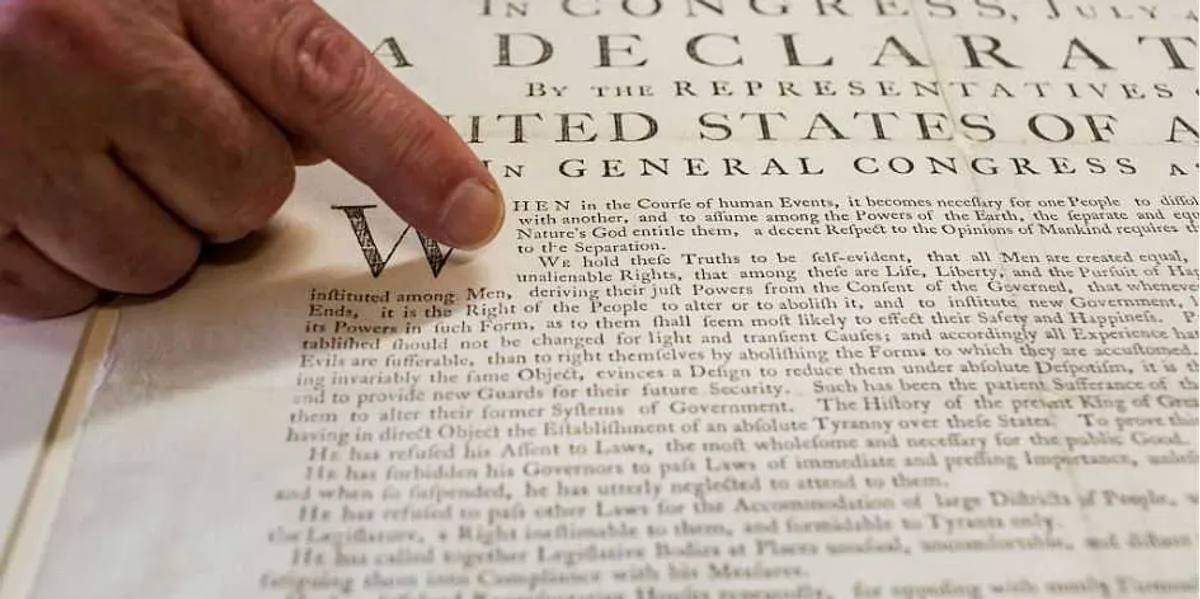

On the night of July 4, 1776, as delegates of the Continental Congress dispersed into the Philadelphia darkness, a printer named John Dunlap got to work.
The assignment was urgent. Congress had just approved the Declaration of Independence and needed copies immediately. Through the night, Dunlap and his assistants set type and printed roughly 200 broadsides carrying the astonishing news that Britain’s American colonies had declared themselves free and independent states.
By early 1778, copies of the Declaration were being debated in Parliament itself.
These first printings were never intended to become museum pieces. They were meant to travel — by horseback, by ship, and by express rider — to army camps, city squares, and eventually, to foreign governments whose support the fledgling republic desperately needed. Some were pinned to walls and read aloud to soldiers. Others were folded, carried, and eventually discarded.
Most were lost, damaged, or simply thrown away.
In enemy hands
Just 26 of the original Dunlap broadsides are known to survive. One of them took an especially unlikely journey.
Barely five weeks after it rolled off Dunlap’s press, the document fell into British hands. Captured during the Revolutionary War and sent back across the Atlantic, it arrived in London accompanied by a dispatch from Vice Admiral Richard Howe and General William Howe, the brothers leading Britain’s military campaign in North America.
The Howes occupied an unusual position. They were not only commanders tasked with defeating the rebellion but also King George III’s peace commissioners, charged with seeking some form of reconciliation with the colonies. Ironically, they were among the last senior British officials who still believed the breach might be repaired. Lord Howe would later suggest that, had his peace commission arrived only days earlier, independence might have been avoided.
Instead, it was the Howes themselves who sent London one of the first printed copies of the Declaration of Independence, informing ministers that the colonists had declared themselves “absolved from all allegiance to the British Crown.”
A decisive break
For many on both sides of the conflict, the Declaration marked a decisive break. The quarrel with the colonies had become something altogether different: the birth of a new nation.
In that sense, this was the copy that told Britain the American crisis had entered an entirely new phase.
Now, nearly 250 years later, that same sheet of paper is on display as the centerpiece of the America 250 celebrations at the American Museum and Gardens in Bath.
The broadside’s story has acquired another twist in recent years. Although it had long been held by Britain’s National Archives, it was only identified in 2009 as a surviving Dunlap Broadside, making it the most recently discovered of the 26 known copies.
RELATED: America’s founding is an inheritance purchased with blood; we owe it our remembrance
David Jones III. Chris Hondros/Getty Images
Philadelphia freedom
More recently still, historians traced the document’s origins to Jonas Phillips, a Jewish merchant and patriot who lived just doors from John Dunlap’s Philadelphia print shop. Research suggests that Phillips mailed the broadside to his cousin and business partner in Amsterdam in hopes of spreading the news of American independence abroad.
To evade British searches, he enclosed a note written in Yiddish referring only to “a declaration of that whole country.” The precaution failed. The letter, the Declaration, and the accompanying papers were seized by the British and eventually filed away in government archives.
What survives, then, is not merely one of America’s founding texts but also a rare piece of wartime intelligence — a document that crossed an ocean, vanished into the British state papers, and remained hidden there for more than two centuries.
The annotations on the reverse are striking for their banality. Officials in the colonial secretary’s office simply logged the Declaration and its accompanying papers as part of the ordinary business of government. One of history’s most consequential political texts was processed like routine correspondence.
Talk of the town
Yet the document did not simply disappear into an archive. By early 1778, copies of the Declaration were being debated in Parliament itself. Charles Lennox, 3rd Duke of Richmond, a leading critic of Lord North’s government, read portions of the text aloud in the House of Lords and argued that Britain might ultimately have no choice but to recognize American independence.
In that sense, the Declaration became more than an American founding document. It also became part of Britain’s own argument over the war and the future of its empire.
The document also illustrates the tyranny of distance in the eighteenth century. News from North America often took six to 10 weeks to reach Britain, and any instructions sent in response required an equally long journey back across the Atlantic. By the time officials in Whitehall learned of dramatic events in the colonies, those events had already become history.
Read the full article here

![Russia Pounds Kyiv With Massive Missile Barrage In Deadliest Assault Of The Year [WATCH]](https://www.rvmnews.com/wp-content/uploads/2026/07/2026.07.03-16.57-rvmnews-6a47e9e40be3c.jpg "Russia Pounds Kyiv With Massive Missile Barrage In Deadliest Assault Of The Year [WATCH]")

![Doxxed Michigan Man Stares Down Backlash After Criticizing Muslim Changes, Vows to Keep Speaking Out [WATCH]](https://www.lifezette.com/wp-content/uploads/2026/09/2026.09.27-13.12-lifezette-6ab91639f254a.jpg "Doxxed Michigan Man Stares Down Backlash After Criticizing Muslim Changes, Vows to Keep Speaking Out [WATCH]")
![Canada’s State-Funded CBC Punishes Jewish Journalist Who Exposed Vile Hamas Sympathizers [WATCH]](https://www.rvmnews.com/wp-content/uploads/2026/09/2026.09.27-13.26-rvmnews-6ab9199f42805.jpg "Canada’s State-Funded CBC Punishes Jewish Journalist Who Exposed Vile Hamas Sympathizers [WATCH]")