


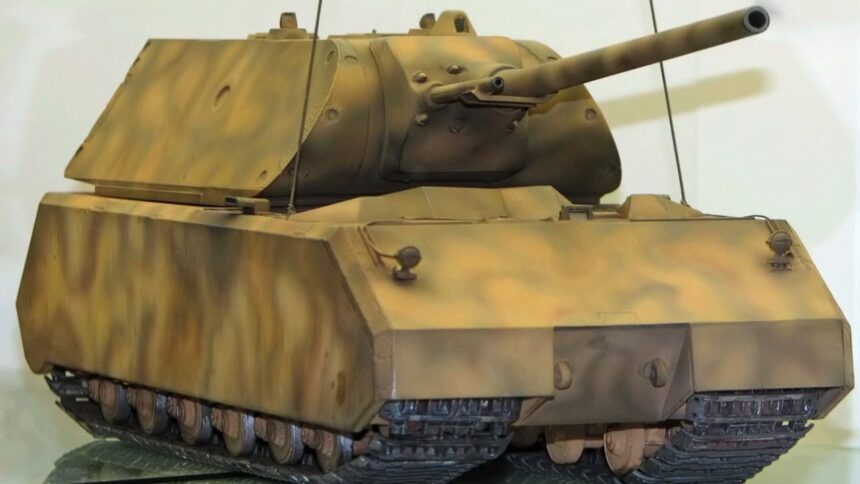

Summary and Key Points: As the Second World War dragged on, Germany entered a tank arms race with the Soviet Union to see who could develop the largest tanks with the largest guns. Hitler would have the final say in this arms race with the development of the Panzerkampfwagen VIII, more commonly known as the Maus. The Maus was a huge, imposing tank, the size of a small barn, armed with a massive gun and armor thicker than any tank had before. Unfortunately for Hitler, the tank would never reach the front lines, with only two prototypes ever completed.
Development of History’s Largest Tank: Meet the Maus
Today, historians almost universally consider the Maus a big mistake. So why did Germany invest so much manpower, materials, and funding in the project at a time when all three were incredibly scarce resources?
The answer, essentially, is that Hitler wanted it, and as the grand Führer, whatever he wanted, he got. Development of the Maus began in 1942, when tank designers Fried Krupp A.G. and Dr. Ferdinand Porsche were given independent contracts to develop a new 100-tonne tank.
At the time, the offensive on the Eastern Front had stalled just outside of Moscow.
The Soviet defenders had suffered enormous casualties, but they had stubbornly resisted the German war machine, and with their steadily improving tanks, it was clear the war in the East would be long and bloody.
Panzer IV tank. Image Credit: Creative Commons.
To that end, German high command, particularly Hitler, wanted a new super-heavy tank that would be impervious to Soviet tanks and deliver the final killing blow to the Russian defenses. Soon after the project began, the weight requirements increased.
It turns out 100 tonnes was a conservative estimate, and it was adjusted to 120 tonnes to allow for the heaviest possible armor and armament.
The initial design of the “Mäuschen” (little mouse) in October 1942 had an estimated weight of 170 tonnes.
The design underwent several changes to try to reduce its monstrous weight. Some armor was removed from the sides, the turret ring received minor changes, and other changes were considered to make the project easier to manufacture.
Even before the design was finalized, Hitler ordered production of five vehicles, hoping to produce 10 tanks per month by the end of the war.
Production and Prototypes
In 1943, the German high command saw a wooden mockup of the tank. Many Nazi higher-ups were impressed by the colossal tank, with a few exceptions, most notably Heinz Guderian, who felt that the tank would be useless in close-quarters urban combat.
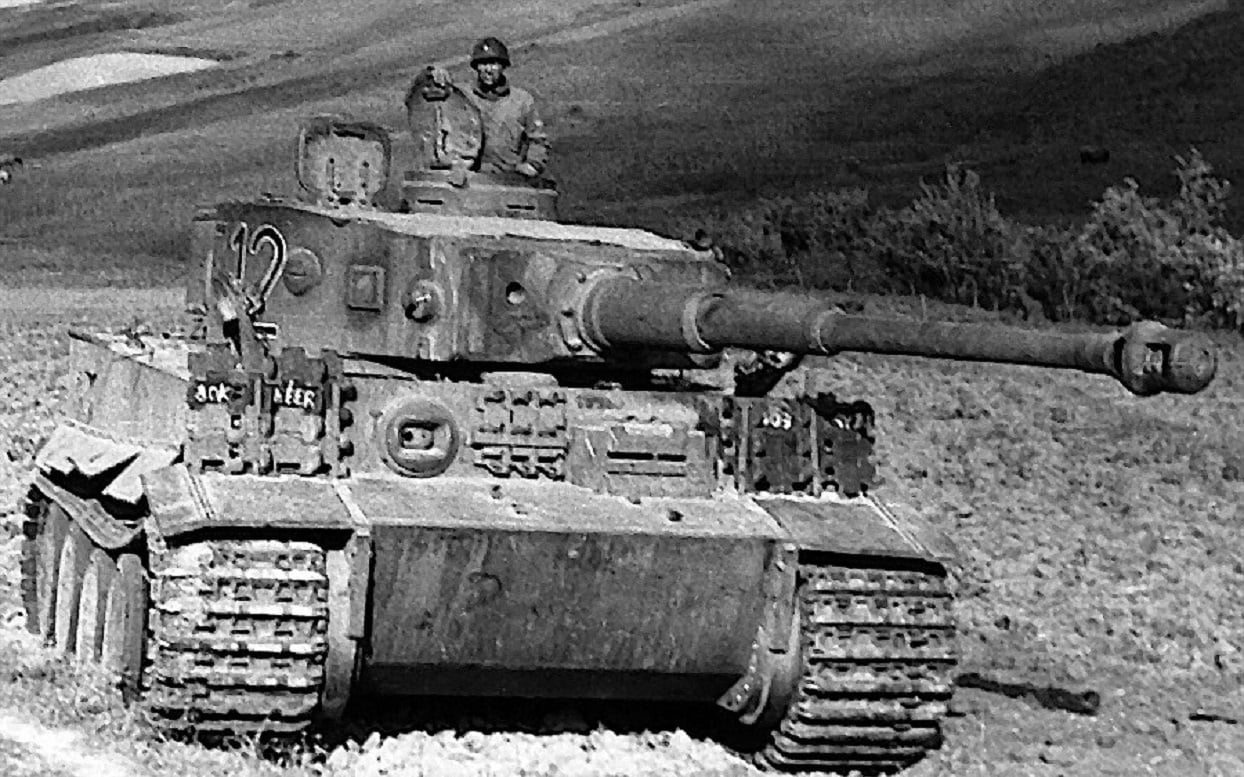
Image of Panzer Tank. Image Credit: Creative Commons.
This concern was exacerbated by the fact that the design at the time lacked a machine gun, which Guderian considered a major flaw of the Elefant heavy tank destroyer. The first prototype, V1, was assembled in December 1943.
This turretless prototype was deemed too heavy to cross bridges.
Instead, the Germans devised a solution that allowed the tank to ford rivers using an added snorkel system.
The second prototype, V2, was finished in March 1944 and featured an operational powerplant and turret.
At the time, Krupp was working on four more Maus hulls, but with the enemy closing in on all sides, work came to an abrupt end.
One cannot help but appreciate the Germans’ commitment to an ultimately untenable project.
The armor on the Maus was insanely formidable for its time.
The frontal hull armor was 220 mm thick, while its sides were “only” 190 mm thick (this was considered a compromise to somewhat reduce its weight. Meanwhile, the turret armor was thicker, with the front measuring at 240 mm, the gun mantlet at 250 mm, and the sides and rear at 200 mm.
V2, the only prototype with a working turret, was armed with a 128 mm KwK 44 L/55 gun and a coaxial 75 mm KwK 44 L/36.5 gun.
Addressing Guderian’s concerns, a coaxial 7.92 mm MG 34 was also included.
For propulsion, V2 was fitted with a Daimler-Benz MB 517 diesel engine capable of producing 1,200 hp.
This gave the tank a modest speed of 18 km/h, which, for a tank of that size and weight, is pretty impressive.
Final Resting Place
The Maus never saw combat. As the Soviets rolled through Germany, the Germans blew up V1 and V2, but because of their sheer armor, both prototypes were mostly intact on the outside.
When the Soviets reached the Kummersdorf firing range, where they housed them, they combined the undamaged V2 turret with the undamaged V1 hull.
The Soviets sent the final Maus back to the testing facility in Kubinka, where they disassembled it and stripped it of its internal components.
In 1978, the tank was put on display in the Kubinka Tank Museum, where it remains today.
Historians and enthusiasts have long debated whether the Maus would have turned the tide of the war had it been completed.
The answer, in my humble opinion, is an emphatic no.
Despite its impressive armor and imposing size, German manufacturing late in the war was not ready to produce the Maus on a large-scale.
The tank was too heavy and too expensive to ever make a meaningful difference.
Its greatest battlefield value would have been as a mobile bunker, which, given the Allied advantage in artillery and air support, would have made it little more than an inconvenience.
Maintenance would have been a logistical nightmare, as its engine compartment is blocked by more than 100 mm of steel.
Overall, the Maus project was a waste of everyone’s time and resources, but technically, one cannot help but be impressed by Germany’s ability to manufacture such a vehicle even at its lowest point.
About the Author: Isaac Seitz
Isaac Seitz, a Defense Columnist, graduated from Patrick Henry College’s Strategic Intelligence and National Security program. He has also studied Russian at Middlebury Language Schools and has worked as an intelligence Analyst in the private sector.

![Ohio Dem Candidate’s Handlers Melt Down as Cameraman Presses on Her Debate Dodge [WATCH]](https://www.rvmnews.com/wp-content/uploads/2026/09/2026.09.13-09.02-rvmnews-6aa666b22f7a2.jpg "Ohio Dem Candidate’s Handlers Melt Down as Cameraman Presses on Her Debate Dodge [WATCH]")


![Tennessee Prison Chief Quits After Christa Pike Execution Fiasco [WATCH]](https://www.rvmnews.com/wp-content/uploads/2026/10/2026.10.03-18.50-rvmnews-6ac14e62dde12.jpg "Tennessee Prison Chief Quits After Christa Pike Execution Fiasco [WATCH]")
![Tom Homan Demolishes CBS Reporter with Brutal Immigration Reality Check [WATCH]](https://www.rvmnews.com/wp-content/uploads/2026/10/2026.10.03-16.01-rvmnews-6ac126cf73bde.jpg "Tom Homan Demolishes CBS Reporter with Brutal Immigration Reality Check [WATCH]")