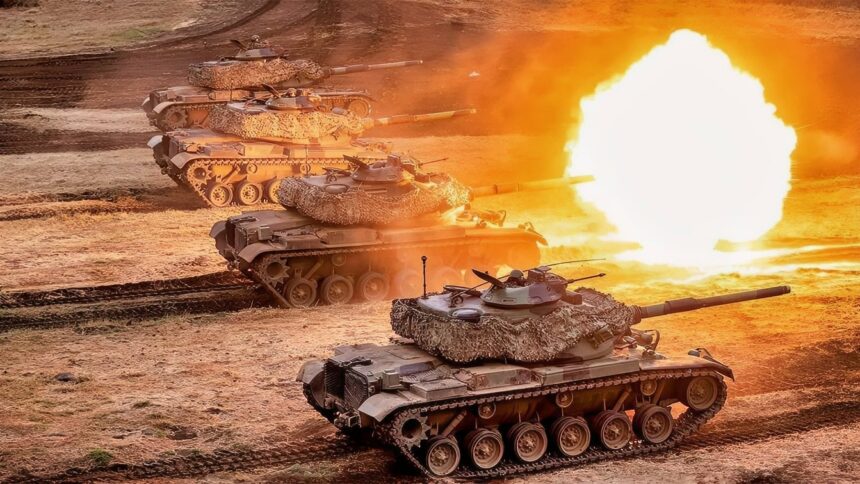

Summary and Key Points: An M60 gunner in 1970 judged range by looking through an optical coincidence rangefinder and manually sliding two images together until they lined up. It took time he often did not have, and it went wrong under stress, in bad light, and against anything moving. By the early 1970s, the Soviets were fielding the T-64 and T-72, anti-tank guided missiles were changing what a tank had to survive, and the American answer — the M1 Abrams — was still years from service. So the Army did the arithmetic and spent its money on one thing. Not the armor. Not the engine. The gunsight. Enter the M60A3.
The M60A3 Tank Explained
Throughout the Cold War, the Patton series of tanks was the US’s main battle tank. The Patton series culminated in the M60 (which is not technically a Patton, but it basically is), which offered better armor, firepower, and optics.
However, as Soviet tanks advanced rapidly, it became clear that the US would need something better to compete. While working on the tank that would become the M1 Abrams, the Americans modernized the M60 one last time as a stopgap solution to keep the tank relevant until its replacement was ready.
The M60 Patton: America’s Cold War Tank of Choice
The origins of the M60A3 lie in lessons learned from the M48 Patton and the original M60, both of which were products of Cold War urgency rather than long-term technological foresight. The M48, introduced in the early 1950s, was rushed into production amid fears of Soviet armored superiority.
While it performed adequately, its gasoline engine, limited range, and outdated fire control system quickly became liabilities.
The M60, fielded in 1960, addressed some of these concerns by adopting a diesel engine, a new hull design, and the British-derived 105 mm M68 cannon, which would become one of the most respected tank guns of the era.
T-72 Tank from Poland – Creative Commons Image
Despite these improvements, by the early 1970s, the basic M60 and even the improved M60A1, were increasingly vulnerable to emerging threats. Soviet tank designs, such as the T-64 and later the T-72, introduced better armor protection, improved firepower, and more sophisticated optics.
At the same time, advances in anti-tank guided missiles and the growing importance of night operations exposed a critical weakness of US Patton tanks: their reliance on daylight optics and manually intensive gunnery procedures. While the United States was already developing a new generation of main battle tank that would become the M1 Abrams, that project was still years away from operational maturity.
From M60 to M60A3
The M60A3 modernization program was therefore conceived as a practical interim solution. Rather than replacing the entire tank, the Army sought to extend the M60’s combat relevance by focusing on the area that offered the greatest return on investment: fire control.
The resulting M60A3 emerged as a vehicle that outwardly resembled its predecessors but was dramatically more lethal in practice, particularly at long range and in low-visibility conditions.
The biggest change to the M60A3 was its integrated fire-control system. Earlier M60 variants relied on optical coincidence rangefinders, which required the gunner to manually align visual images to estimate distance.
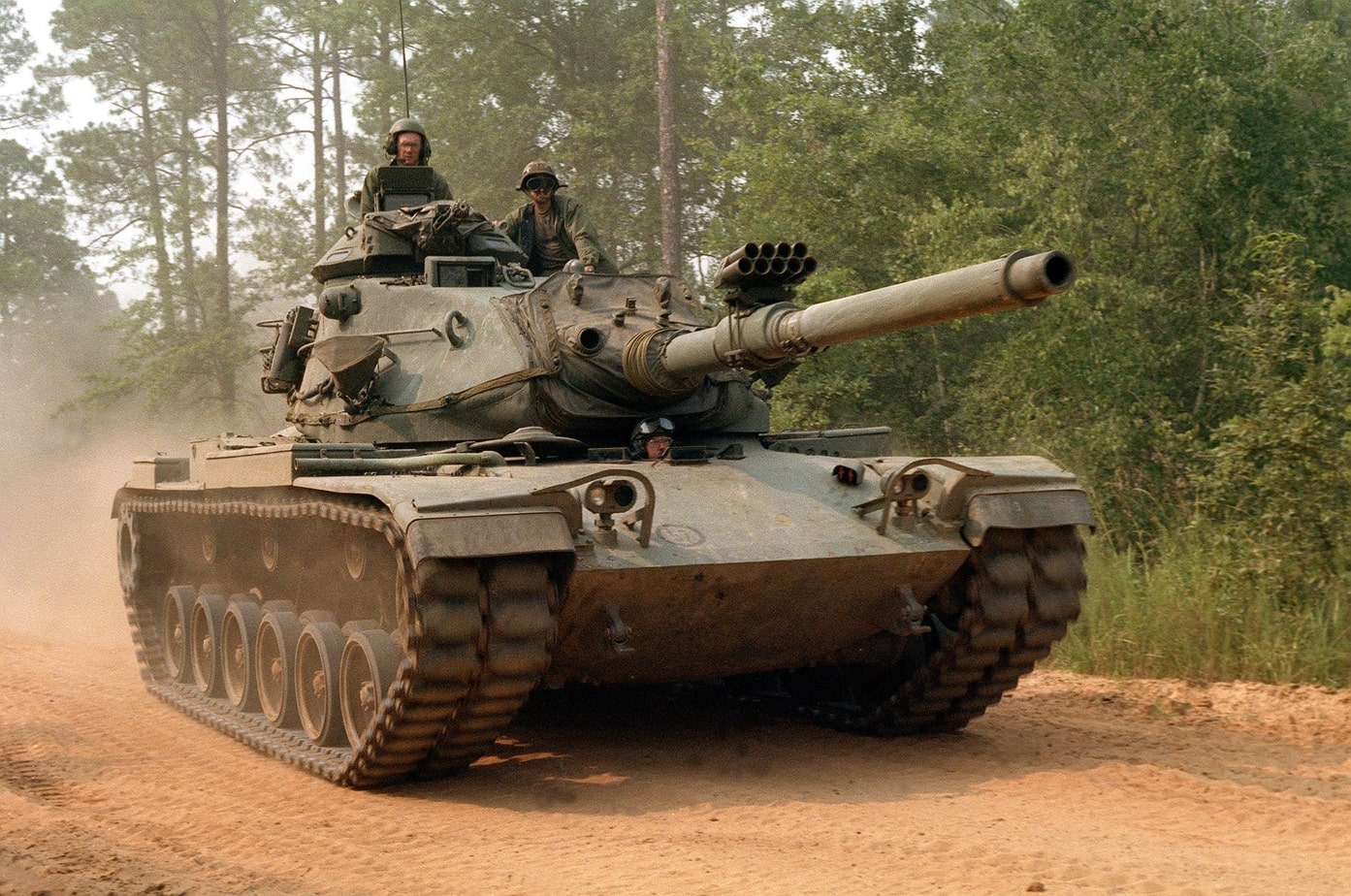
An M60A3 main battle tank from the 1st Platoon, 48th Brigade, 108th Armored Division, Georgia National Guard, moves through a recently cleared roadblock during the training exercise Company Team Defense. (1983)
This method was time-consuming and prone to error, especially under combat stress or poor visibility. The M60A3 replaced this system with a laser rangefinder, allowing the gunner to obtain precise range data almost instantly.
This information was fed into a ballistic computer, which calculated firing solutions based on variables such as ammunition type, barrel wear, and environmental conditions. The result was a dramatic increase in first-round hit probability, which was increasingly recognized as the key factor in armored combat.
General Specs
The tank’s primary armament remained the 105 mm M68 rifled cannon, a weapon that had already proven itself across multiple NATO armies but was nearing its limits.
While newer tanks would soon adopt larger and more powerful smoothbore guns, the M68 remained fully capable of defeating most contemporary armored threats when paired with modern ammunition.
The M60A3 could fire a wide variety of rounds, including armor-piercing fin-stabilized discarding sabot projectiles and high-explosive anti-tank rounds, giving it flexibility across a range of combat scenarios. The gun was stabilized in the vertical plane, allowing for more accurate fire while moving, though it lacked the full stabilization offered by other tanks even at the time.
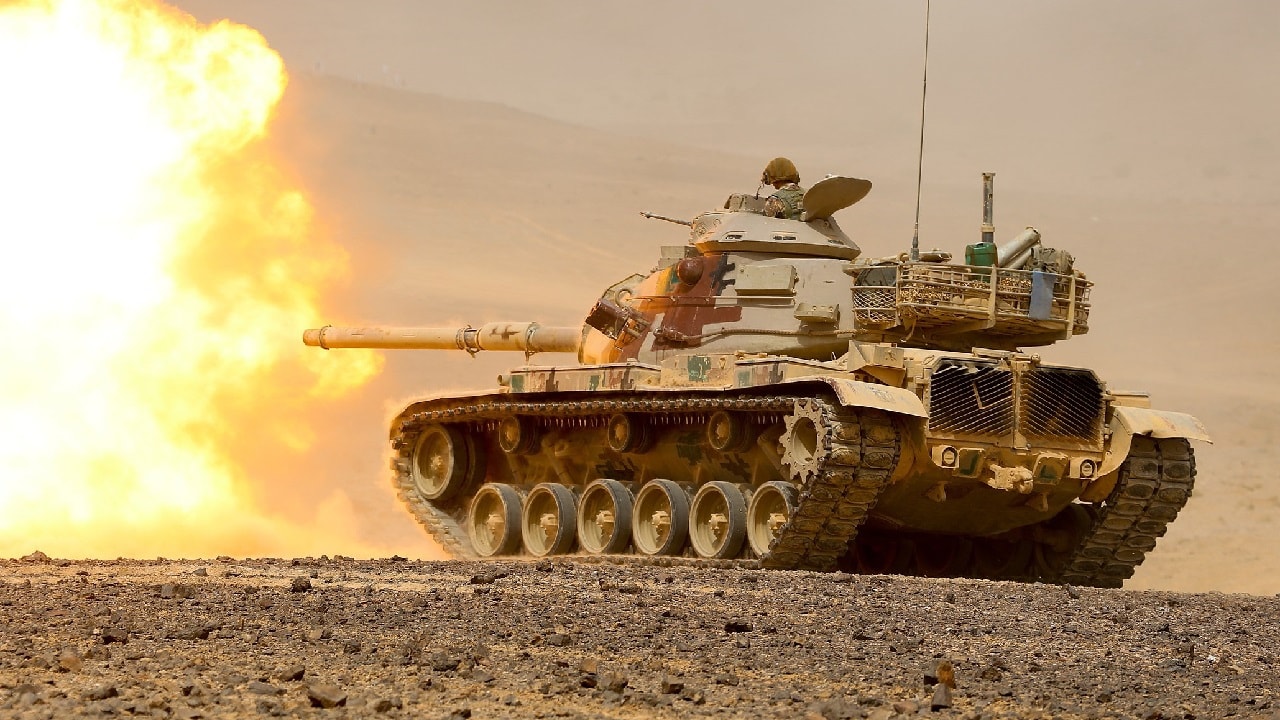
An M60A1 tank from the Royal Jordanian Armed Forces fires a round at a range in Wadi Shadiyah during a massive military demonstration in front of dignitaries and media.
While the M60A3’s improvements in fire control were substantial, its armor protection remained largely unchanged from earlier variants. The tank relied on thick rolled homogeneous armor arranged in a sloped glacis and a heavily reinforced turret front.
This configuration provided respectable protection against older munitions but was increasingly outmatched by newer kinetic penetrators and shaped-charge warheads. Unlike the Abrams, which would introduce composite armor technology, the M60A3 had no passive armor advancements beyond incremental refinements in casting and shaping.
As a result, its survivability depended heavily on engaging enemy forces at long range, using superior accuracy to destroy opponents before they could return fire.
Mobility also remained consistent with previous M60 models. Power was provided by the Continental AVDS-1790 air-cooled diesel engine, producing approximately 750 horsepower. While not particularly fast by modern standards, the engine was reliable and comparatively fuel-efficient, offering logistical advantages over gas turbine designs.
The tank’s top speed hovered around thirty miles per hour on roads, with a substantial operational range that made it well-suited for sustained deployments, particularly in the European theater for which it was primarily intended.
Service History and Retirement of the M60A3 Tank
The M60A3 served mainly as a frontline tank in US Army units stationed in Europe during the late Cold War. It was intended to counter massed Warsaw Pact armored formations in defensive scenarios, leveraging superior optics and gunnery rather than raw armor or speed.
By the mid-1980s, as the M1 Abrams entered widespread service, the M60A3 was gradually phased out of National Guard units and into secondary roles. However, its service life did not end with the US retirement.
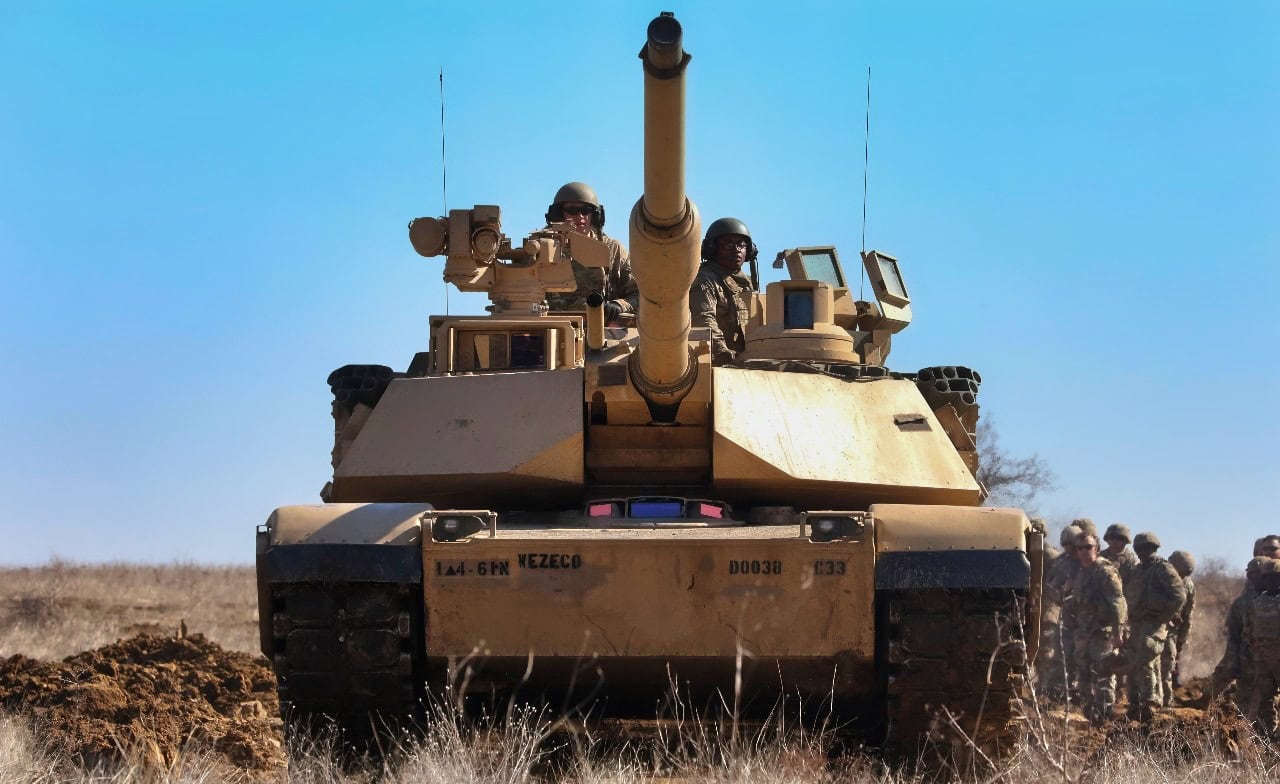
A U.S. Army M1 Abrams, assigned to 4th Battalion, 6th Infantry Regiment, 3rd Armored Brigade Combat Team, 1st Armored Division, fully emerges from the tank firing point to engage the simulated enemy at Novo Selo Training Area, Bulgaria, March 5, 2025. 1st Armored Division, a rotational force supporting V Corps, conducts training with engineers and tank operators in the European Theatre to maintain readiness and instill fundamental Soldier skills that are vital in maintaining lethality. (U.S. Army photo by Spc. Kyle Kimble)
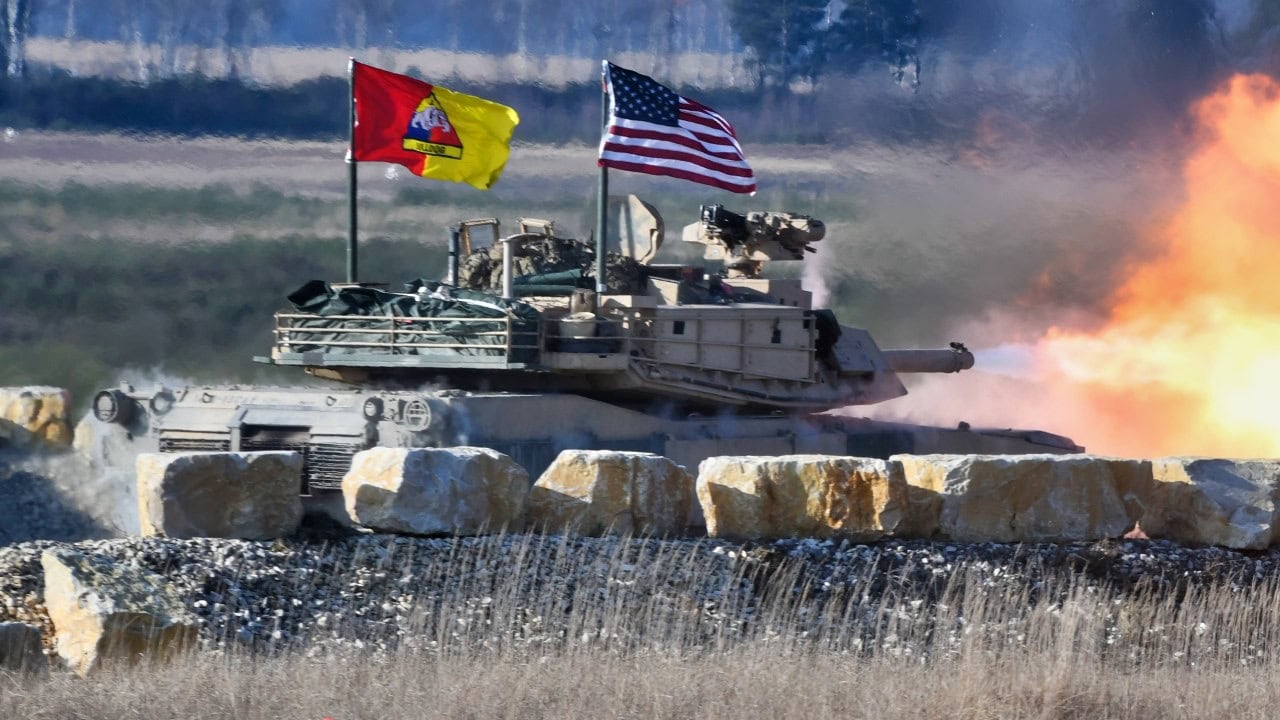
A U.S. M1 Abrams engages a target during the final event on Feb. 17, 2025 as part of the U.S. Army Europe and Africa International Tank Challenge at 7th Army Training Command’s Grafenwoehr Training Area, Germany. The USAREUR- AF International Tank Challenge builds tactical skills and enhances esprit de corps across the 11 teams from five participating allied and partner for peace nations. (U.S. Army photo by Sgt. Collin Mackall)
Indeed, the M60A3 enjoyed a more eventful combat history with foreign users. Numerous allied and partner nations received the tank through military aid programs or direct purchases.
Countries in the Middle East, Mediterranean, and East Asia operated M60A3s well into the twenty-first century, often upgrading them with explosive reactive armor, improved thermal sights, and indigenous fire-control enhancements.
In several regional conflicts, upgraded M60A3s demonstrated that the platform still possessed considerable combat potential when properly modernized.
About the Author: Isaac Seitz
Isaac Seitz, a Defense Columnist, graduated from Patrick Henry College’s Strategic Intelligence and National Security program. He has also studied Russian at Middlebury Language Schools and has worked as an intelligence Analyst in the private sector.




![Doxxed Michigan Man Stares Down Backlash After Criticizing Muslim Changes, Vows to Keep Speaking Out [WATCH]](https://www.lifezette.com/wp-content/uploads/2026/09/2026.09.27-13.12-lifezette-6ab91639f254a.jpg "Doxxed Michigan Man Stares Down Backlash After Criticizing Muslim Changes, Vows to Keep Speaking Out [WATCH]")
![Canada’s State-Funded CBC Punishes Jewish Journalist Who Exposed Vile Hamas Sympathizers [WATCH]](https://www.rvmnews.com/wp-content/uploads/2026/09/2026.09.27-13.26-rvmnews-6ab9199f42805.jpg "Canada’s State-Funded CBC Punishes Jewish Journalist Who Exposed Vile Hamas Sympathizers [WATCH]")