
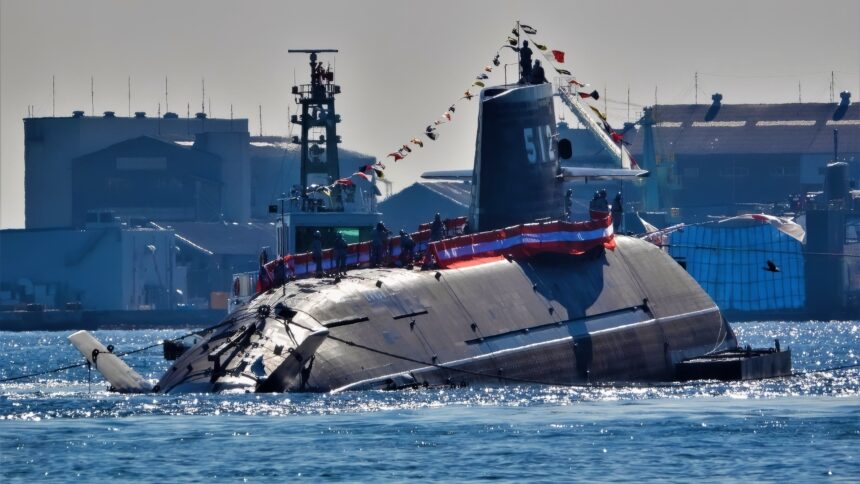

Summary and Key Points: When JS Soryu entered service in 2009, Japan was waking up to China’s naval buildup in the East and South China Seas, and it wanted a submarine that could stay hidden longer and reach farther. The Soryu class, developed from the earlier Oyashio design, delivered that with an X-shaped stern for agility in shallow water and enough size and range to operate far from home. Its job is to guard Japan’s sea lanes and watch the first island chain alongside U.S. forces, and it will continue to do so for years, even as the Taigei-class takes over.
The Soryu-Class Submarines Are a Real Powerhouse
Soryu-Class Japan Submarines. Image Credit: Creative Commons.
Japan’s Sōryū-class submarines are among the most advanced conventional submarine designs in the world.
They’re also a key pillar of Japan’s Maritime Self-Defense Force (JMSDF).
Built between 2005 and 2021, these diesel-electric attack submarines were Japan’s first to use air-independent propulsion (AIP), which allowed them to remain submerged for extended periods without surfacing to recharge batteries.
The first of twelve vessels, JS Sōryū (SS-501), entered service in 2009 and represented a significant leap for Japan’s undersea warfare capability.
The submarine’s entry into operational service coincided with the country’s growing recognition of the threat posed by Chinese naval forces in the East and South China Seas.
By 2021, Japan had completed ten AIP-powered Sōryū vessels and two later variants equipped with lithium-ion batteries—the first operational submarines of their kind in the world.
The Sōryū-class – also known as 16SS – is a development of the earlier Oyashio-class design. It was initially conceived to improve the range, stealth, and underwater endurance of Japan’s regional defense posture, making Japan a stronger naval force at a time when China had begun investing heavily in its naval and general military assets and operations.
Built jointly by Mitsubishi Heavy Industries (MHI) and Kawasaki Heavy Industries (KHI), the class features a distinctive X-shaped stern that provides superior maneuverability in shallow waters.
It’s a feature that many modern submarine programs have since copied.
The submarines are advanced for good reason; their primary mission is to defend Japan’s sea lanes, conduct surveillance in the first island chain, and perform anti-ship and anti-submarine warfare in coordination with the United States and allied forces.
How AIP Technology Works
The first ten Sōryū boats used a Stirling-engine air-independent propulsion system, designed to extend underwater endurance without running noisy diesel engines or surfacing to the air.
Each submarine is powered by two Kawasaki 12V 25/25 SB diesel engines for surface and battery charging, as well as four Kawasaki-licensed Kockums V4-275R Stirling engines that burn diesel fuel using liquid oxygen to generate electricity while underwater.
Those systems allow the submarine to remain submerged silently for as long as two weeks while traveling at slow patrol speeds of between five and seven knots, significantly reducing its acoustic signature and therefore its detectability.
There is, however, a trade-off—and it comes in the form of reduced power output and increased mechanical complexity.
That aside, the AIP system was a significant technological milestone for Japanese shipbuilders and remains an impressive feat.
Technical Specifications
The Sōryū-class is among the largest conventional submarines ever built, measuring around 84 meters long and 9.1 meters wide, and displacing roughly 4,200 tonnes submerged.
Despite being non-nuclear, its size and range give it near-blue-water capability, enabling it to operate far from home waters for extended periods.
The submarines are crewed by 65 sailors, including specialists in sonar operations, engineering, weapons, and navigation.
Underwater, the boats can reach speeds of up to 20 knots (roughly 37 km/h), comparable to other advanced diesel-electric designs such as Germany’s Type 212CD and South Korea’s KSS-III.
Their endurance is significantly extended by either air-independent propulsion (AIP) or, on the later units, lithium-ion batteries.Each submarine is fitted with the ZQQ-7 sonar suite, a Japanese-built integrated detection system that includes bow-mounted, flank-mounted, and towed-array sensors.
And these features matter. Flank arrays are long panels along the hull sides designed to detect sound from targets off the submarine’s bow, increasing situational awareness and helping the crew identify surface ships or other submarines at medium range.
The towed array, meanwhile, is an extended cable deployed behind the submarines, equipped with hydrophones (underwater microphones) that can pick up extremely faint sounds over long distances.
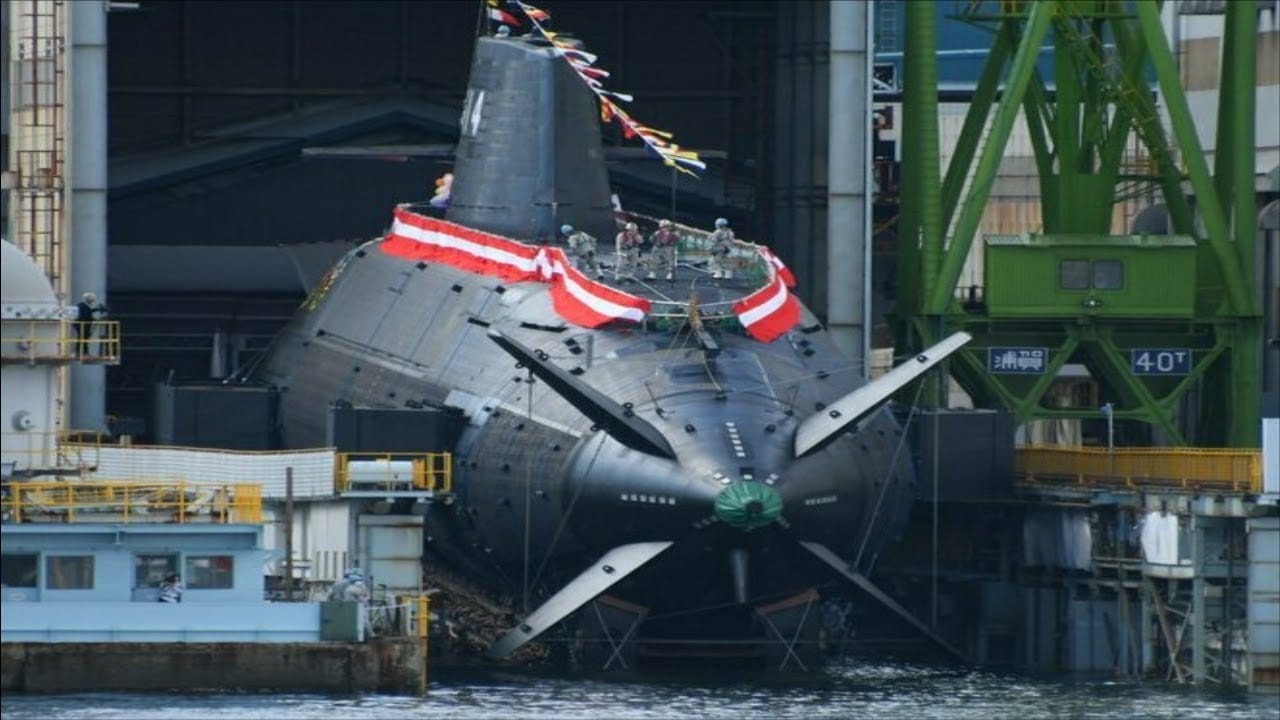
Taigei-Class Submarine. Image Credit: Creative Commons.

Taigei-Class. Image Credit – Creative Commons.

Taigei-class. Image Credit: Creative Commons.
And because the microphone trails far behind and is separated from the submarine noise, it is one of the most sensitive tools for tracking adversaries who may also be operating in stealth.
Together, the two systems feed into onboard combat computers that display acoustic data in real time, allowing crews to triangulate and classify other vessels with precision.
As for armament and combat systems, the Sōryū-class carries six 533mm torpedo tubes in its bow, capable of launching Type 89 heavyweight wire-guided torpedoes – Japan’s primary anti-submarine and anti-ship weapon.
The Type 89 is equivalent in performance to the U.S. Mk 48 ADCAP, with active/passive homing and a range exceeding 27 nautical miles.
The tubes can also launch UGM-84 Harpoon anti-ship missiles, enabling the boats to strike surface targets at extended ranges, and deploy naval mines.
A modern combat management system also integrates sonar, radar, and weapon data, enabling targets to be tracked and engaged simultaneously under electronic countermeasure conditions.
The Sōryū-class is an essential asset for Japan and will remain in service for years to come.
Still, it is already being gradually replaced by the new Taigei-class submarines, which rely entirely on lithium-ion batteries.
The new class will mark a significant evolution in conventional undersea warfare.
About the Author:
Jack Buckby is a British author, counter-extremism researcher, and journalist based in New York. Reporting on the U.K., Europe, and the U.S., he works to analyze and understand left-wing and right-wing radicalization, and reports on Western governments’ approaches to the pressing issues of today. His books and research papers explore these themes and propose pragmatic solutions to our increasingly polarized society. His latest book is The Truth Teller: RFK Jr. and the Case for a Post-Partisan Presidency.



![Megyn Kelly Torches Sydney Sweeney Ad Backlash and Blames Republican Ties [WATCH]](https://www.boredtrashpanda.com/wp-content/uploads/2026/09/2026.09.25-16.02-boredtrashpanda-6ab69b19801a7-e1790362389963.jpg "Megyn Kelly Torches Sydney Sweeney Ad Backlash and Blames Republican Ties [WATCH]")
![Trump Revives Supreme Court Immigration Battle After Hochul Pardon Sank First Case [WATCH]](https://www.lifezette.com/wp-content/uploads/2026/09/2026.09.25-16.04-lifezette-6ab69b779f98e.jpg "Trump Revives Supreme Court Immigration Battle After Hochul Pardon Sank First Case [WATCH]")