

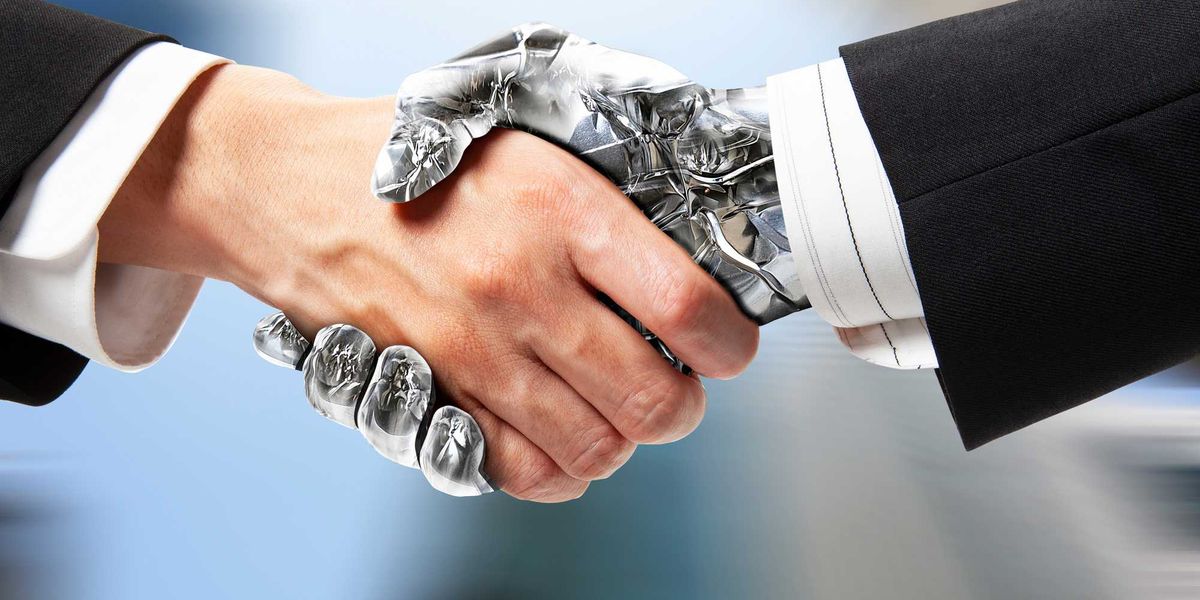

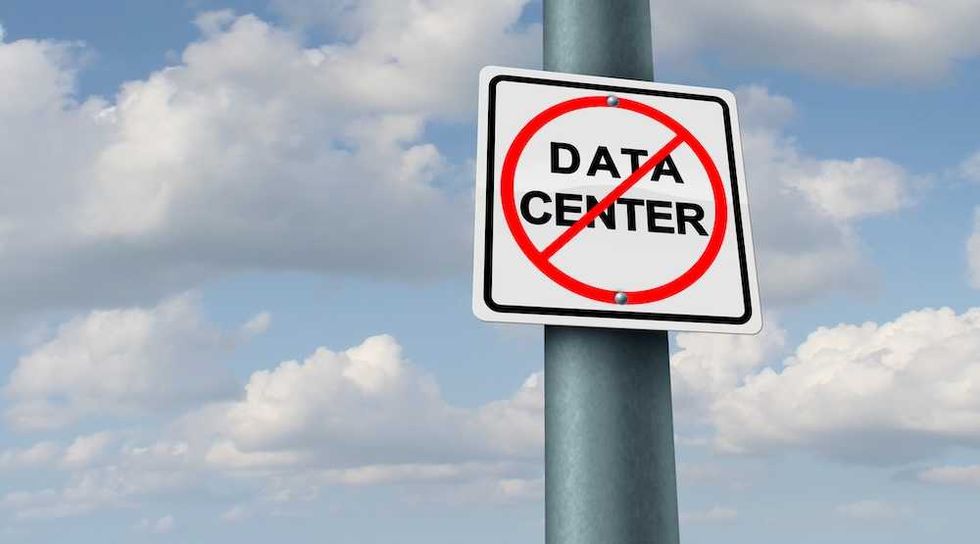
Artificial intelligence has become a national political issue and increasingly a local one. Communities across the country are fighting over the massive data centers needed to power the AI boom. Environmental groups warn about water consumption. Ratepayers worry about electricity bills. Workers fear the technology will undermine their livelihoods.
The backlash crosses ideological lines, and many of the concerns deserve to be taken seriously. But too often, the debate begins and ends with a terrifying number stripped of the context needed to understand it.
As AI advances, America will face difficult choices. The only way to make them intelligently is to start with the facts rather than with numbers selected for maximum panic.
There are genuine questions surrounding AI — privacy, surveillance, censorship, individual autonomy, and concentrated power among them. But three of the most common criticisms of AI and data centers are often overstated.
Claim 1: Data centers are consuming all our water
Stories about data-center water use often begin with numbers designed to shock. One project may use millions of gallons a day. Another state may be projected to consume billions of gallons annually. In a water-stressed community, those figures can absolutely matter.
But scale matters too. A 2026 analysis published by the Florida Water and Pollution Control Operators Association estimated that all U.S. data centers combined accounted for roughly 0.3% to 0.4% of total daily U.S. water withdrawals, based on 2021 figures.
Cooling methods also vary dramatically. Some facilities rely heavily on evaporative cooling. Closed-loop and air-cooled systems can use far less water. Location, water source, cooling design, and the condition of the surrounding system matter enormously.
Industrial comparisons help restore perspective. Data centers are hardly unique in consuming large volumes of water. U.S. golf courses use roughly 30 times as much water annually, while California almond production alone has been estimated at well over 100 times as much.
That does not mean a poorly located data center cannot strain a local supply. It means “millions of gallons” is not an argument by itself. The relevant question is whether a particular facility imposes a meaningful burden on a particular water system.
Claim 2: Data centers are consuming all our power
The electricity numbers are enormous too. Lawrence Berkeley National Laboratory estimated that U.S. data centers consumed about 200 terawatt-hours of electricity in 2025, roughly 4.7% of total national electricity consumption.
From there, critics often assume that more data-center demand must translate directly into higher household bills. The evidence is less straightforward. Some research suggests that recent data-center growth has had only a limited effect on retail rates, while broader inflation and energy-policy choices may explain more of the increase consumers have seen.
That does not mean new data centers are costless to the grid. Poor rate design can shift infrastructure costs onto ordinary customers, and badly planned projects can strain local capacity. But the obvious answer to rising demand is not simply to suppress demand. It is to build more abundant, reliable power.
RELATED: AI is coming for your job, your voice … and your worldview
LPETTET/iStock/Getty Images
The AI boom may be creating exactly that incentive. Amazon recently acquired an 8,000-acre site in Texas for a data-center project that could include up to 7.65 gigawatts of on-site natural-gas generation. Microsoft, meanwhile, signed a deal tied to the restart of Three Mile Island to supply roughly 835 megawatts of nuclear power.
America spent decades making it harder to build reliable energy. If AI demand helps reverse that habit, that is not obviously a national disaster. It may be the pressure needed to start building again.
Claim 3: AI is going to displace all our jobs
Of the three claims, job displacement deserves the most caution. I have written before about the real possibility that AI could eliminate certain jobs, especially entry-level positions. Long-term forecasts are difficult because nobody knows how capable these systems will become. Still, history gives us reason to distrust the most apocalyptic predictions.
In 2016, AI pioneer Geoffrey Hinton argued that people should stop training to become radiologists because machines would soon outperform humans at reading medical images. A decade later, radiology is hardly disappearing. Research shows the number of active U.S. radiologists rose over the past decade, salaries increased, and workloads expanded along with the use of medical imaging.
That may be an example of “Jevons paradox”: When technology makes a resource or service cheaper and more efficient, total demand can rise. A recent medical paper applied the idea directly to AI and physicians.
The same possibility applies beyond medicine. If AI makes a programmer five times more productive, it is tempting to assume the economy will need one-fifth as many programmers. But economies are not static. If software becomes dramatically cheaper to produce, businesses that could never afford custom software may suddenly buy it. New applications become economical. Entirely new product categories can emerge.
None of that guarantees that every displaced worker will land comfortably in a new job, or that every profession will grow. Technological change creates winners and losers. The point is narrower: Productivity gains do not translate mechanically into equivalent job losses.
RELATED: The next fight over freedom will run through AI models
 wildpixel/iStock/Getty Images
The concerns we should consider
None of this means AI is safe or harmless. The strongest concerns may simply be different from the ones dominating the headlines.
As AI becomes embedded throughout society, these systems could shape what information people see, how institutions make decisions, and how individuals interact with government and business. Massive data collection could strengthen surveillance. Ideological biases could be embedded in algorithms. Dependence on AI could weaken personal autonomy and concentrate decision-making power in governments and corporations.
Those questions deserve more attention than sensationalized claims about water, watts, and workers.
As AI advances, America will face difficult choices. The only way to make them intelligently is to start with the facts rather than with numbers selected for maximum panic.
The goal should be to preserve individual liberty, privacy, transparency, personal autonomy, and constitutional principles while allowing innovation to flourish. Exaggerating the easy concerns only makes the difficult ones harder to confront.
Read the full article here


![Lauren Boebert Demands They Lose Nonprofit Status [WATCH]](https://www.lifezette.com/wp-content/uploads/2026/02/2026.02.13-09.39-lifezette-698ef14cb73b8.jpg "Lauren Boebert Demands They Lose Nonprofit Status [WATCH]")