
At the beginning of April, I did a little roundup of the current waste-disposal difficulties renewables were facing, both in solar and in the wind industry.
The solar nightmare is incoming…
Millions (it could be billions) of solar panels are already hitting their end-of-life cycles.
The world is completely unprepared for this coming toxic avalanche. By 2050, the International Renewable Energy Agency projects up to 78 million metric tons of solar e-waste, and even… pic.twitter.com/LkDSWj6ovR
— Peter Clack (@PeterDClack) June 21, 2026
… and even those projections are based on outdated, conservative models.
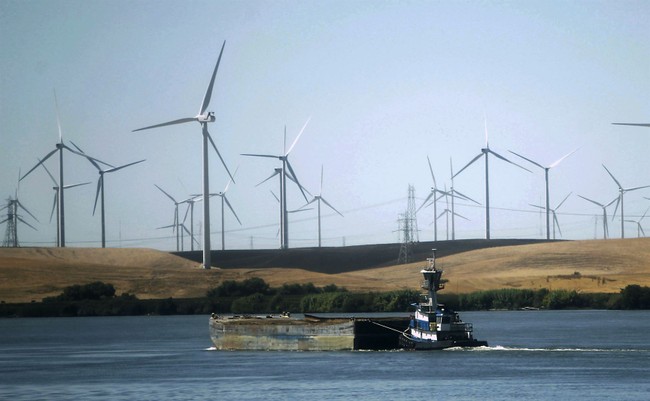
By 2050, the estimated total boundary area required for 1.5 million wind turbines is expected to reach 3.1 to 4.6 million square kilometers – the combined size of India and Argentina.
The obvious question regarding this transition—with its towering turbine skeletons, virtually indestructible composite blades, and billions of solar panels—is this: Just where will all this metal, silicon and concrete be buried?
This could leave a damning human legacy for the next thousand years. Perhaps a century from now, people will be asking just how this all happened. It will be seen through a prism of systemic failure.
A serious problem that has not yet become clear to all, is that they create an endless loop of replacement. This means endlessly intensive mining for shrinking supplies of valuable metals and rare minerals. This is already depleting copper and lithium.
Earth’s open spaces are becoming saturated with vistas of silicon and glass – already in various stages of mechanical decay.
That’s the big question right?
Where’s it all going to be buried?
One of the items I covered in that post a couple of months ago was a company which had been founded to recycle the notoriously impossible-to-recycle wind turbine blades. This is also proving more and more difficult, as these blades have grown to monstrous proportions as the towers themselves have climbed to heights no one ever really thought about when all this madness started. For example, the towers that are to be ‘tethered’ to the bottom of the Pacific Ocean when they’re dragged offshore of Morro Bay in Northern California (should the state win its lawsuit to force the issue) are penciled in at some 1,100 feet tall. As one enthusiastic wind brochure put it, they are ‘taller than the Eiffel Tower,’ as if 1600 Eiffel Towers bobbing, weaving, and hanging on to their tethering chain for dear life in a raging Pacific Ocean could possibly be a good thing.
These are minor details to unicorn fart true believers, to be worked out later.
In Sweetwater, Texas, Global Fiberglass Solutions and its CEO Donald Lilly were already fighting off lawsuits in other states when it sold county fathers there, desperate to buy into renewable lucre, a bill of goods that they had the recycling angle covered.
It’s now been over ten years since the company dumped tons upon tons of blades to service the recycling plant that never happened, and Sweetwater had just been told it would take $54M to clean them up.
…Sweetwater, Texas, is also having a time with the business opportunist, once so promising in turbine blade recycling. The same company sold them a song and dance routine, and now the town’s been told it could cost up to $54M to move the blades that Global Fiberglass Solutions dumped on them ten years ago, with promises of green renewal to come.
For nearly a decade, residents of Sweetwater have been confronted by a jarring sight as they leave and enter this small West Texas town: thousands of used wind-turbine blades.
The blades take up nearly 1 million square feet in a field off Interstate 20. Hundreds more occupy a second site nearby. Originally up to 200 feet long — nearly the wingspan of a Boeing 747 — the blades have been cut into thirds, exposing gaping openings. Locals complain they’re a haven for rattlesnakes, collect water that attracts mosquitoes and pose a threat to children living nearby.
The town has repeatedly asked the company that left the blades there to remove them, with no success.
“It’s really ugly,” says Samantha Morrow, the city attorney. She’s received quotes to remove the blades, but they range from $13 million to $54 million, beyond the city’s budget.
Mr. Lilly says it’s not his fault that no one wants what his company was selling.
Texas Attorney General Ken Paxton had just filed his own civil lawsuit against Global at the beginning of March, and four people had been indicted for illegal dumping and theft of property.
Yesterday, the AG secured a temporary injunction forcing a clean-up to begin of the illegally dumped blades in and around Sweetwater, with no wiggle room left for the company.
The court order is crystal clear:
✅ Immediately stop accepting any new wind turbine blades at the Sweetwater facilities.
✅Begin breaking down the existing blades and haul them to authorized, permitted disposal facilities. No more free dumping on Texas soil.
— ⚡️David Blackmon⚡️ (@EnergyAbsurdity) July 8, 2026
At least in Texas, for the moment, wind developers can no longer offload their trash.
These blades are enormous, often 150+ feet long and made of tough fiberglass composites that are notoriously difficult and expensive to recycle.
Proper disposal or recycling routinely costs 10–20 times more than cheap landfilling or illegal stockpiling.
Wind developers can no… pic.twitter.com/lT790UAjtR
— ⚡️David Blackmon⚡️ (@EnergyAbsurdity) July 8, 2026
…Wind developers can no longer externalize that massive expense onto Texas landowners and taxpayers.
But that begs the question – WHERE IS IT all going to go? Even the Sweetwater refuse. It’s great to say, ‘get it gone, ‘ but now who gets it?’
This is the problem with no answer, and yet blades are aging out, and turbine installations are still planned.
HELLO!!!
Europe has banned burying them. Neat trick, huh?
On January 1, 2026, the European wind industry implemented a self-imposed landfill ban on turbine blades.
This has left many countries scrambling silently for solutions. Landfill has become the next unwanted crisis, yet it’s the conversation no one wants to have. Germany,… pic.twitter.com/tUOpxBme6x
— Peter Clack (@PeterDClack) May 3, 2026
… yet it’s the conversation no one wants to have. Germany, Finland, and the Netherlands have banned blade landfills, and so for a time they are being exported to countries like the UK or France, where they can still be buried.
Banning waste like turbine blades doesn’t make it vanish though—it just puts it on a truck to a neighbour’s backyard. Low-scale solutions are often cited as the answer, like turning blades into noise barriers, bridges or playground equipment.
How do you turn 43 million tons of blade waste from turbines into park benches and koala crossings? How many park benches does one planet actually need?
Modern recycling for glass and carbon fibre often requires pyrolysis (high-heat chemical decomposition). To recycle a ‘green’ blade, you must burn an immense amount of energy to break down the resins.
We are trading a physical waste problem for a new energy demand problem. People love a quirky solution that highlights the absurdity of the problem—like the image of a massive 80-metre blade being used as a single, very long bus shelter.
Even ‘green’ solutions have a physical footprint that can’t be wished away by a spreadsheet.
They have no workable, viable solutions to dealing with these monstrosities, and certainly not at the scale they’re coming off.
By 2050, the world is forecast to face 43 million tons of decommissioned wind turbine blades.
These blades are built from high-strength composites made to survive years of weathering. Still, every single turbine standing today will age out before 2050.
Most are difficult to… pic.twitter.com/C8PbDfmGvk
— Electroverse (@Electroversenet) May 6, 2026
…So most are likely to be buried. But Europe now has a landfill ban for blades coming into force.
Nations like Germany, Finland and the Netherlands are already blocking landfills. But they still have blades to dispose of. So the waste is pushed elsewhere. Blades are exported to countries where burial is still allowed, such as the UK.
Any proposed “solutions” to landfill are tiny. A handful of blades become park benches or playgrounds. But 43 million tons does not fit into park furniture.
Net Zero creates a mountain of composite waste, but then has the audacity to call itself “green”.
I am delighted for Sweetwater, but the order is only as good as the company’s ability to remove the blades…and who are the poor saps who get them next?
Such a scam.
Editor’s Note: The mainstream media continues to deflect, gaslight, spin, and lie about President Trump, his administration, and conservatives.
Help us continue to expose their left-wing bias by reading news you can trust. Join HotAir VIP and use promo code FIGHT to receive 60% off your membership.
Read the full article here