
WHAT YOU NEED TO KNOW
- The 68th African Artillery Regiment is splitting Caesar batteries into smaller sections to improve responsiveness and survival against drones and counter battery fire.
- A dedicated support section will prepare firing positions, deploy decoys, preposition ammunition and install protective metallic cages.
- The Atlas fire control system will coordinate dispersed guns while preserving the regiment’s ability to concentrate fires.
- The first Caesar battery will permanently adopt the new structure next year, with the remainder expected to follow.
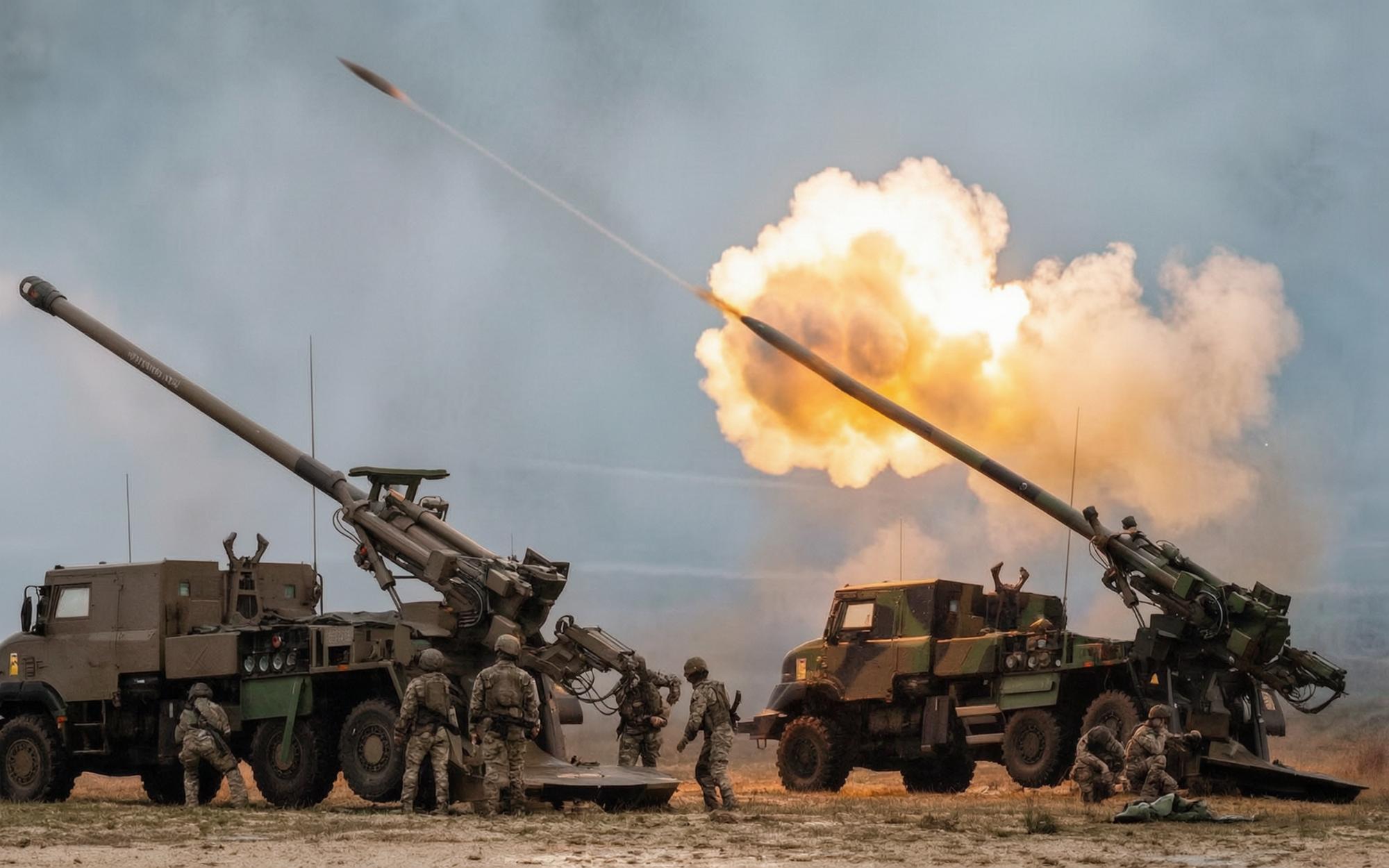
The French Army’s 68th African Artillery Regiment is breaking its Caesar batteries into smaller elements and creating a dedicated support section to improve survival against drones and counter battery fire on a modern battlefield.
The reorganization changes batteries of 155 mm Caesar howitzers from two four gun sections into three two gun sections while leaving the total fleet of truck mounted guns unchanged for now. Col. Rémy Jaillet, the formation’s commander, described the plan during an innovation day organized by the 7th Armored Brigade in Besançon earlier this month.
The regiment will rely on its Atlas fire control system to coordinate the dispersed sections and preserve the ability to concentrate fires. The arrangement is intended to keep guns available and responsive even when they are operating farther apart.
“As counter-intuitive as it may seem, splitting sections into pairs increases the availability of fires and therefore their responsiveness,” Jaillet said. “Smaller, more dispersed units also improve their survivability and resilience in a degraded environment with a strong counter-battery threat.”
Gold. Upgraded. Buy real gold from $1. Store it in America. Sell it with one click.
NATO militaries are examining lessons from Ukraine, where persistent drone observation has exposed firing positions to counter battery attacks. According to an analysis by the Royal United Services Institute, Ukrainian forces have responded by dispersing guns, shortening missions, concealing positions and separating ammunition from firing units.
Jaillet cautioned that the structure is being spearheaded by the 68e RAA and should not currently be viewed as the French Army’s standard format. Under the model, each battery has fewer guns, but the number of batteries increases.
The 68e RAA is one of six French artillery regiments operating the Caesar, which is manufactured by KNDS. The French Army’s combat ready brigade model includes an artillery regiment with 16 Caesar self propelled howitzers and eight MEPAC mortars.
A newly created artillery support section will identify firing positions, establish decoys and preposition ammunition. That represents a shift from the previous arrangement, in which each gun section maintained its own small reconnaissance element.
This Could Be the Most Important Video Gun Owners Watch All Year
Jaillet said the objective is to “recreate a dynamic artillery maneuver” by placing survivability, movement and coherent deployment functions under one section commander. Previously, two firing sections autonomously prepared their movement and protection, an arrangement Jaillet said carried limitations.
Image Credit: DoW
The new organization “in a way” brings back reconnaissance sections that previously existed in French artillery formations. This time, however, the section receives additional capabilities, particularly for deception.
Before receiving a firing mission, Caesar guns will wait inside what Jaillet called “opacity bubbles,” remaining concealed and emitting as little as possible to avoid detection. The support section will establish ammunition resupply plots, deploy decoys and prepare firing positions with protective metallic cages that the howitzers can reverse into.
The regiment tested the model at the Canjuers military camp in southern France earlier this year. It tested the organization again during the large scale French exercise Orion 2026, which continued until the end of April.
Those experiences allowed the regiment to refine the structure and components, including its protective cages and decoys. Jaillet said the first Caesar battery will permanently adopt the new structure next year, with the remaining batteries scheduled to follow.
During a drone observation and artillery shooting competition in Romania in August, the French Army fired Caesar howitzers from dug in positions. Jaillet called that a particular case that “we shouldn’t turn into a general rule.”
“The essence of the Caesar is to provide survivability through mobility,” Jaillet said. He noted that Ukraine’s static front and battlefield transparency have encouraged “very defensive” tactics involving prepared positions, heavy engineering equipment and lengthy groundwork.
Those methods are “not the be-all and end-all. We need to be able to adopt a more dynamic approach,” Jaillet said. The regiment’s overhaul aims to pair that mobility with deception, dispersion and centralized preparation.
Jaillet said drones have produced their biggest artillery change in target acquisition. He identified “the real shock, the real turning point” as the 2020 conflict in Nagorno-Karabakh, where Azerbaijan used drones, rapid communications and integrated target acquisition and strike systems to call in artillery attacks.
The Atlas system is interoperable with brigade level platforms such as SitaWare command and control, but Jaillet said more capabilities are needed to connect sensors and effectors across the battlefield. Liaison, observation and coordination detachments are also evolving into teams combining armored vehicles with ground, radar and drone capabilities.
Jaillet said he is satisfied with the Caesar, the MEPAC mortar entering service, Thales produced Murin ground surveillance radar and Delair’s DT46 reconnaissance drone. “There’s always room for technological improvement. The battlefield is expanding, so we need to increase range and improve responsiveness.”
Gold is the oldest answer. SoundMoney makes owning it as easy as the apps you already use.
The opinions expressed by contributors and/or content partners are their own and do not necessarily reflect the views of LifeZette. Contact us for guidelines on submitting your own commentary.
Read the full article here