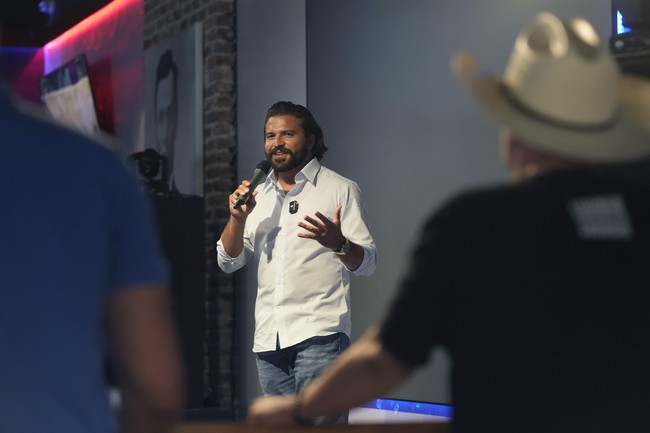
![Trump Strikes Back as U.S. Launches Blistering Attack on Iran After Drone Assault [WATCH]](https://www.lifezette.com/wp-content/uploads/2026/06/2026.06.14-07.01-lifezette-6a2e51d01a59c.jpg "Trump Strikes Back as U.S. Launches Blistering Attack on Iran After Drone Assault [WATCH]")

The United States launched military strikes against Iran on Friday, responding to Iranian drone attacks on a cargo ship in the Strait of Hormuz.
The strikes came moments after President Donald Trump appeared to hint that retaliation was imminent, signaling that Tehran’s provocation would not go unanswered.
Speaking to reporters in the Oval Office, Trump left little doubt about his sentiments toward the Iranian action.
“Well, you’ll find out,” he said after being asked whether the United States would respond.
Here’s What They’re Not Telling You About Your Retirement
He went on to describe the Iranian drone attacks as an unacceptable breach of a ceasefire agreement that had brought a brief pause to escalating tensions.
The president confirmed that four Iranian drones had targeted a ship traversing the Strait of Hormuz.
“We knocked down three, and one hit the upper deck of a very expensive ship,” Trump said.
“They shouldn’t be doing that, so you’ll find out.”
This Could Be the Most Important Video Gun Owners Watch All Year
WATCH:
His choice of words, as usual, carried an element of strategic suspense that foreshadowed a swift and powerful display of American resolve.
Trump also took to Truth Social earlier in the day, calling Iran’s drone attack “a foolish violation of our Ceasefire Agreement.”
He described the incident in detail, explaining that damage had been done but the vessel was able to continue its voyage.
The message sent a clear signal to adversaries abroad and critics at home: America under Trump does not tolerate aggression without consequence.
The decision to strike Iran was announced by the United States Central Command shortly after Trump’s comments.
Officials framed the move as a defensive response, intended to safeguard international shipping lanes and reaffirm America’s commitment to protecting global commerce.
According to initial reports, the strikes targeted Iranian military assets believed to be involved in launching the drones.
This latest confrontation comes only weeks after the United States and Iran signed a memorandum of understanding intended to cool simmering hostilities.
But even that effort, encouraged by some on Capitol Hill as a path toward stability, appears to have collapsed under Iran’s continued belligerence.
Tehran’s government, emboldened by years of weak leadership before Trump’s return to power, seems to have miscalculated once again.
The president, who met with Republican senators earlier in the week, had hinted that diplomacy could give way to action if Iran failed to maintain the peace.
“Iran is being very nice, they’re agreeing to everything I want, and they have to. Otherwise we just go back and do what we have to do,” he said.
Two days later, Iran tested that resolve, and Trump wasted no time proving his word means business.
The military response received immediate praise from conservatives who have long argued that strength, not appeasement, is the only language Tehran understands.
Iran’s pattern of proxy warfare, constant threats to shipping, and repeated violations of international law have made it a thorn in America’s side for decades.
Even as some in Washington continue to preach “restraint” and “dialogue,” the reality is that weakness invites aggression.
WATCH:
The previous administration’s soft approach only encouraged Tehran’s arrogance.
Billions in unfrozen assets, empty threats, and meaningless red lines convinced Iran that it could push the United States without severe consequence.
Those days are clearly over. Trump’s decisive response reasserts American deterrence in one of the world’s most volatile regions.
Details about the scope of the U.S. strikes remain limited, but defense sources suggest that multiple Iranian military facilities were targeted, including drone launch sites and communications hubs. There were no immediate reports of American casualties.
The Pentagon has confirmed that operations were carried out to minimize civilian harm, though officials emphasized that Iran alone bears responsibility for any escalation.
Reactions in Congress broke sharply along partisan lines. Republicans largely backed the president’s decision, applauding his leadership and his willingness to act when American interests are attacked. Democrats, predictably, called for “restraint” and warned against the “risk of widening conflict.”
The same crowd that stood silent when Iran harassed U.S. naval forces during prior years now seems to have rediscovered concern for peace.
Iranian state media, meanwhile, downplayed the damage and accused the United States of “violating sovereignty.”
The same tired propaganda has followed every episode in which Tehran finds itself on the losing end of confrontation.
Yet for the Iranian regime, these strikes should serve as a wake up call: the era of unchecked aggression is over.
The administration’s quick and forceful move demonstrates the contrast between Trump’s foreign policy and the flailing indecision seen under prior leadership.
Where weakness invited enemies, resolve sends them running. As the world watches, America has reminded its adversaries that peace comes through strength, not submission.
The Real MOU: What Trump’s Iran Agreement Actually Says – Truth Thursday | EP 677
Read the full article here

![Runaway Trucker Sparks Fireball Collision with Freight Train in Atlanta as Company Faces Safety Scandal [WATCH]](https://www.lifezette.com/wp-content/uploads/2026/06/2026.06.27-08.53-lifezette-6a3f8f75d9063.jpg "Runaway Trucker Sparks Fireball Collision with Freight Train in Atlanta as Company Faces Safety Scandal [WATCH]")



![Dual Citizenship in Congress? Anna Paulina Calls Out Obvious Loyalty to America Issue [WATCH]](https://www.rvmnews.com/wp-content/uploads/2026/09/2026.09.19-12.02-rvmnews-6aae79d73a249.jpg "Dual Citizenship in Congress? Anna Paulina Calls Out Obvious Loyalty to America Issue [WATCH]")
![PLA Surveillance, Police Systems, and State Logins Leaked Through Claude [WATCH]](https://www.rvmnews.com/wp-content/uploads/2026/09/2026.09.19-11.56-rvmnews-6aae788b9b118.jpg "PLA Surveillance, Police Systems, and State Logins Leaked Through Claude [WATCH]")