
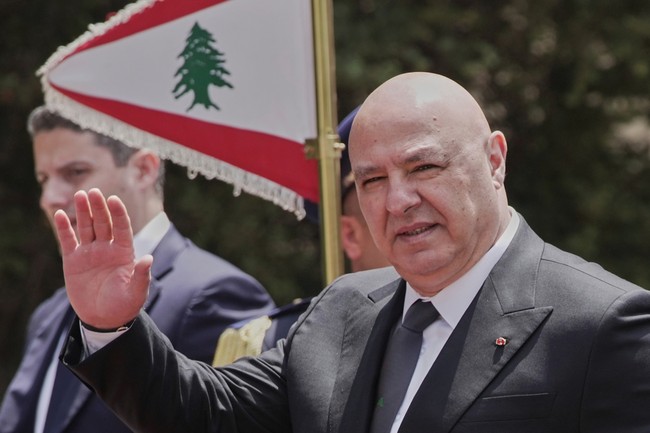

The “ceasefire” in Lebanon continues to misfire today, which will likely prompt a return of the same cycle that produced an exchange of attacks between Israel and Iran this weekend. That’s because, despite all of the PR by various parties to this ceasefire, it has exactly the same value as every ceasefire arranged with Iran or its proxies. Zero.
The Trump administration has tried repeatedly to shore up the ceasefire between Lebanon and Israei, but it has one fatal flaw. Lebanon isn’t at war with Israel; Hezbollah is at war with Israel. Despite promising twice to abide by the Lebanese government’s truce with Israel, Hezbollah has reneged at every turn while demanding new conditions for its compliance. Their continued fire at Israel and its forces has Benjamin Netanyahu ramping quicly back up to full-scale warfare against the IRGC’s proxies, including strikes on Tyre:
At least eight people were killed and dozens more wounded in an attack on Tyre, one of southern Lebanon’s largest cities, Lebanon’s health ministry said. The latest attacks underlined how Lebanon has emerged as a major wedge issue in efforts to negotiate an end to the U.S.-Israeli war with Iran.
Tehran has insisted that any peace agreement include security for Lebanon, while Israel has rejected any such link, insisting it will keep striking there to target the Iran-allied Hezbollah militia. After an Israeli strike near the Lebanese capital, Beirut, set off a brief round of clashes with Iran, Tehran warned on Monday that it would attack Israel again if it resumed its “aggression and hostile acts,” including in southern Lebanon.
Hezbollah, for its part, has rejected any cease-fire with Israel, and has continued firing on Israel from its positions in southern Lebanon. Israel has occupied large parts of southern Lebanon, arguing that it is needed to defend itself against Hezbollah attacks, and the Israeli military issued new evacuation warnings in the region early Tuesday, warning of imminent strikes. Some of the attacks were in areas that were not covered by evacuation warnings, according to Lebanon’s state-run news agency.
When Israel attacked Beirut and southern Lebanon a few days ago, Iran fired a volley of 30 ballistic missiles at Israel. The IDF then attacked several military-industrial targets, most notably a petrochemical plant that produces fuel for Iran’s ballistic missiles. Iran stopped firing at Israel but warned it would attack again if Israel did not stop operations in Lebanon, while Hezbollah again refused to honor any ceasefire unless Israel withdrew fully from the sub-Litani region.
That is an amusingly ironic response, but the Wall Street Journal seems to miss the joke. Instead, they fret that Israel’s actions might create a civil war in Lebanon because they, er, expect the Lebanese government to fulfill their many promises to end Iran’s occupation via Hezbollah:
The government of Lebanon is barely able to manage the basic requirements of statehood. It can provide electricity for only a few hours a day, and people avoid its flattened currency in favor of dollars. Its military is only the second-most-powerful force in the country after Hezbollah—or the third counting Israel, which has been expanding its monthslong occupation.
But it is now being pressed by the U.S., Israel and many of its own people toward a confrontation with Hezbollah that risks tilting the country into a new civil war.
The growing pressure comes via a new and already-strained ceasefire deal to end the war with Israel that has rocked Lebanon since early March, when Hezbollah sided with Iran and began firing rockets across the border. The agreement requires the Lebanese state to take back control of its territory a little at a time as it disarms and dismantles the militant group.
It is a plan that was tried after Israel’s last war with Hezbollah in late 2024 and made some progress before faltering when Hezbollah—which represents many of Lebanon’s Shia Muslims and is one of the world’s most powerful nonstate militias—dug in and refused to disarm.
Yes, this is the bitter irony that the WSJ misses. The government of Lebanon has made multiple agreements with Israel to remove Hezbollah from the sub-Litani region and the Bekaa Valley. Those agreements also included disarming Hezbollah, and they go back more than 20 years. The UN Security Council passed a resolution demanding that Lebanon disarm Hezbollah and clear southern Lebanon, and even sent its UNIFIL peacekeepers to enforce it … when all they did was provide cover for Hezbollah to rearm and dig in. The 2024 ceasefire agreement made all of these same demands, to which the Lebanese government agreed and still did nothing to enforce.
This time, Israel is not going to rely on empty promises of compliance and enforcement. They will force the issue themselves, because they are tired of having to absorb attacks from Lebanon by Iran’s proxy army. The problem in Lebanon is not the risk of a new civil war but of the Aoun government’s refusal to assert its sovereignty and eject Iran’s proxy from its territory.
Lebanon is not going to have a civil war. They are going to experience a liberation from foreign occupation, one way or the other. If they won’t act for themselves, then Israel will act in its own defense to finally end the threat from Hezbollah while it’s mainly cut off from its IRGC sponsors in Tehran.
This is yet another example of the folly of pursuing a deal with the IRGC junta in any context. The Iranian regime and its proxies have never honored any agreement, ever, especially in relation to Israel and the US. The only way to get them to comply is to force them into an existential vise, and even then, they will only comply long enough to reset their strength and then renege again.
The Israelis have figured this out; it’s time for Washington DC to do the math as well, and Lebanon is a good place to start.
Addendum: In the meantime, executions of political prisoners continue in Iran. The NCRI plans to hold another rally in Paris on June 20 to escalate attention to oppression within Iran, political and religious, and to push the West to effectively find ways to bring this regime to an end (via e-mail):
On June 20, more than 100,000 people are expected to gather at a major international rally in Paris. The goals of the rally are to draw global attention to the wave of executions and widespread human rights abuses in Iran, including severe restrictions imposed on religious minorities, Christians and others, and to call on the international community to take urgent action to halt this trend and support the rights of all the people of Iran. The rally also expresses support for the establishment of a democratic republic (as outlined in the Ten-Point Plan advanced by Mrs Maryam Rajavi, President of the NCRI).
Support from other voices in civil society and religious leadership is crucial for such a vision to be realised. Please consider adding your voice in solidarity with all who are suffering and struggling in Iran and adding your support for the objectives of the rally.
If “help is on the way” is to mean anything, it should start with a recognition of the true nature of this radical and murderous regime, not to mention its track record on “agreements.”
Editor’s Note: For decades, former presidents have been all talk and no action. Now, Donald Trump is eliminating the threat from Iran once and for all.
Help us report the truth about the Trump administration’s decisive actions to keep Americans safe and bring peace to the world. Join HotAir VIP and use promo code FIGHT to get 60% off your VIP membership.
Read the full article here

![Lara Logan Drops a Bombshell on the Real Reason Trump Went After Maduro [WATCH]](https://www.lifezette.com/wp-content/uploads/2025/11/2025.11.24-11.35-lifezette-69244300ef3f9.jpg "Lara Logan Drops a Bombshell on the Real Reason Trump Went After Maduro [WATCH]")

![FBI Possessed Proof of Biden Pay-to-Play and Chose Silence [WATCH]](https://www.lifezette.com/wp-content/uploads/2025/09/2025.09.19-12.07-lifezette-68cd479b9541a.jpg "FBI Possessed Proof of Biden Pay-to-Play and Chose Silence [WATCH]")
![Lauren Boebert Demands They Lose Nonprofit Status [WATCH]](https://www.lifezette.com/wp-content/uploads/2026/02/2026.02.13-09.39-lifezette-698ef14cb73b8.jpg "Lauren Boebert Demands They Lose Nonprofit Status [WATCH]")