
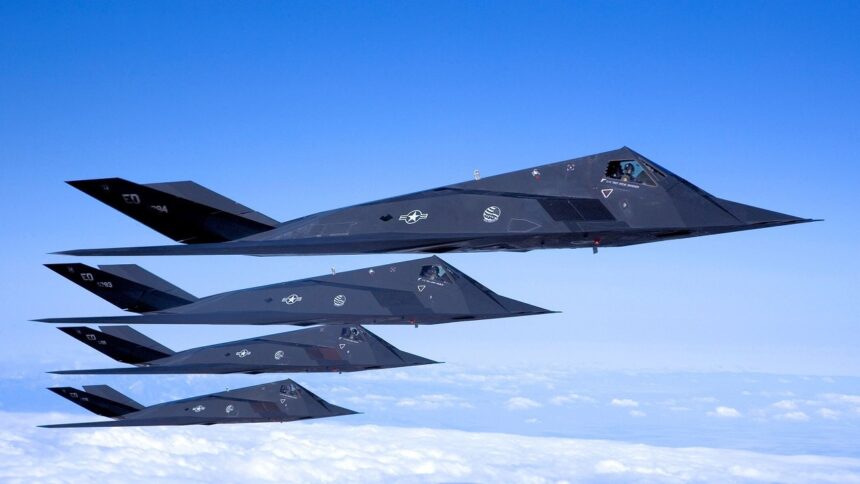

Summary and Key Points: Lockheed’s naval F-117 needed a new wing, a reduced sweep angle, folding mechanisms, strengthened landing gear, an arrestor hook, a ground-attack radar, air-to-air missiles, afterburning engines, and external hardpoints for another 8,000 pounds of weapons. Which raises the question the Navy eventually answered: at what point is it no longer an F-117?
The F-117 Nighthawk: Aircraft Carrier Edition?
At one time, the United States military considered developing a variant of the iconic F-117A Nighthawk capable of deploying from and landing on aircraft carriers.
Known in aerospace circles as the “F-117A Seahawk,” this concept was a heavily redesigned variant of the F-117A, originally pitched by the visionary engineers at Lockheed Skunk Works in the early 1990s.
After reviewing the proposal and assessing the requirements for a carrier-based F-117, the Navy ultimately rejected it for being too expensive.
The Seahawk Proposal
Part of the problem the F-117N Seahawk faced was that it was based on a fragile stealth plane. As the United States’ first major stealth warplane, the F-117A Nighthawk pushed the boundaries of what was technologically possible in the 1990s.
But the original stealth plane ultimately didn’t deliver on the full promise of stealth.
Subsequent stealth planes achieved it. Those subsequent planes, like the B-2 Spirit or even the current crop of fifth-generation F-22 Raptors and F-35 Lightning IIs, were more durable, could achieve more, and had superior stealth.
While the Lockheed F-35 Lightning II is controversial in some circles because of the many problems that arose during its development, the Navy’s decision to ultimately choose the F-35C as its next main carrier-based warplane was the smarter choice.
Yes, it took longer than expected to embrace the F-35C. The F/A-18E/F Super Hornet fleet has had to do more for longer than expected because the F-35C has taken longer to stand up, but the Navy’s decision to wait rather than go with the F-117N likely saved the maritime branch from expensive headaches.
Lockheed Skunk Works proposed the F-117N Seahawk because the original F-117A Nighthawk was designed to penetrate sophisticated Soviet air defenses and then attack well-defended targets with precision-guided munitions deep inside enemy territory.
F-117
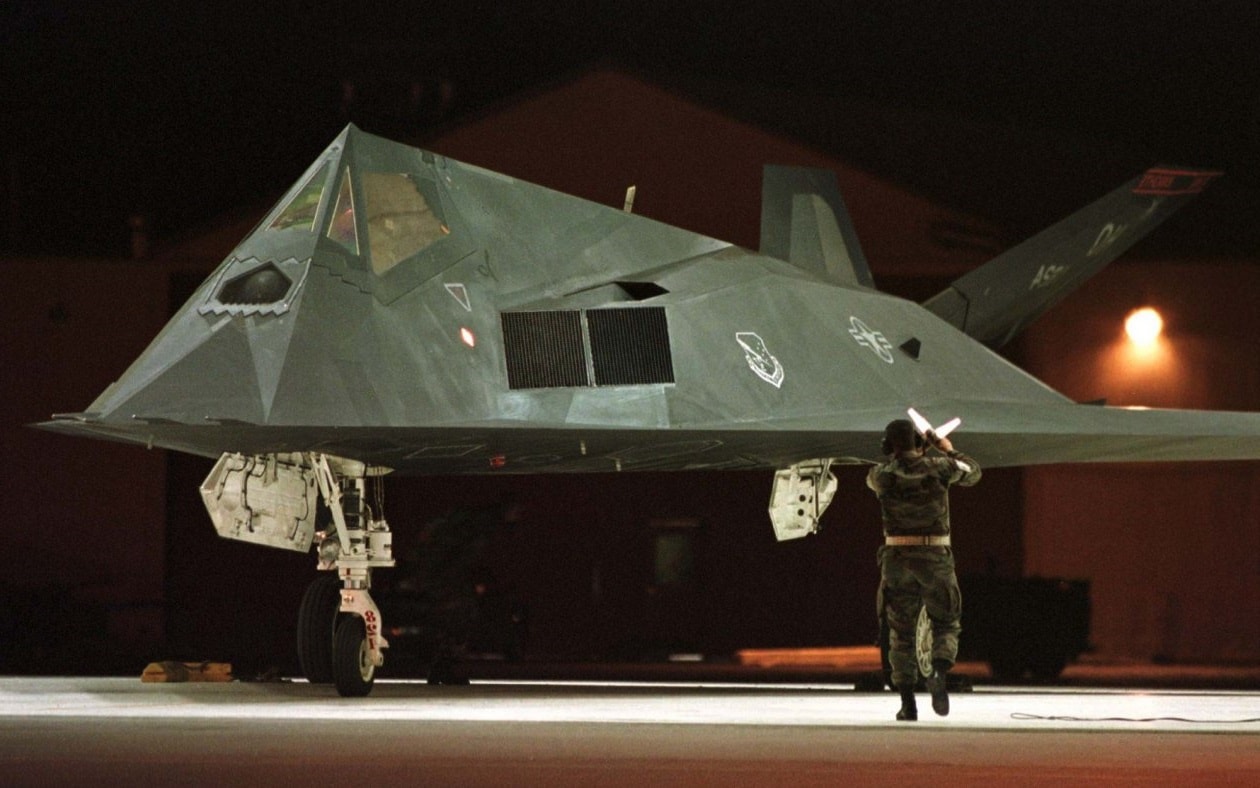
F-117 Stealth Fighter. Image Credit: US Government.

An F-117 Nighthawk taxies down the runway after landing Jan. 11 at Kunsan Air Base, Republic of Korea. A squadron of F-117s, together with 300 Airmen, have deployed here in support of a continuing force posture adjustment throughout the Pacific. The aircraft, assigned to the 9th Expeditionary Fighter Squadron, is part of the third squadron of Kunsan AB’s host unit, the 8th Fighter Wing, during the deployment’s duration. (U.S. Air Force photo/Senior Airman Darnell Cannady)
The F-117A Nighthawk’s combat performance in Operation Desert Storm was truly impressive.
Its biggest problem was that the plane was subsonic and could carry only two internally mounted bombs.
In fact, the F-117A lacked an onboard search radar and was not meant for conventional air-to-air combat (no dogfighting).
When Lockheed proposed the F-117N Seahawk, the Pentagon had just canceled the Navy’s A-12 Avenger II (the “Flying Dorito”) stealth attack warplane.
The Navy lacked any viable replacement for its aging A-6 Intruder. So Lockheed saw an opening. The Navy chose not to take that opening.
Not Letting Go
Lockheed offered only modest changes to the existing F-117A Nighthawk.
These changes included corrosion protection (a must-have for any plane operating from a carrier deck) and an automatic carrier landing system.
But the Navy believed the F-117N would have been too limited for its needs.
After being denied the bid, Lockheed went back to the drawing board and developed the A/F-117X, which was far more ambitious than the F-117N Seahawk concept.
The proposed changes included a totally redesigned wing and greater horizontal control surfaces.
These changes were meant to improve low-speed handling (required for carrier landings).
Lockheed was desperate to turn its specialized Nighthawk into a versatile naval combat aircraft.
Proposed changes included a 64-foot wingspan and reduced wingsweep from 50 degrees to 42 degrees.
Lockheed proposed folding mechanisms to help the carrier-capable F-117 fit inside the carrier.
The landing gear would have been strengthened for carrier-based operations. It would also have installed a retractable hook for carrier landings.
What’s more, Lockheed intended to expand the proposed carrier-based F-117’s internal weapons capacity.
A ground-attack radar with air-to-air capability would have been installed on the plane.
It was also designed to carry AIM-120 AMRAAM air-to-air missiles.
For the A/F-117X, Lockheed wanted to add afterburning engines and better avionics along with the other changes listed above.
Lockheed engineers proposed external hardpoints to carry another 8,000 pounds of weapons (though using them would have negated at least some of the stealth).
Lockheed envisioned the Navy ordering as many as 255 of these planes, each worth $70 million.
Congress Wanted a Carrier-Based Nighthawk
Congress was especially interested in determining whether this platform could replace the canceled A-12 Avenger II.
In 1995, the Senate Armed Services Committee directed the Secretary of the Navy to investigate the A/F-117X as a potential carrier-based aircraft.
A year later, Congress authorized $175 million for the project: $25 million for an initial examination (and risk-reduction report) and $150 million for possible engineering and manufacturing development (depending on the results of that $25 million examination).
But given the specialized nature of the F-117 Nighthawk, navalizing the F-117 was not easy, and the Pentagon was moving forward with what would become the F-35.
The Department of Defense was worried that if it diverted resources into any other specialized aircraft while pursuing the common warplane design for the F-35 with the Air Force, Navy, and Marine Corps, the Navy would ultimately lose focus and momentum on the F-35.
Again, this was likely the smartest move by the Navy, since the F-35C, despite its many false starts, still offered the most promise and long-term viability.
About the author: Brandon J. Weichert
Brandon J. Weichert is the Senior National Security Editor at 19FortyFive.com. He also manages The Weichert Brief on Substack. Weichert also hosts “National Security Talk” on Rumble. He is the author of four bestselling national security books, most recently A Disaster of Our Own Making: How the West Lost Ukraine (Encounter Books). Follow him via Twitter/X @WeTheBrandon.


![Texas Attorney Goes Viral After Judge Allegedly Humiliates Her Over ‘Inappropriate’ Dress [WATCH]](https://www.lifezette.com/wp-content/uploads/2026/09/2026.09.28-14.47-lifezette-6aba7de89d8ba.jpg "Texas Attorney Goes Viral After Judge Allegedly Humiliates Her Over ‘Inappropriate’ Dress [WATCH]")
![Joe Biden Accepts Planned Parenthood Award With Rambling Gala Speech [WATCH]](https://www.lifezette.com/wp-content/uploads/2025/09/2025.09.02-08.54-lifezette-68b75978a7875.jpg "Joe Biden Accepts Planned Parenthood Award With Rambling Gala Speech [WATCH]")