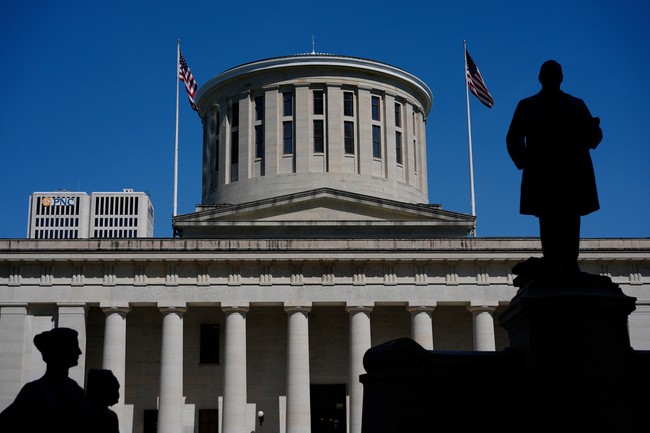

In my mind’s eye, I’ve always thought of Ohio as being sort of a reddish, purple place. You know, lots of salt-of-the-earth Midwest but not quite Cornbelt folks in the communities around what have always seemed to be pretty liberal cities. Part of that impression had been formed by the politicians they vote for, like the uber-lefty Sherrod Brown types (of course, there are two GOP senators now, but Sherrod’s making gurgling noises again.).
They’ve also had the almost Mid-Atlantic-ish Republican, like their current governor, Mike DeWine, who has been a fly in the GOP machine ointment on numerous occasions. Right now, he’s in a contentious battle over the death penalty with what seems to be nearly everyone in the state.
Republican Gov. Mike DeWine said Tuesday that Ohio should abolish the death penalty, saying it is no longer a deterrent to violent crime, confirming his change of heart on the policy he helped write as a state legislator 45 years ago. https://t.co/RRk8Hzytv2
— NEWSMAX (@NEWSMAX) June 16, 2026
So, shame on me, but when and for whatever reason, Ohio would be mentioned in any of the material I came across while doing my posts on renewable energy, I just sort of wrote them off, figuring they were big players in the scam, like their neighbors in Michigan.
Which is why this announcement about a bill that passed the Ohio State Senate last week was so intriguing. In fact, when you consider the fights going on in upstate New York and Michigan, for example, against wind farm developments being spearheaded by the state and underwritten by legislation that takes local autonomy for such decisions out of local hands, this bill – which still has to go to the Ohio House – would codify an amazing, reliable, and responsible energy policy into state law.
This week, Ohio Senate Bill 294 passed the Ohio Senate. This legislation provides guidance to the state’s Power Siting Board on the intent of the General Assembly that the energy powering the Buckeye State should be “affordable, reliable and clean,” and the energy produced and the manner in which it is produced shall rely on domestically sourced materials and “minimize reliance” on “foreign adversary nations for critical materials or manufacturing.”
…According to the bill, an “affordable” energy source is one that has “a stable and predictable cost” and provides a “cost-effective means of heating, cooling, and generating electricity.” Further, “affordable” sources must deliver “substantial savings relayed to residential and commercial customers comparable to energy sources listed in 42 U.S.C. 15852(b),based on the average cost per unit of energy output calculated to include any direct or indirect payment by any level of government for the previous five years.” Those energy sources in the U.S. code being solar, wind, biomass, landfill gas, geothermal, municipal solid waste, or hydroelectric.
To be considered a “reliable” energy source, the bill demands the resource be “readily available at all times to meet energy demands with minimal interruptions during high-usage periods” and that, when used for power generation, the resource must have a “minimum capacity factor of fifty per cent,” that it’s electricity output is “dispatchable at all times and with the capability to ramp up or down electricity generation within one hour to stabilize the electrical grid,” and have the ability to “complement and provide backup to renewable energy resources during periods of low availability.”
Reliability, affordability that is ‘stable and predictable’ (based on real cost per unit, which includes ANY government subsidies paid in the past five years), and, most importantly, readily available for dispatch when needed at all times, and the capability to ramp up or down as needed to meet demand.
RENEWABLES WILL NEVER BE DISPATCHABLE
…“Dispatchable” power sources are those that can adjust to the electric grid on demand, such as a natural gas turbine, a coal plant, a hydroelectric dam, or a nuclear plant. Non-dispatchable power sources, such as solar and wind, cannot be turned on or off to meet demand and are highly intermittent. They are not continuously available 24 hours a day because of factors that cannot be controlled—such as cloud cover, daylight, wind speed, air density, and other variables—and are therefore unreliable.
The bill considers a “clean” source to be any energy generated by natural or gas or nuclear or “any energy generated by utilizing those sources listed in 42 U.S.C. 15852(b) or hydrocarbons, which, when combusted for the purpose of electricity generation, meet the national ambient air quality standards set by the United States environmental protection agency under the authority of the Clean Air Act,” 42 U.S.C. 7401.
SB 294 establishes a clear state policy prioritizing affordable, reliable, and clean energy – not as mutually exclusive goals, but as interdependent pillars of sound energy governance. By aligning state policy accordingly, the bill provides regulatory clarity and market certainty for investors, utilities, and consumers alike.
By encouraging affordable, reliable, and clean energy sources, Ohio not only protects its consumers and industries from unreliable or costly alternatives but also sets a policy model for other states. SB 294 charts a pragmatic energy path that promotes both innovation and dependability without sacrificing affordability or security.
A balanced energy framework guarantees dependable power for homes, hospitals, and manufacturers. Energy independence for Ohio also means economic resilience. Prioritizing American-produced fuel, particularly natural gas, which is in abundant supply in the Buckeye State, reduces exposure to hostile or unstable foreign suppliers, secures jobs, and keeps energy dollars in Ohio.
I was thinking that this would not only be quite the shot across the bow of the renewable energy grift, but what a Godsend for Ohio households in the middle of, say, one of the infamous deep freezes or Midwest blizzards if they weren’t subject to the vagaries and whims of battery farms and frozen wind turbines leaving them in the lurch when they needed the heat the worst.
That’s when I found out that Ohio has been in the forefront of citizens’ rights to fight these things off on their own terms for almost a decade.
There are any number of whining, wind and solar industry Xweets on X, moaning about how Ohio has spurned yet another project and would surely regret it, the knuckle-dragging Luddites.
Ohio has blocked more than 5.3 gigawatts of solar and wind projects over the last dozen years, and a new analysis from Save Ohio Parks finds the lost generation is driving up electricity costs for residents as demand surges from a wave of proposed data centers. Read more:… pic.twitter.com/j8NroGUVF0
— TiffinOhio.net (@TiffinOhioNews) June 17, 2026
In point of fact, the Ohio Supreme Court has even gotten into the act and has renewable advocates wailing and gnashing their teeth about all the energy ‘savings’ this intransigent attitude is costing unaware Ohioans.
WAAH!
The Ohio Supreme Court recently blocked a permit for what would be the state’s largest solar installation. State lawmakers and other officials have now blocked more than 5.3 gigawatts of solar and wind projects in Ohio over the last dozen years. https://t.co/jnfnKwC6qH
— David DeWitt (@DC_DeWitt) June 16, 2026
But what I found reading this self-serving little piece made me want to go shake some Buckeye hands for their prescience in the face of the climate cult-induced renewable juggernaut.
…This is just the latest example of how state lawmakers and other officials have obstructed renewable energy development in Ohio. In total, they have thwarted more than 5.3 gigawatts of solar and wind projects over the last dozen years.
So says a recent analysis released by Save Ohio Parks, which opposes fracking and oil and gas extraction from public lands.
…Ohio, like many other states, is facing rising utility bills as well as massive new energy demand due to a wave of proposed data centers. The Save Ohio Parks report contends that clean energy could have helped rein in those energy costs while meeting a huge chunk of data centers’ demand if Ohio had allowed more development. The 5.3 GW of blocked clean energy would have also avoided large amounts of greenhouse gas emissions and local air pollution.
The state stepped up its pushback on wind and solar as each of those clean energy sources became more cost-competitive with fossil fuels and nuclear power.
Oh, the backwoods, backward folks in Ohio ‘pushed back’ on renewables as those ‘clean energy sources became more COST COMPETITIVE‘ with fossil fuels and nuclear.
See what the argument’s missing there?
Where’s ‘reliability’ and ‘dispatchable’?
And then I hit the money paragraphs in the middle of all the whining.
...A 2014 law that more than doubled property-line setbacks for wind turbines effectively blocked over 3.3 GW of utility-scale projects in the state, the report notes. Efforts in 2017 to roll back those restrictions failed, leaving Ohio among the nation’s most restrictive states for wind power.
“The economics of a wind farm don’t work when you need that amount of setback from a property line,” said Rachel Kutzley, a Save Ohio Parks board member who worked on the report.
Aw! What a shame! The Ohio legislature saved neighbors who wanted nothing to do with towers overlooking their laundry line from long and expensive, and usually hopeless court battles.
But there was more, and kudos to Gov DeWine. He handed autonomy over renewable farm decisions, which take up an inordinate amount of land, back to the local authorities who would be most impacted by the unsightly and environmentally unfriendly land grab.
…Seven years later, Gov. Mike DeWine signed Senate Bill 52, which lets counties ban new solar projects above 50 MW of capacity and “economically significant” wind farms able to produce more than 5 MW of electricity. SB 52 doesn’t let counties ban power plants that use fossil fuels or nuclear power.
Neither the Save Ohio Parks report nor a February 2026 paper in the journal Frontiers in Sustainable Energy Policy quantified how much clean energy generation the bans by Ohio counties have prevented.
Projects that were already in grid operator PJM Interconnection’s queue are not subject to outright bans under SB 52. The Ohio Power Siting Board, however, can deny permits for individual projects — and since 2021 it has rejected eight installations, making Ohio one of the toughest states for developing clean energy. The board has routinely referenced local government opposition when rejecting projects.
You’ll notice that the last highlighted sentence is about exclusions to the law that were already in operation or being built? That interconnector – PJM – is one I have often referenced in my posts about New Jersey and the Mid-Atlantic’s ongoing power acquisition and distribution problems. The latest post was in mid-May and on the skyrocketing rates. That massive interconnector (it covers 13 states) could not secure enough guaranteed electricity in a recent auction to cover anticipated capacity shortfalls this summer. PJM is going to have to pay spot rates should they reach a critical level and have to find additional power to cover.
…What that auction did was look for spare capacity for the PJM system to help save itself of on the worst day…and there was none.
And truer words have never been written.
…For decades, coal, natural gas, and nuclear plants carried the system. They ran day and night. They showed up during heat waves and cold snaps. They kept reserve margins healthy and prices stable. Policy choices accelerated their exit before replacements were ready.
The auction simply counted what was left.
By the time bidding hit the price cap, PJM still had not secured enough dependable capacity. That is not a market failure. That is a supply failure. You cannot buy power plants that no longer exist, no matter how high the bid.
YOU CANNOT BUY POWER PLANTS THAT NO LONGER EXIST
Those clean, reliable, and dispatchable coal, natural gas, and nuclear plants that the Ohio Senate is now trying to enshrine into state law are what will keep the lights on and rates from bankrupting their citizens.
That is being proactive and responsible, and man.
More states should follow the leaders there.
Editor’s Note: Hollywood, academia, and liberal elites are out of touch with the average American.
Help us continue to report the truth about what 77 million patriots voted for by joining HotAir VIP and using promo code FIGHT to receive 60% off your membership.
Read the full article here


![Al Gore Gets Embarrassed After Reality Shreds His Climate Boasting During ABC Interview [WATCH]](https://www.rvmnews.com/wp-content/uploads/2026/06/2026.06.18-09.30-rvmnews-6a33bac09d3e4.jpg "Al Gore Gets Embarrassed After Reality Shreds His Climate Boasting During ABC Interview [WATCH]")