



This is another instance of Democrats talking out of one side of their mouths while doing the exact opposite.
For example, here’s our weaselly, turncoat, ex-Republican, now Democrat candidate for Florida governor, David Jolly.
He’s busy running all over the state, bleating about data centers, flooding the airwaves with anti-data center campaign commercials, and boasting about how he’s going to ‘fight them.’
He’s made data centers the center of his campaign, as has the goofy Doug Jones, who lost his bid for reelection as Alabama’s U.S. senator, so he figured he’d run for governor.
Sadly for him, he’s up against another former U.S. senator, Tommy Tuberville, who happens to be the same fellow he lost his Senate seat to, and a guy who’s a lot more popular than Doug Jones.
So Doug has glommed onto the ‘We hateses data centers!’ talking points, just like the underwhelming Jolly.
Hey, wait a minute – is this the new ‘threat to democracy’ election talking point?
Turns out it is.
The Democrat higher-ups cooked it all up at the beginning of this month as the data centers conspiracy spazz-out started to heat up.
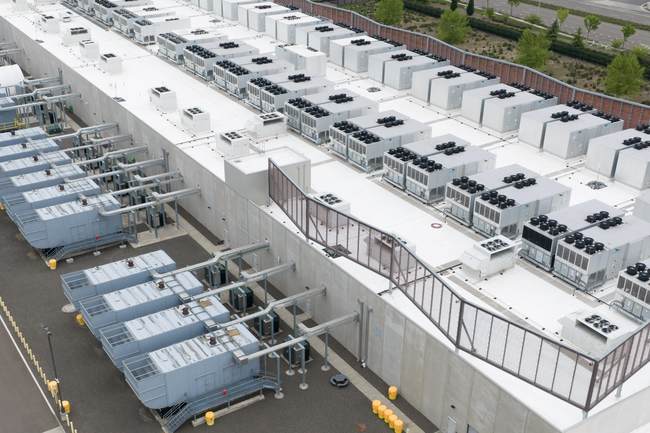
Democrats want voters to see data centers as giant outposts of megacorporations that enjoy undue tax breaks and ill-begotten monstrosities that suck up precious water and hog electricity.
After months of probing and message-testing, Democrats are aligning on a few key thematic attack lines as they figure out how to take advantage of a fast-moving issue riling up voters across the political spectrum.
The two themes of costs and corruption have dominated politics during President Donald Trump’s second term, and new party guidance makes that strategy even more explicit. In recent days, House Democrats’ campaign arm updated the webpage it uses to quietly communicate with super PACs, signaling them to focus on data centers in 11 different battleground races, either by calling for negative ads that connect data centers with candidate corruption or resource scarcity or requesting more polling on the issue.
And an internal memo from the House Majority PAC, the top super PAC supporting House Democrats, obtained by POLITICO, calls on allies to attack vulnerable Republicans with language that touches the “conspiratorial nerve that runs through the data center discourse among voters.”
And they want to beat every Republican candidate about the neck and shoulder with it. So, as the fellow above says, while Tommy Tuberville is talking taxes, his actual record and where he wants to take Alabama, ‘disheveled Doug Jones is standing in my driveway,’ and all he’s doing is squawking, ‘DATA CENTERS! DATA CENTERS! DATA CENTERS!’ like a chubby demented parrot.
Same for Jolly, only he’s on the trimmer, the more well-kept side.
Happening on the TV near you? It might well be, and it’s all part of the plot.
The idea is to hang the general paranoia about data centers around Republicans’ necks – party of rapacious corporate America, right?
…Democratic campaigns and their allies have begun pouring money into a wave of more than 40 political ads across two dozen races on the issue — revealing a concerted effort to use data centers as a way to slam the GOP on affordability and corruption.
House Minority Leader Hakeem Jeffries on Monday hinted at this new messaging, highlighting the $70 billion in tax breaks for big tech companies in the GOP’s One Big Beautiful Bill Act when asked about data centers.
The House Majority PAC memo provided sample attack language that connects data centers to that bill.
But hang on here – this is where the story runs off the rails as far as the attacks on ‘affordability and corruption.’
The House, in what has to be considered a modern-day miracle, just passed what’s known as the ‘Ratepayers’ Protection Act,‘ written by a Republican congressman. And I call it a miracle because the bill only had three ‘nays’ with 417 ‘LFGs!’
The House just voted 417-3 to stop making families eat the electric bill for giant AI data centers.
The Ratepayer Protection Act tells states to consider forcing those 100-megawatt server farms to cover the full extra cost of the new plants and power lines they need, instead of…
— Kacee Allen (@KaceeRAllen) September 17, 2026
…The Ratepayer Protection Act tells states to consider forcing those 100-megawatt server farms to cover the full extra cost of the new plants and power lines they need, instead of passing it onto households.
Both parties piled on because people are tired of watching their rates climb so a computer warehouse can sit next to a suburb.
It still has to get through the Senate, and states can refuse the standard.
Now, states can ‘refuse the standard‘ (thanks to the variability of utility schemes across the country), but that opens state officials up to the fury of their constituents for whatever happens. That’s not a choice or a backlash many state elected officials will be willing to brave.
As to affordability and corruption, look what it addresses:
A 417–3 vote is about as close to unanimous as Congress gets on anything. The House delivered that margin for the Ratepayer Protection Act, a bill designed to stop AI and hyperscale data centers from quietly passing the cost of grid upgrades onto your electricity bill. If it clears the Senate, big tech would face a harder time treating power infrastructure as a shared expense billed to everyone else.
What the Bill Actually Does
The Ratepayer Protection Act amends PURPA, the Public Utility Regulatory Policies Act of 1978, a federal framework that sets utility standards states must formally consider adopting. This bill adds a new “large-load standard” aimed at data centers drawing 100 megawatts or more at a single site, roughly enough power to serve 80,000 average homes. Under that standard, those operators would cover the full incremental cost of any new substations, transmission lines, or generation capacity built specifically to serve them.
The bill also addresses what happens when a data center scales back, relocates, or walks away from a utility contract. In those cases, stranded infrastructure costs stay with the data center operator, not with residential customers and small businesses. Utilities would also gain authority to require financial assurances upfront, before breaking ground on new infrastructure, reducing the risk of being left with costly investments for a tenant that never moved in.
“Large data centers can cover the full incremental cost of any generation, transmission, or distribution upgrades needed to meet their high energy demand,” said Rep. Gabe Evans (R-Colo.), co-sponsor of the bill, during House Energy and Commerce Committee consideration, as reported by the Washington Examiner. The committee passed the bill 52–0 before the full House vote, a preview of the bipartisan support that followed.
The federal government is setting the standard that ‘major new power users should pay for what they consume.’
This does not sound as if Republicans are in bed with data center developers at all. In fact, it appears they are trying to protect American consumers from unbridled growth and unrelenting utility bills.
And if national Democratic candidates for office are so concerned about the rise of data centers in their locales that they have to campaign on fighting them, why are they not besieging Senate Majority Leader Chuck Schumer’s office to ask him why he’s blocking this bill protecting their potential constituents?
Because that’s what he’s doing.
Senator Schumer says the Ratepayer Protection Act is “a fraud.”
Last week, Democrats blocked this bipartisan bill that would shield Americans from higher costs related to data centers.
Democrats are standing in the way of lower prices. pic.twitter.com/jhPCm6n0EU
— Senate Republicans (@SenateGOP) September 23, 2026
So candidates are all about protecting the public while Schumer is doing the exact opposite, and in the face of an overwhelmingly bipartisan House vote?
Not a good look. And it’s setting up a bit of a senatorial jousting match, when everyone thought the slackers were going home.
…Before the House left for the midterms the week before last, it accentuated its session by passing the Ratepayer Protection Act, 417-3. Let me tell you, not much passes around here with 417 votes. Like their Senate colleagues, House Republicans also worry about voters doubting they’re addressing affordability. So this bill hit the mark for them.
…Sen. Jon Husted, R-Ohio, is one of the most vulnerable Republicans on the ballot this fall. Husted’s longtime support for data centers is also dragging him down in the eyes of some voters. Husted tried to fix that. He went to the floor and asked for the Senate to pass on the spot the House bill. However, Sen. Martin Heinrich, D-N.M., objected, blocking the effort.
Republicans viewed that as an opening. Democrats stood in the way of passing a bill on affordability which 417 bipartisan House members supported without blinking. Senate GOPers immediately seized this opportunity as a wedge against their adversaries. And, they interpreted this as a chance to assist their Ohio colleague.
“Tell the data centers we’re happy to have you. But you’ve got to pay your own electricity. People are not going to pay for it,” said Sen. John Kennedy, R-La.
Schumer says the Democrat version is much stronger and they’re willing to debate it…later.
No one’s falling for Chuckie’s stronger-bill-in-the-tailpipe trick.
…”Sen. Schumer, what he cares about is the midterm election and politics. And I don’t think he cares about the substance of this,” said Sen. John Cornyn, R-Texas. “Obviously there’s a hot and heavy Senate race going on in Ohio, and he doesn’t want to let Sen. Husted have something he can talk about when he goes home.”
Republicans view the opportunity to turn the affordability issue against Democrats – capitalizing on Schumer’s remark and forcing Democrats to take a stand. Either you’re for affordability (especially as it pertains to the toxic issue of data centers) or you’re not. Moreover, this could boost Husted in his competitive contest with former Sen. Sherrod Brown, D-Ohio. In fact, it was the Senate GOP’s campaign arm which specifically flagged vulnerabilities for Republicans generally and Husted in particular over the summer.
Republicans are willing to take the affordability issue to the Senate Dems in a vote on Wednesday – start debate on the bill or block it again.
And let Democrats explain why they didn’t defend bipartisan affordability if they shoot it down.
There will be Republican answers for those empty squawks if they do.
Editor’s Note: The 2026 Midterms will determine the fate of President Trump’s America First agenda. Republicans must maintain control of both chambers of Congress.
Help HotAir continue to report on the Democrats’ radicalism and inform voters as our nation faces a crossroads. Join HotAir VIP and use promo code FIGHT to receive 60% off your membership.
Read the full article here






![Texas Attorney Goes Viral After Judge Allegedly Humiliates Her Over ‘Inappropriate’ Dress [WATCH]](https://www.lifezette.com/wp-content/uploads/2026/09/2026.09.28-14.47-lifezette-6aba7de89d8ba.jpg "Texas Attorney Goes Viral After Judge Allegedly Humiliates Her Over ‘Inappropriate’ Dress [WATCH]")